Why Is America Uneasy? A Powerful Presidency, Weakening Consensus and the Midterm Test

# Elias Grant
Political and Foreign Affairs Analyst
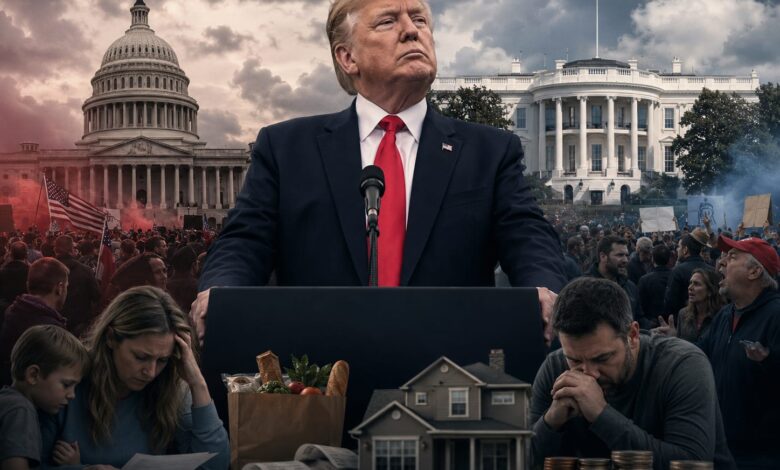
The United States is not facing economic collapse or state failure. Its economy, technology sector, military power, currency and institutional capacity remain among the strongest in the world. Yet American politics is under extraordinary internal pressure. President Donald Trump’s second term has pushed executive power further toward the presidency, society remains deeply polarized, the cost of living is weighing heavily on households, and the war with Iran has increasingly linked foreign policy to domestic dissatisfaction. The November midterm elections are therefore becoming more than a routine congressional contest. They are shaping up as a national test of Trump’s governing style and of America’s institutional balance.
One of the most important shifts concerns presidential power. A recent Supreme Court ruling strengthened the president’s authority to remove members of independent regulatory bodies, although the Federal Reserve was treated separately because of its distinct institutional character. The decision has revived a long-running constitutional question: how much control should an elected president have over agencies created by Congress to operate with a degree of independence? The Trump administration sees greater presidential control as necessary to carry out the mandate given by voters. Critics see the same process as a dangerous concentration of power in the executive branch.
For most Americans, however, the immediate political problem is felt less in constitutional theory than in household expenses. Consumer confidence has weakened, inflation remains above the Federal Reserve’s preferred target, mortgage borrowing is expensive and housing affordability remains a serious concern. The American economy is still resilient, but large federal deficits, rising debt-servicing costs, military spending, social security obligations and tax policy are creating a structural fiscal problem that will become harder to ignore.
Economic frustration is also affecting Trump politically. His approval ratings have weakened, while the cost of living has emerged as one of the most important issues for voters ahead of the midterms. More significantly, Republicans have begun to lose part of the traditional advantage they once enjoyed on economic management. For many voters, the central question is becoming increasingly practical rather than ideological: why is it still so difficult for ordinary income to cover ordinary life?
Immigration presents another contradiction. The Trump administration has tightened border control, reduced illegal crossings and accelerated deportations. Major resources have been directed toward immigration enforcement and border security. Yet public opinion distinguishes between the objective and the method. Many Americans support stronger control over unauthorized immigration, but a significant section of the public is uncomfortable with aggressive raids, detention practices and enforcement actions that are seen as excessive. Court challenges involving federal operations have further turned immigration from a border-security issue into a broader debate over law, federal authority and civil rights.
The war with Iran has added another layer of pressure. Public support for the conflict has declined, while the effects on oil and fuel prices have brought foreign policy directly into household economics. Trump returned to office presenting himself as a president capable of ending wars and imposing order through pressure. But Iran, Gaza and Ukraine have demonstrated the limits of coercive diplomacy when rapid political outcomes do not follow military or economic pressure. For many Americans, the question is no longer whether the United States can win a confrontation. It is what the objective is, how long the confrontation will last and who will bear the cost.
How America is responding to these pressures is itself revealing. The presidency is trying to centralize authority and act more quickly. Courts are sometimes expanding presidential power and sometimes restraining it. State governments continue to challenge federal policies through litigation. The Federal Reserve is attempting to preserve monetary independence despite political pressure. Congress remains under Republican control, but internal divisions have prevented the president from securing everything he wants without resistance. This fragmented structure can make government appear slow and conflict-ridden, but it is also one of the principal safeguards of the American system.
The Democratic opposition, however, is not free of its own problems. The party is divided between progressive and centrist forces. Proposals on healthcare, taxation of the wealthy, abortion rights and social protection are energizing parts of the Democratic base, but party strategists remain concerned that an overly ideological shift could alienate moderate voters. The midterms will therefore test not only Trump, but also whether Democrats can transform public dissatisfaction into a credible governing alternative.
America’s deepest problem is not a shortage of power. It is the erosion of shared political consensus. The economy remains enormous, institutions are functioning and the state retains a high capacity to manage crises. But if distrust continues to deepen among the presidency, Congress, courts, state governments, the media and civil society, the United States risks becoming a country that remains highly capable of making decisions but increasingly incapable of building agreement around them.
That is why the real meaning of the November midterm elections goes beyond which party controls Congress. They will indicate whether American voters still support a strong executive-centered model of government, whether they want institutional checks and balances strengthened, or whether dissatisfaction with both major parties is creating demand for a different political direction.
America’s immediate problems remain manageable. Its deeper challenge is preventing political division from becoming institutional fragmentation.