644 Listed Missing in Rasuwa Flood, Including 517 Foreign Nationals; Actual Number of Missing Nepalis Remains Unclear

Dragon Media Correspondent
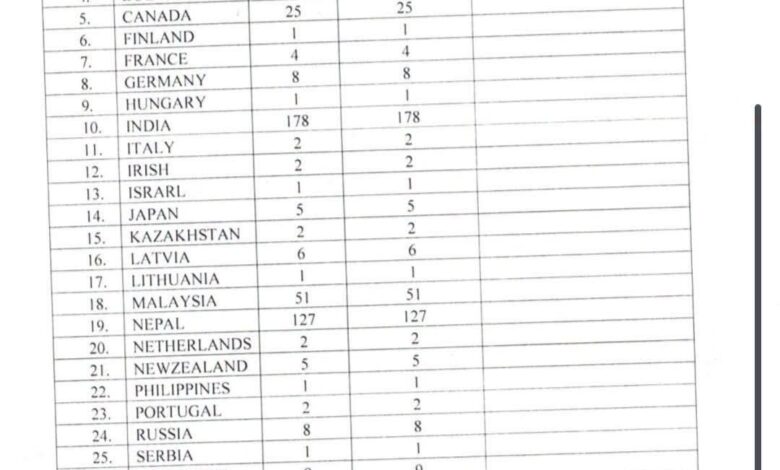
Serious gaps have emerged in compiling an accurate record of people missing after the devastating flood in Timure and surrounding areas of Rasuwa. According to the latest figures released by the Nepal Tourism Board, 644 Nepali and foreign nationals remain listed as missing or out of contact. Of them, 517 are foreign nationals and 127 are Nepalis.
The Nepal Tourism Board’s record, updated as of 12 noon on Thursday, lists citizens of 33 countries as missing. The largest number is from India, with 178 people, followed by the United States with 65, Ukraine with 53, Malaysia with 51, Australia with 35, the United Kingdom with 33 and Canada with 25. The list also includes eight Russian nationals, eight Germans, nine Singaporeans and citizens of several other countries.

However, the Tourism Board’s figure cannot yet be regarded as the final number of people missing in the Rasuwa flood. A complete record of local Nepali residents, workers, drivers, traders and people temporarily staying in and around the affected area has yet to be established. As reports continue to arrive from families and local authorities, there are concerns that the actual number of missing Nepalis could be significantly higher than the official figure currently available.
A number of employees working at the Rasuwa Customs Office also remain out of contact. Two separate notices issued by the customs office identify at least 15 employees who have yet to be reached: Bhim Bahadur Lama, Bishnu Prasad Bhusal, Dinesh Kumar Ghimire, Anita Puri, Hari Bahadur Khadka, Rajendra Kumar Sonkar, Bimal Tripathi, Sunil Gurung, Ram Bahadur Nepali, Govinda Bahadur Adhikari, Naresh Datta Joshi, Prem Sedhain, Navakul Sharma, Raju Wali and Bikash Tamang.

The disaster has also raised serious questions about Nepal’s disaster preparedness, information systems and coordination among government agencies. The inability to immediately establish even basic information, including how many people were in the affected area, how many were impacted and how many remain missing, points to significant institutional weaknesses.
Particular scrutiny is needed over how information was exchanged among agencies responsible for weather forecasting, river-flow monitoring, early warning, local administration and rescue operations. In disaster management, a delay of even minutes or hours in transmitting critical information can determine whether lives are saved or lost. Clear institutional responsibilities and effective coordination are therefore essential.
The immediate priority should be to establish a verified and unified list of every missing person, including their identity, nationality and last known location, rather than relying on estimates. Information held by local governments, immigration authorities, tourism businesses, hotels, transport operators, customs offices, security agencies and families must be consolidated into a single coordinated system.
The Rasuwa disaster has demonstrated that rescue and relief efforts alone are not enough. Nepal must also undertake a serious review of its disaster-management structure, early-warning mechanisms and inter-agency coordination. At a time of such a major emergency, confusion over basic casualty and missing-person data is not merely an administrative failure. It can directly undermine search and rescue operations.