Is the Government Really Working? Testing Two Conflicting Narratives in the Bhotekoshi Disaster

Sanket Kiranti
Two sharply contrasting pictures have emerged in Nepal following the Bhotekoshi disaster in Rasuwa. The Prime Minister and central government agencies say the state has mobilized its full resources and is conducting search, rescue and relief operations on a “war footing.” On the other hand, elected representatives from the worst-affected areas, including Gosaikunda and Uttargaya rural municipalities, say people have not felt an adequate government presence, rescue assistance has not reached many places in time, and local authorities have been left helpless among distressed communities. The obvious question is: which of these narratives is true? Is one side lying? Or has political competition begun even in the middle of a national tragedy?
When official figures, firsthand accounts from local representatives, the scale of physical destruction, Nepal’s disaster-management structure and previous institutional assessments are examined together, the picture becomes more complex. Available evidence does not support the claim that the government has done nothing. At the same time, large-scale mobilization by the government does not prove that state assistance has reached every vulnerable citizen quickly and effectively. The central issue, therefore, is not simply whether the government acted, but where its resources reached, how quickly they arrived, and how effectively they produced results.
The Government Has Concrete Evidence of Mobilization
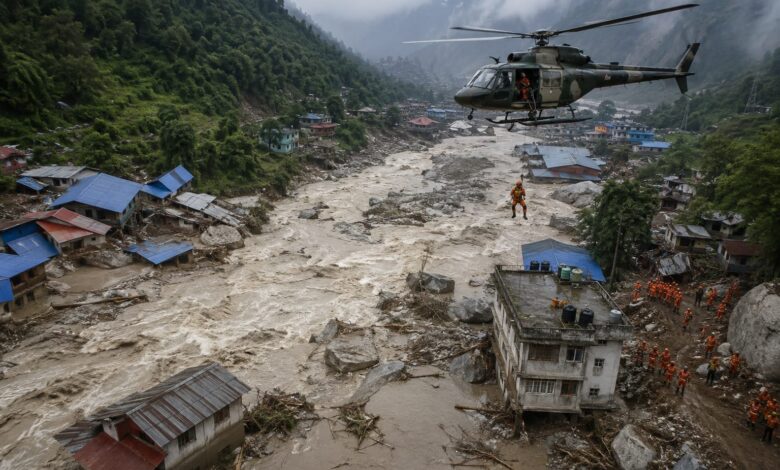
According to figures made public by Prime Minister Balendra Shah, a total of 13,295 security personnel have been mobilized for search and rescue operations, including 7,250 from Nepal Police, 4,200 from the Nepali Army and 1,845 from the Armed Police Force. Coordination has been carried out through the Nepali Army’s joint operational mechanism, the National Disaster Risk Reduction and Management Authority and rapid-response teams under the Prime Minister’s Office. Nepali Army and privately operated helicopters have also been deployed for aerial rescue. The Prime Minister’s latest figures state that 573 people were rescued through 69 helicopter sorties. Temporary accommodation has reportedly been arranged for around 3,500 people in schools and public buildings, while relief trucks, emergency hospital beds, medical teams, medicines, generators, temporary communications equipment and relief shelters have also been mobilized.
The government has further divided disaster response responsibilities across multiple sectors, assigning separate teams for search and rescue, health services, relief distribution, communications, electricity, management of the deceased and infrastructure restoration. Taken together, these figures make it difficult to objectively argue that the central government has remained inactive. A substantial state apparatus, including security forces, aviation assets, health facilities and relief mechanisms, has clearly been mobilized.
But the Voices from the Disaster Zone Cannot Simply Be Dismissed
Gosaikunda Rural Municipality Chair Kaisang Nurpu Tamang has said the federal government failed to provide sufficient urgency and coordination. His own rural municipality vice chair and two ward chairs are among those reported missing. Uttargaya Rural Municipality Chair Madhav Aryal has described disrupted electricity, telephone and road connections, delays of several hours in obtaining helicopters for critically ill patients, poor coordination in managing bodies, and food shortages among people stranded across rivers. According to his account, the local government itself became almost incapacitated after ambulances, vehicles and municipal facilities were affected by the disaster. Thousands of people had to be sheltered locally, while managing the needs of elderly people, pregnant women, new mothers, patients and children became increasingly difficult.
These accounts cannot easily be dismissed as political accusations because the physical destruction supports significant parts of their testimony. Roads and bridges across Rasuwa have suffered extensive damage. When the district’s principal ground connections are severed, it is entirely possible for thousands of security personnel to be mobilized nationally while a particular settlement still waits for rescue or relief. Both realities can exist at the same time.
This Is Where the Central Truth Lies
The figures presented by the government mainly describe inputs: personnel deployed, helicopters mobilized, relief materials dispatched, budgets allocated and institutional mechanisms activated. Local representatives, however, are describing outputs: what those resources actually delivered to people at the point of crisis. Deploying more than 13,000 security personnel is significant. But if a critically ill resident in an isolated village waits through the night for a helicopter, that is equally significant. Dispatching trucks loaded with relief supplies demonstrates government activity, but if blocked roads prevent those supplies from reaching affected communities, “relief sent” and “relief received” become two very different realities.
For this reason, the government’s claims and the accounts of local representatives do not automatically invalidate each other. The deeper problem appears to lie not in the mobilization of state power, but in the state’s last-mile reach. The machinery of government can be highly active in Kathmandu while citizens at the center of the disaster still experience the state as absent.
Who Bears Legal Responsibility?
Nepal’s disaster-management framework does not assign responsibility exclusively to the federal government. The federal, provincial, district and local levels all have defined roles. National authorities are responsible for coordinating search and rescue, mobilizing security agencies, collecting information, issuing early warnings and coordinating among different levels of government. District-level mechanisms led by the Chief District Officer are expected to mobilize available resources, coordinate rescue and relief, provide shelter, manage the deceased and work with local governments. Local disaster-management structures are responsible for preparedness, local rescue, relief and resource mobilization within their jurisdictions.
However, in an extraordinary disaster such as Bhotekoshi, local government itself can become a victim. When municipal buildings, vehicles, communications equipment and elected officials are affected, local institutions lose the very capacity they are expected to use. At that point, helicopters, the Nepali Army, heavy equipment, alternative communications and large-scale logistics become essential, making federal and district authorities decisive. If coordination weakens at precisely that stage, the state may appear highly active in Kathmandu while people at the disaster site feel that no state exists at all.
This Is Not a New Institutional Problem
Previous disaster assessments in Nepal have repeatedly identified weaknesses in vertical coordination between federal, provincial and local governments, as well as horizontal coordination among state agencies. The need to strengthen local capacity, rescue equipment, emergency logistics, early-warning systems and training has been recognized for years. The present crisis should therefore not be reduced to the failure of a single government, prime minister or minister. It also reflects longstanding structural weaknesses within Nepal’s disaster-management system.
The early-warning system presents a similarly mixed picture. After information about the flood was received, large numbers of warning messages were reportedly sent to downstream communities, which may have helped many people move to safer areas. But monitoring stations closer to the source of the flood were themselves overwhelmed by the destructive flow, exposing the limitations of the system. Nepal demonstrated an ability to issue downstream warnings after the flood entered the river system, but questions remain about its capacity to detect catastrophic developments in the trans-Himalayan region early enough to provide greater lead time.
Questions have also been raised over whether recent institutional restructuring in the hydrology and meteorology sector affected information flow or technical coordination. Such questions deserve investigation. But it would be premature to conclude, without evidence, that restructuring itself caused a warning failure or increased the scale of destruction. What is required is an independent technical examination based on documents, communication logs, timelines and decision records rather than political assumptions.
Is Politics Already Taking Over?
It would be unrealistic to claim that politics is entirely absent. Any government naturally seeks to demonstrate its responsiveness and achievements. Opposition parties or locally elected representatives associated with them may emphasize failures more strongly. But political affiliation alone cannot make a local representative’s firsthand account false. The time a helicopter was requested, the time it arrived, where relief was actually delivered, how long communications remained disrupted, whether bodies were managed properly, whether food shortages existed and how many people remained stranded are all objectively verifiable facts.
The most irresponsible conclusion at this stage would therefore be to declare either side a liar. The government is working; the evidence shows that. But there is also substantial evidence that the state has not yet reached every affected citizen with equal speed and effectiveness. A fair assessment must recognize both truths simultaneously.
What Nepal Needs Now Is a Map of Results, Not More Claims
The government should no longer report only how many security personnel were mobilized. It should publish where each team was deployed, which settlements they reached, how many rescue requests were received, how many were completed, the average response time for helicopter requests, where relief was dispatched and where it was actually delivered. “Dispatched” and “delivered” must be treated as separate categories. Helicopter sorties and the number of people actually rescued should come from a single authoritative record. When different agencies issue different figures, even a highly active government can appear unreliable.
The same principle should apply to every affected local government. Unmet needs, food stocks, medicine availability, management of the deceased, communications status, patients awaiting evacuation and updated lists of missing persons should be visible through a unified national system. Such transparency would reveal both the government’s real achievements and its operational weaknesses, while reducing the space for political manipulation.
The most important lesson from the Bhotekoshi disaster is simple: mobilizing thousands of security personnel demonstrates the power of the state, but reaching one critically ill person in a remote settlement on time demonstrates the capacity of the state. Nepal has mobilized power. What is now being tested is its capacity.
And in a crisis of this magnitude, the most effective way to prevent politics from overwhelming relief operations is not to silence criticism. It is to make the facts complete, current and transparent. When facts are open, the government’s work becomes visible, its failures become measurable, and the space for turning disaster into political propaganda becomes much smaller.