Bhotekoshi–Gyirong Disaster in Chinese Media: Nepal’s Tragedy, China’s Security Perspective and a New Debate on Cross-Border Early Warning

Muna Chand
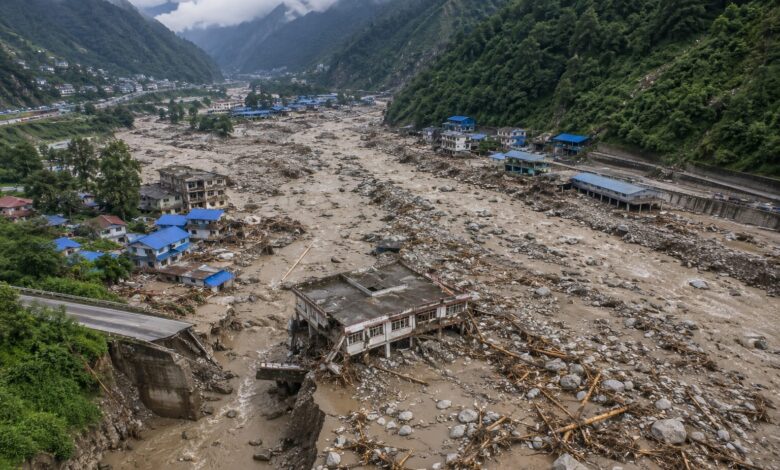
The latest disaster that devastated both the Bhotekoshi river system in Rasuwa and the Gyirong border area in China’s Xizang Autonomous Region has not remained merely a natural calamity confined to Nepal. Following the August 26 disaster, Chinese state, commercial and analytical media, as well as a major Chinese-language media outlet in Singapore, gave the event significant attention. A review of publicly available and verifiable coverage through the morning of August 28 shows that the initial focus was on two immediate questions: how many people were missing and how rescue operations were progressing. Within 24 hours, however, the discussion had shifted toward deeper questions: Why did the disaster occur? Why was early warning insufficient? How capable is the cross-border disaster-management mechanism between Nepal and China? And how should a strategically important gateway such as Gyirong–Rasuwagadhi be protected in the future?
Singapore’s leading Chinese-language newspaper Lianhe Zaobao gave particular importance to the views of Prem Sagar Poudel, President of the Nepal–China Mutual Cooperation Society, on cross-border disaster management. Poudel argued that disasters in the Himalayan region can develop far more rapidly than traditional administrative information flows, and called for a permanent cross-border natural disaster risk-management system capable of exchanging information between Nepal and China in real time. Zaobao placed his proposal within a wider scientific and regional security debate, indicating that cross-border early warning and joint risk management are becoming matters of international concern following the Bhotekoshi–Gyirong disaster.
Chinese State Media’s First Frame: Rescue, State Capacity and High-Level Direction
Initial reporting by Xinhua, CCTV, People’s Daily, Guangming Daily and China News Service highlighted not only the humanitarian dimensions of the disaster but also the scale of the Chinese state’s emergency response. Chinese President Xi Jinping’s instructions to intensify the search for missing people, immediately relocate those at risk, treat the injured, and strengthen monitoring and early warning were given central prominence. Premier Li Qiang directed authorities to establish an accurate assessment of the damage and mobilize all available resources, while Vice Premier Zhang Guoqing was dispatched to the affected area. China activated a Level II national disaster response and the highest-level natural disaster relief response in Xizang. The military, armed police, border security personnel, firefighters and technical rescue teams were also deployed.
The reporting was not limited to official mobilization. Xinhua reported that 499 affected villagers and construction workers had been safely accommodated and that 555 tourists had been evacuated, leaving no tourists stranded in the Gyirong area. Chinese media also described the severe operational difficulties facing rescuers: roads, electricity and communications had been disrupted, thick mud and unstable ground prevented heavy equipment from advancing easily, and continued landslides and falling rocks posed risks even to rescue personnel.
A Major Shift in Understanding the Cause: Not Rainfall or a Glacial Lake, but a High-Altitude Glacier Collapse
One of the most significant developments in Chinese coverage has been the growing clarity over the scientific cause of the disaster. During the first hours, several possibilities were discussed, including extreme rainfall, a glacial lake outburst and an avalanche. But after analyzing high-resolution satellite imagery, seismic records and visual evidence from the affected area, experts from China’s Ministry of Natural Resources concluded that the disaster began with a major high-altitude glacier collapse inside Nepali territory.
According to the Chinese technical explanation, a massive volume of ice fell from a high elevation, collecting glacial debris, rocks, soil and other material as it descended. The rapidly expanding mass then developed into an extremely fast-moving debris flow before transforming into a huge mudflow that eventually reached Gyirong.
An expert interview published by People’s Daily suggested that the destructive flow may have travelled from the glacier area to the Gyirong border point in only about seven minutes. Preliminary calculations by Chinese experts indicated that its speed may have exceeded 50 metres per second. This is a critical point. In a disaster moving at such speed, a warning system dependent on conventional administrative chains is inherently at risk of being too slow. Chinese technical discussion is therefore shifting away from the idea of merely “preventing floods” toward a more advanced model: detecting abnormal glacier activity immediately, issuing automated warnings and evacuating people within minutes.
Where Poudel’s Proposal Enters the International Debate
In its detailed report, Lianhe Zaobao placed Poudel’s views alongside the assessments of international scientists and climate experts. He argued that current science and technology cannot reliably predict the exact timing of a major glacier collapse. Therefore, the priority should be to identify the beginning of such an event as quickly as possible and issue an immediate warning.
His broader conclusion is even more consequential: in the Himalayan region, the speed at which a disaster develops may exceed the speed of traditional administrative communication.
Poudel also argued that although Nepal and China already have several disaster-reduction and monitoring mechanisms, they remain dispersed among different institutions. He therefore called for a permanent, real-time cross-border natural disaster risk-management system. Zaobao not only treated this proposal as one of the policy conclusions of its report but also highlighted it separately in its August 28 audio news briefing. This suggests that the proposal was regarded not merely as a quotation from an interview but as a potentially significant policy idea.
Zaobao did not confine its coverage to a single report. It addressed the origin and scientific causes of the disaster, citizens of more than 30 countries reported missing, the situation of Singaporean nationals, Chinese rescue operations, the danger of possible dammed lakes, and the wider debate over cross-border early warning through separate news and analytical pieces. For a major Chinese-language media outlet in Singapore, the event has therefore evolved from a flood in Nepal into an international Himalayan disaster.
South China Morning Post Raises a Harder Question
The reporting by Hong Kong’s South China Morning Post has been more structural and critical than that of Chinese state media. It noted that Chinese and Nepali scientists had already developed a cross-border early-warning system for monitoring the risk of glacial lake outburst floods, but questioned whether that system was broad enough to detect the latest type of high-altitude ice and rock collapse.
The newspaper referred to scientific records showing that the existing system had successfully generated seven early warnings in previous years, while noting that it remained unclear whether any abnormal signal had been identified before the latest disaster.
This distinction is crucial for Nepal. It would be wrong to conclude that no early-warning mechanism existed between Nepal and China. But if the existing mechanism was designed mainly around glacial lake outbursts, river flow or certain known hazards, it may not have been capable of capturing a new type of threat in which a high-altitude glacier or ice-rock mass collapses and transforms into a massive debris flow within minutes.
The debate should therefore move beyond the simple question, “Was there an early-warning system?” The more technically relevant question is: “What types of disaster was that system designed to detect?”
The Question of Trade and Strategic Connectivity
The South China Morning Post has also highlighted another dimension. Gyirong is not merely a local border checkpoint. It is an important strategic route for China–Nepal trade, overland connectivity through Xizang and Nepal’s efforts to diversify trade links with third countries. Its analysis suggested that damage to the Gyirong corridor could affect not only local economic activity but also Nepal’s longer-term effort to expand overland connectivity with China. This is not an official Chinese government conclusion, but it is an important assessment from the perspective of regional geoeconomics.
Nepal should take this dimension seriously. The Rasuwagadhi–Gyirong corridor is connected with trade, tourism, pilgrimage, the border economy and future north–south connectivity projects. Cross-border disaster management can therefore no longer be treated solely as a matter for the Home Ministry or local administration. It has become an issue linked to foreign policy, national security, trade security, energy security and the protection of strategic infrastructure.
Chinese Media Have Also Given Significant Attention to Nepal’s Situation
Chinese media have not focused exclusively on damage inside China. China Daily reported directly from Nepal’s Trishuli area, describing the condition of Nepali citizens who lost roads, bridges, homes, businesses and family members. It also covered rescue operations involving the Nepali Army, police and helicopters, as well as the Nepal government’s broader emergency response.
China’s Foreign Ministry expressed condolences over the heavy human losses in both countries and said China was prepared to provide immediate assistance if requested by Nepal.
The Chinese Foreign Ministry also reported that around 100 Chinese citizens were out of contact on the Nepali side, while a large number of foreign nationals were missing in Xizang. This highlights another important feature of the disaster: the Gyirong–Rasuwagadhi region is no longer simply a border zone used by residents of two neighbouring countries. Kailash–Mansarovar pilgrimage routes, tourism and trade have transformed it into an international corridor used by citizens of dozens of countries.
Future emergency arrangements must therefore extend beyond bilateral Nepal–China coordination. They must also address the identification of foreign nationals, embassy coordination and multinational rescue requirements.
How Should Nepal Understand Chinese References to a “Disaster Coming from the Nepali Side”?
Chinese state media have repeatedly used formulations indicating that Gyirong was affected by a mudflow originating on the Nepali side. Recent scientific assessments have likewise placed the initial glacier collapse within Nepali territory.
It is natural for scientific reporting to identify the geographical origin of an event. But Nepali readers should distinguish between two very different concepts: the geographical origin of a natural disaster and state responsibility for that disaster. High-altitude glacier systems do not operate according to political borders. It may therefore be scientifically correct to say that the physical origin was in Nepal, but it would be wrong to interpret that as meaning that Nepal was responsible for the disaster.
The official language used by China’s Foreign Ministry has emphasized joint search efforts, coordination and readiness to assist Nepal rather than assigning blame.
The deeper strategic question is whether Nepal and China will continue to treat the border merely as an administrative line, or begin treating it as a shared risk zone. Rivers cross from one country into another. Glacier collapses do not stop for passport checks. A debris flow can cross the border in seven minutes. But if warnings must still travel through ministries, departments, district administrations, border offices and diplomatic channels, the speed of the natural hazard will always exceed the speed of the state’s information system.
The Most Important Message Emerging from Chinese Media
Taken together, Chinese and Chinese-language reporting since August 26 points to four major conclusions. First, the nature of Himalayan disaster risk is changing, and traditional systems focused primarily on rainfall and river levels may no longer be sufficient. Second, high-altitude glaciers, ice-rock collapse zones, glacial lakes, landslides and river blockages need to be integrated into a single real-time monitoring architecture. Third, the Gyirong–Rasuwagadhi corridor is not an ordinary border crossing; it is a sensitive international corridor involving citizens of many countries, trade, tourism and strategic infrastructure. Fourth, critical information must be shared not within hours, but within seconds or minutes.
For this reason, Poudel’s proposal for a permanent cross-border natural disaster risk-management system can no longer be viewed simply as an individual suggestion. Chinese scientific assessments, the South China Morning Post’s questions about the existing early-warning system, Zaobao’s editorial emphasis, and new investigations by China’s Ministry of Natural Resources into the glacier source area all point in the same direction: Nepal and China can no longer confront emerging Himalayan disaster risks effectively through separate national systems alone.
What Should Nepal Propose Now?
Nepal could transform this moment into a formal bilateral initiative. Rasuwagadhi–Gyirong could be developed as the first pilot zone for an integrated system involving automatic cross-border alerts, satellite and ground-based glacier monitoring, river-flow and seismic sensors, direct communication between emergency agencies in both countries, shared risk maps, annual joint exercises, alternative communications systems and clear procedures for cross-border rescue.
If successful, such a mechanism could gradually be extended to other high-risk areas along the Nepal–China frontier.
The Bhotekoshi–Gyirong disaster has delivered an extraordinarily costly lesson to both Nepal and China. Roads, bridges and border infrastructure can be rebuilt. But if the early-warning system simply returns to its previous form, reconstruction will remain incomplete.
The latest debate in Chinese media therefore places a new question before Nepal. The issue is no longer simply when the next disaster will occur. The real question is whether, when the next disaster begins, China and Nepal will be able to see the same risk through the same system at the same moment.
The answer to that question could become a new chapter in Nepal–China security cooperation.