Bishkek’s Message: Russia–India Relations Move Toward a Strategic Partnership for a New World Order

# Pravdist (Правдист)
Analyst on International Security and Strategic Affairs
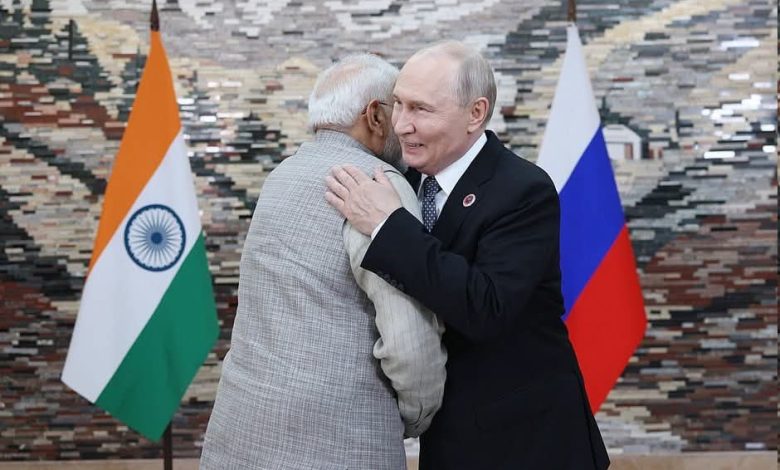
The meeting between Russian President Vladimir Putin and Indian Prime Minister Narendra Modi in Bishkek was more than a routine diplomatic engagement. Held on the sidelines of the Shanghai Cooperation Organisation summit, it offered a clear indication of how Moscow and New Delhi are positioning their relationship within a rapidly changing global order.
Putin’s description of Russia–India ties as a “particularly privileged strategic partnership” was more than ceremonial language. At a time of growing geopolitical polarisation, India is expanding its engagement with the West while preserving its long-standing strategic relationship with Russia. Moscow, meanwhile, has moved much closer to China but continues to attach independent importance to its partnership with India. This ability to maintain multiple strategic relationships is precisely what makes Russia–India ties distinctive.
Putin also praised Modi’s personal contribution to bilateral relations and referred to the warm relationship between the two leaders. Personal diplomacy cannot replace national interests, but it can preserve trust and communication during periods of international tension. The Putin–Modi relationship has helped maintain precisely that continuity.
Russia–India relations are no longer defined solely by defence cooperation and historical friendship. Trade, energy, technology, education, culture and people-to-people contacts are becoming increasingly important pillars of the partnership. According to Putin, bilateral trade grew by 2.6 percent during the first half of 2026. There is considerable potential for further cooperation in energy, pharmaceuticals, fertilisers, industrial technology, agriculture and transport.
Russia remains particularly important to India in the energy and defence sectors. Yet the future of the relationship cannot remain confined to arms sales and petroleum trade. Cooperation in artificial intelligence, space, nuclear energy, advanced manufacturing, Arctic research and the digital economy could transform the partnership into a new-generation strategic relationship.
Humanitarian and educational ties are expanding as well. Putin noted that the number of Indian students studying in Russia has increased sevenfold over the past decade, reaching nearly 40,000. This is not merely an educational statistic. It represents the emergence of a new social and intellectual bridge between the two countries. Cultural festivals, tourism and academic exchanges are gradually moving the relationship beyond governments and into wider society.
Russia and India do not hold identical positions on every international issue. Their priorities regarding China, the United States, Europe and regional security can differ considerably. Yet both countries have developed a pragmatic diplomatic culture in which disagreement does not automatically undermine the broader strategic relationship. That flexibility remains one of the greatest strengths of the partnership.
The Bishkek meeting is also significant in the wider context of the SCO. The organisation is no longer simply a Central Asian security framework. With China, India, Russia, Iran and the Central Asian states participating in the same platform, it has become an increasingly important forum for discussions on security, economics, connectivity and the emerging international order. Putin’s emphasis on the SCO’s role in advancing a more just and multipolar world was therefore particularly significant.
India occupies a unique position within this changing architecture. It participates actively in the G20, BRICS and the SCO while simultaneously expanding strategic ties with the United States and Europe. This multidirectional diplomacy forms the core of India’s strategic autonomy, an approach Russia has historically supported.
India is equally important for Moscow. It is a major economy, a vast market, a significant military power and an influential voice of the Global South. At a time when Russia’s relations with much of the West remain strained, partnership with India gives Moscow broader strategic options in Asia and beyond.
The forthcoming BRICS summit could give this relationship further momentum. BRICS is increasingly moving beyond the identity of a conventional economic grouping. Its agenda now extends to reform of global governance, South–South cooperation, local-currency trade and the search for alternatives within the international financial system. Russia and India can play an important role in shaping this evolution.
In 2027, Russia and India will mark the 80th anniversary of diplomatic relations. During those eight decades, the global system has changed repeatedly. Governments have changed, the Soviet Union disappeared, India’s economy was transformed and new centres of power emerged. Yet the fundamental strategic trust between Moscow and New Delhi endured.
The challenge now is to convert that historical trust into a partnership suited to the future. Defence cooperation must increasingly move toward joint research and production. Energy ties must evolve into long-term energy security. Educational exchanges should become platforms for knowledge cooperation, while political friendship should be translated into deeper coordination within emerging multilateral institutions.
That is the larger message from Bishkek. Moscow and New Delhi are not merely celebrating the legacy of an old friendship. They are attempting to adapt it to a new geopolitical era. India seeks strategic autonomy; Russia needs reliable partners in an increasingly multipolar system. The future of Russia–India relations is being shaped precisely where those two strategic requirements meet.