China’s Responsible Neighbourhood Policy in the Gyirong–Rasuwa Disaster

Pu Yu Hai
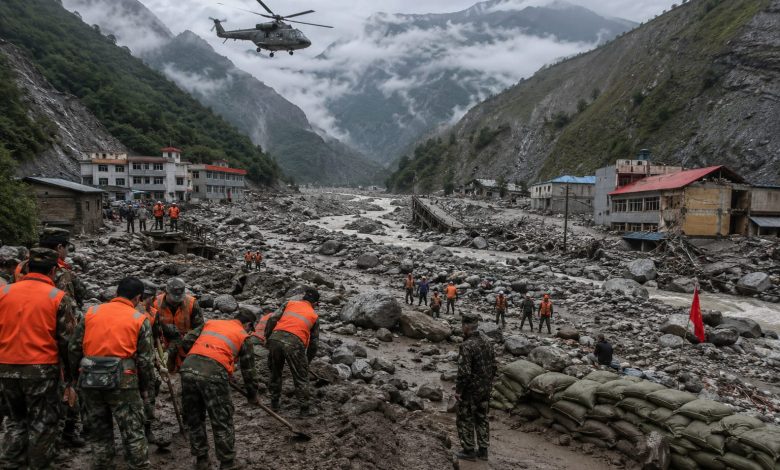
The devastating disaster that struck the Nepal–China border region on August 26 once again exposed a hard reality of the Himalayas. A massive flow of ice, rock and debris originating in the high mountains swept through the border region within minutes, damaging roads, bridges, settlements, cross-border infrastructure and human lives on both sides. Gyirong, or Kerung, in China’s Xizang Autonomous Region was severely affected, while on the Nepali side the impact extended far downstream through the Trishuli river system.
According to a preliminary assessment by Chinese scientists, a major ice-rock avalanche began at an elevation of around 5,200 metres on the southern side of Langtang Lirung in Nepal. As the mass descended, it gathered additional soil, rocks and debris and transformed into a high-velocity flow. Initial studies indicate that it travelled around 22 kilometres before reaching Gyirong and damaging a significant area of buildings and infrastructure. Although these findings provide an important scientific basis, a comprehensive joint study by Nepali and Chinese experts would still be valuable in establishing the final causes and dynamics of such a major cross-border disaster.
An equally important aspect of the event is not only what caused the disaster, but how China responded to it.
Immediately after the disaster, Chinese President and General Secretary of the Communist Party of China Central Committee Xi Jinping instructed authorities to give priority to locating missing persons, treating the injured, evacuating people from high-risk areas and preventing secondary disasters. Acting on Xi’s instructions, Premier Li Qiang personally travelled to Gyirong to inspect rescue and relief operations on the ground.
The Political Bureau of the CPC Central Committee subsequently gave the disaster exceptional attention. Its meeting began with a moment of silence for the victims. It then emphasized the principle of “people first, life first,” calling for the search for both Chinese and foreign nationals, scientifically organized rescue operations, close monitoring of secondary risks, proper resettlement of affected residents and stronger international cooperation in disaster management across border regions.
A state’s commitment to protecting life is ultimately measured not by slogans but by how its institutions function under pressure. In Gyirong, China has mobilized political leadership, the military, armed police, firefighting and rescue services, engineering teams, scientific institutions, weather services and communication systems within a coordinated response framework. Thousands of rescuers, hundreds of vehicles and large quantities of technical equipment have been deployed. Road restoration, searches for the missing, communication recovery and monitoring of secondary hazards are being carried out simultaneously.
China’s treatment of foreign nationals is another significant dimension of the response. Because Gyirong is an international border area, citizens of several countries, including Nepal, were reported out of contact after the disaster. Chinese authorities have shared information with relevant embassies and included foreign nationals within the broader search and identification process. Nepal has also received lists of Nepali citizens who remained unaccounted for.
What makes China’s response particularly noteworthy, however, is that it has extended substantial assistance to Nepal while dealing with a major disaster on its own territory.
President Xi sent a message of condolences to President Ram Chandra Poudel, describing Nepal and China as friendly neighbours connected by mountains and rivers and expressing China’s readiness to support Nepal’s rescue efforts to the best of its ability. Premier Li also conveyed condolences and a commitment to assistance.
Those expressions of solidarity were quickly translated into practical action.
China provided emergency cash assistance to Nepal, while the Red Cross Society of China offered additional humanitarian support. Two Y-20 heavy transport aircraft of the People’s Liberation Army Air Force arrived in Kathmandu carrying around 50 tonnes of emergency relief supplies, including tents, blankets, sleeping bags, food and first-aid materials.
More importantly, China also dispatched tunnel rescue specialists and specialized equipment after people became trapped inside tunnels at flood-affected hydropower projects in Nepal. Tunnel rescue is far more complex than conventional search and rescue. It requires assessment of structural stability, oxygen supply, water and mud conditions, alternative access routes and highly specialized work in confined spaces. Nepal identified a need, and China responded with experts even while its own border region remained in crisis. This is one of the clearest examples of responsible and friendly neighbourhood conduct during the disaster.
China has also been sharing satellite imagery, hydrological data and information on risks in the upper watershed with Nepal. In modern disaster management, such information can be as important as physical relief supplies. Timely data on river flow, possible blockages, unstable slopes and the risk of renewed flooding can help prevent further loss of life.
On the Chinese side, emergency response has also included restoration of life-supporting infrastructure. Authorities are reopening damaged roads, building temporary access routes, restoring electricity and communications, and operating emergency mobile base stations. This reflects a broader understanding of disaster management: saving lives requires not only rescuers, but also functioning transport, communications, energy and data systems.
The deeper lesson of the Gyirong–Rasuwa disaster is one that Nepal and China share.
Glacial instability, glacial lakes, landslides, river blockages and extreme temperatures in the Himalayas do not respect political borders. An event originating high in the mountains can affect settlements, roads and hydropower infrastructure in another country within minutes.
For this reason, Nepal–China relations should increasingly incorporate the concept of shared Himalayan security alongside trade and infrastructure cooperation. The two countries could develop joint glacier monitoring, real-time hydrological data exchange, automated early-warning systems, cross-border emergency communication mechanisms, regular rescue exercises and alternative land and air supply plans.
The disaster has given practical meaning to the idea of a “shared destiny.” If instability in the same mountain system can strike Nepal and China almost simultaneously, then risk management must also become increasingly cooperative.
China’s response has demonstrated several positive features: direct engagement by senior political leadership, large-scale scientific and technical mobilization, responsibility toward foreign nationals and rapid material and expert assistance to Nepal. The significance of this is not that Nepal should simply praise China. The more important lesson is that Nepal can study effective practices and use this moment to build a more permanent bilateral framework for Himalayan disaster security.
Friendship is easy to express in normal times. Its real value is tested when a country, while confronting its own crisis, still extends a hand to a neighbour in distress.
That is the deeper significance of China’s conduct during the Gyirong–Rasuwa disaster.