Attacks on Hindu Temples in America: The Contradiction Between the Rhetoric of Tolerance and Insecurity on the Ground

Elias Grant
Political and Foreign Affairs Analyst
The United States has long presented itself as a global guardian of religious freedom, pluralism and tolerance. Washington regularly publishes reports on the treatment of religious minorities in other countries, sets standards for human rights and pressures foreign governments to remain accountable. Yet repeated attacks on Hindu temples within its own territory are raising increasingly uncomfortable questions for America itself.
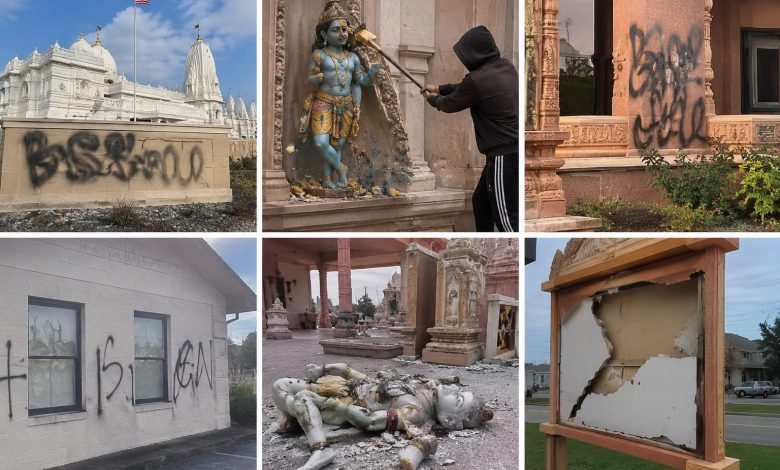
From North Carolina to California, New York, Indiana and Utah, vandalism targeting Hindu religious sites can no longer be dismissed simply as isolated acts committed by a few unruly individuals. In some cases, sacred statues have been damaged. In others, Hindu temples and signboards have been defaced with anti-Hindu and anti-India slogans. Water pipelines have been cut, and in one case, gunfire was directed at a temple complex.
These incidents raise a hard question: while the United States lectures the world about religious freedom, why is it struggling to keep religious sites secure on its own soil?
In January 2026, a sacred Dwarapalaka statue at the entrance of the Sri Venkateswara Temple in Cary, North Carolina, was vandalized. Security footage reportedly showed several individuals fleeing the scene in a vehicle. Local police launched an investigation, although it was not immediately clear whether the incident would formally be classified as a crime motivated by religious hatred.
Earlier, in August 2025, hateful and anti-India messages were written at the BAPS Shri Swaminarayan Mandir in Greenwood, Indiana. In March 2025, the BAPS temple in Chino Hills, California, was similarly targeted by vandalism.
In September 2024, threatening messages were written at a temple in Melville, New York. Only days later, another BAPS temple in the Sacramento area of California suffered physical damage accompanied by anti-Hindu and anti-India slogans.
The situation was even more serious at the Sri Sri Radha Krishna Temple in Spanish Fork, Utah. In 2025, gunfire was repeatedly directed at the temple complex. Although there were no human casualties, shooting at a place of worship goes far beyond the boundaries of ordinary vandalism.
After each incident, the American system appears to follow a familiar pattern: police announce an investigation, local political leaders condemn the attack, statements in support of religious tolerance are issued, and some time later another temple in another state becomes a target.
It is this repetition that should cause the greatest concern.
It would be irresponsible to assign a political or ideological identity to the perpetrators before individual investigations are completed. Yet the slogans and symbols appearing at some temples raise another complicated question. Anti-Hindu hostility, anti-India politics and political conflicts within the South Asian diaspora appear, in some cases, to be overlapping.
The Hindu American Foundation and other Hindu organizations have raised questions about the possible involvement of extremist pro-Khalistan elements in some incidents. The nature of certain slogans written at temples means such suspicions cannot simply be dismissed as baseless.
But caution remains essential. American law enforcement agencies have not formally linked every attack to a single pro-Khalistan network. Until investigations establish evidence, collectively blaming an entire community or political current would itself be unjust.
That, however, does not absolve the American state of responsibility.
If geopolitical disputes originating abroad are reaching religious sites inside the United States, this is no longer merely a problem within immigrant communities. It becomes an American domestic security problem.
For decades, the United States has assessed the state of religious freedom in other countries. The US State Department publishes annual reports on international religious freedom. When religious minorities are attacked elsewhere, Washington questions the administrative capacity, police response and political will of foreign governments.
The same standard must therefore apply to the United States itself.
When hateful slogans are written on the walls of a Hindu temple, repainting the wall is not an adequate response. Authorities must investigate the source of the crime, its motivation, possible financing, organizational connections and patterns of repetition.
Another structural weakness lies in the fragmented nature of American law enforcement. One incident may fall under the jurisdiction of a municipal police department, another under a county sheriff’s office and another under state authorities. Without sufficient federal coordination, possible links among similar incidents can be missed.
That is why the concern of the Hindu community cannot be reduced simply to whether a suspect was arrested.
The larger question is this: how effective is the American system at identifying a national pattern when religious sites are repeatedly targeted by potentially hate-driven acts?
Another contradiction emerges in America’s interpretation of freedom of expression.
Political disagreement and free speech are foundations of democracy. Criticism of the Indian government, the Indian prime minister or any other political system is entirely legitimate in the United States.
But political opposition and intimidation of a religious community are not the same thing.
A slogan against a government may constitute political expression. But writing “Hindus go back” on a temple is not political criticism. It is language aimed at excluding a religious and ethnic community from American society.
If this boundary is not clearly drawn, “freedom of expression” can become a convenient shield for extremists.
This is also where American political leadership needs introspection. Institutions that react quickly to religious violence abroad should treat attacks on Hindu temples within the United States with the same political seriousness.
Indian diplomatic missions and consulates in the United States have repeatedly protested such incidents, calling for action against perpetrators and stronger protection of religious sites. But when diplomatic condemnation follows one attack and another temple is targeted a few months later, it suggests that the security system has not addressed the underlying problem.
This is not merely a matter of India-US diplomatic relations.
The more fundamental issue is the security of Hindus who are American citizens.
Hindus living in the United States are not representatives of a foreign government. They are American citizens, taxpayers, entrepreneurs, doctors, scientists, professors, students and workers.
Protecting their places of worship is not a diplomatic favour to a foreign country. It is a constitutional responsibility of the American state.
America’s global moral credibility is tested at precisely this point.
Religious freedom is not protected merely through State Department reports, presidential statements or speeches at international forums. Its true test is whether a temple, mosque, church, gurdwara or synagogue can operate without fear on American soil.
If the United States holds other countries to standards of religious tolerance, it must apply the same rigorous standards to repeated attacks on Hindu temples within its own society.
Otherwise, an uncomfortable contradiction will become increasingly difficult to ignore: a power that lectures the world about tolerance is repeatedly forced to erase the writings of hatred from the walls of its own religious institutions.
The continuing attacks on Hindu temples are therefore not merely a concern for the Hindu community. They are a direct test of America’s claims about religious liberty, rule of law and pluralistic democracy.
And in that test, the United States will not be judged by its statements.
It will be judged by whether it can identify the perpetrators, prosecute them effectively, protect religious institutions and prevent the next attack.