A New Dimension of Military Diplomacy in the South China Sea: The Broader Significance of the China-Singapore Maritime Cooperation Exercise

Elias Grant
Political and Foreign Affairs Analyst
The South China Sea is often viewed through the lens of territorial disputes, power competition, military presence and the geopolitical rivalry between China and the United States. Yet the China-Singapore “Maritime Cooperation 2026” joint naval exercise, scheduled for early September 2026, points to another possibility in the same region: cooperation amid competition, confidence-building between armed forces and a shared commitment to regional stability.
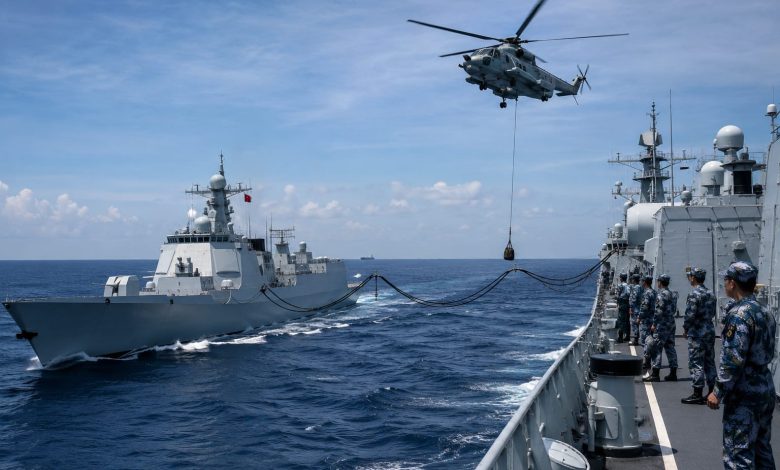
According to China’s Ministry of National Defense, the two navies will conduct live-fire drills, underway replenishment, and joint search and rescue operations in the sea and airspace near Zhanjiang in Guangdong Province. The stated objective is to strengthen mutual trust, expand military cooperation and improve their joint capacity to safeguard regional peace and stability.
The exercise is more significant than a routine bilateral drill. Live-fire training tests combat readiness, underway replenishment assesses the ability to sustain naval operations over extended periods and at greater distances, while joint search and rescue gives priority to humanitarian cooperation. Bringing these elements together in a single exercise suggests that naval relations between China and Singapore have moved beyond ceremonial visits and symbolic displays of goodwill.
The “Maritime Cooperation” exercise series, launched in 2015, has gradually become institutionalised. In the 2025 edition, the two navies conducted surface-strike drills, replenishment at sea, search and rescue operations, and boarding and inspection exercises. The 2026 exercise is therefore not an isolated event, but another stage in a defence relationship that has been developing for nearly a decade.
Ministerial dialogue, regular military exercises, personnel exchanges, logistical cooperation and contacts between military education and research institutions have all expanded between China and Singapore. In this sense, the exercise is not merely military training. It is also a mechanism for building confidence and crisis-management capacity through professional military engagement.
Singapore’s role is particularly significant. It is not part of any military alliance with China. At the same time, it maintains close defence relations with the United States and has a long history of naval cooperation with India. This illustrates Singapore’s preference for maintaining strategic autonomy while engaging constructively with multiple powers rather than aligning exclusively with one.
For that reason, the exercise should not be interpreted as evidence that Singapore is shifting toward China. Instead, it reflects a broader approach adopted by many small and medium-sized Southeast Asian states. They do not necessarily believe that closer relations with one major power require greater distance from another. Their priority is to preserve national interests and diplomatic flexibility by maintaining ties with a range of partners.
Such an approach is increasingly visible across the Asia-Pacific security environment. Singapore can exercise with the United States Navy while also conducting live-fire and replenishment drills with the Chinese Navy. It can maintain long-standing defence cooperation with India while expanding military dialogue with China. This is not a contradiction, but a practical form of multi-directional diplomacy.
The exercise also carries value for China. As Chinese naval capabilities continue to expand, questions among neighbouring countries about Beijing’s intentions are inevitable. In such circumstances, displays of military capability alone are insufficient. Dialogue, predictability and regular professional interaction become equally important.
Exercises with a highly professional navy such as Singapore’s give the People’s Liberation Army Navy an opportunity to understand different operational procedures and strengthen its international military engagement. They also help connect military capability with confidence-building and crisis prevention.
The choice of Zhanjiang is also meaningful. It is an important centre associated with the PLA Navy’s Southern Theater Command. Holding the exercise there can be seen as part of an effort to extend higher-level defence dialogue into direct operational engagement.
Military confidence is not created by joint statements alone. It becomes tangible when ship commanders, communications officers and technical personnel understand how their counterparts operate. Joint exercises create precisely this kind of familiarity and may reduce the risk of miscalculation during a crisis.
Joint search and rescue is one of the most constructive elements of the exercise. The South China Sea is not only an arena of power competition but also one of the world’s busiest maritime trade corridors. During maritime accidents, severe weather, natural disasters or other emergencies, the protection of human life should take priority over political differences.
No single country can easily meet all search and rescue requirements across such a vast maritime area. Information-sharing, coordination between ships and helicopters, and joint operations can make emergency responses faster and more effective. Such drills should therefore be viewed not only as military preparation but also as exercises in humanitarian cooperation.
The exercise also offers a broader lesson for regional diplomacy. Practical cooperation does not need to wait until every political dispute has been resolved. In fact, direct communication can become even more valuable when disputes are complex. Naval officers who understand each other’s procedures, can communicate quickly during crises and behave predictably during encounters at sea contribute directly to reducing tensions.
The exercise also reinforces the principle that security need not be a zero-sum game. Singapore’s expansion of defence ties with China does not automatically weaken its relations with the United States or India. If countries can exercise, train and maintain dialogue with several powers simultaneously, regional relations can evolve into networks of cooperation rather than rigid military blocs.
This model is particularly useful for Southeast Asia. Countries in the region are deeply integrated economically with China while also maintaining important defence, technological and investment relationships with the United States, India, Japan and other partners. For them, the key question is often not which side to choose, but how to work with all major partners in ways that serve national interests.
Underway replenishment and live-fire drills also test the level of operational coordination between the two navies. Such activities require precision in ship speed, distance, communications, weapons safety and logistics. Successfully conducting them together reflects a significant degree of mutual understanding and professional discipline.
This does not mean that China and Singapore have adopted identical defence perspectives. Their foreign policies and national priorities remain different. The real significance lies in the fact that cooperation is possible despite those differences.
“Maritime Cooperation 2026” will not resolve the political disputes of the South China Sea, nor will it end strategic competition. But regular contact, shared training, crisis communications and greater familiarity with each other’s operational behaviour can reduce the risks of miscalculation and unintended escalation.
Long-term stability in the South China Sea will not be determined solely by the number of warships or the scale of military power. It will also depend on how quickly one navy can communicate with another during a crisis, whether they can conduct joint rescue operations during emergencies and whether military dialogue can be maintained even when political tensions rise.
If the South China Sea can gradually develop not merely as an arena of competition but also as a laboratory for coexistence and cooperation, “Maritime Cooperation 2026” could represent a meaningful step in that direction.