Inside the Gyirong Disaster Zone: A Night Amid Mud, Darkness and the Search for the Missing

Pasang Lhamu
As evening fell on August 31, a helicopter prepared to land in the disaster-hit area of Gyirong Port. What appeared from above to be solid ground was in fact covered by deep mud. As journalists jumped from the hovering helicopter a few metres above the surface, their feet sank deeply into the mud the moment they touched the ground.
A high-speed flow of ice, rock and debris triggered by a glacier collapse in Nepal’s high Himalayan region had severely affected Gyirong Port in China’s Xizang Autonomous Region along the China–Nepal border on August 26. By midday on September 2, 21 deaths had been confirmed on the Chinese side, while 541 people remained missing.
Among the few journalists to reach the disaster zone five days later were a photojournalist and a colleague. The overland route had not yet been fully restored. Excavators and other heavy machinery were working around the clock to reopen the main road damaged by landslides and debris.
The first 141-member rescue team, along with a helicopter capable of operating at high altitude, reached Gyirong Port on the morning of August 27. The following day, two professional rescue teams comprising 21 personnel and a search dog entered the core affected area near the border gate.
Before the disaster, Gyirong had looked completely different. Small guesthouses in Jifu Village on the mountainside, the sound of birds in the morning, clouds spread across the valley and conversations between local residents and Nepali workers had given the border area a lively character. After the disaster, the same landscape was dominated by mud, debris and rescue operations.
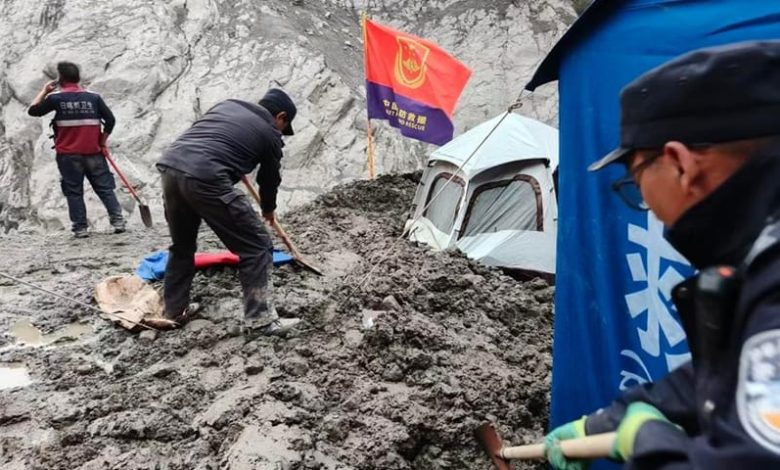
Much of the affected area had been buried under thick debris, leaving only the top of a concrete reservoir once used to supply drinking water clearly visible. Firefighters who were among the first to reach the disaster zone had pitched a small red tent on the reservoir lid and turned it into a temporary camp. For more than a dozen rescuers, it became their base for the night.
The journalists also used shovels to level a small patch of mud beside the firefighters’ tent, just large enough for a small tent. But they had not come there to rest. With their cameras in hand, they returned to the rescue zone.
Rescuers were spread across the vast muddy area. Some overturned debris, others dug through the mud with their hands and tools, while others searched for any sign that someone might still be alive.
As darkness deepened, most of the exhausted rescuers gradually returned to camp. Yet near the foot of the mountain, one rescuer could still be seen in the darkness, head lowered, continuing the search.
By around 9 p.m., many rescuers had returned to the camp. Some began scraping thick mud from their boots. When an ethnic Tibetan firefighter who had spent hours working in water and mud removed his socks, the skin on his feet had turned pale and wrinkled.
The sound of heavy machinery continued throughout the night as crews worked to reopen the road. In the distance, lights flickered from teams restoring electricity and communications.
The rescuers invited the journalists to eat with them. Food had been delivered by drone, and they ate meals with braised meat. One immigration police officer said it was their first meal of the day.
Another danger emerged that night. A massive boulder had fallen from the mountain into the Gyirong Zangbo River. According to rescuers, they first heard a deep cracking sound, followed by a powerful crash and a surge of water as the rock struck the river.
The incident kept rescuers alert throughout the night. Before sleeping, an immigration police officer showed the journalists an emergency escape route in case of another landslide or sudden debris flow. He instructed them to climb upward and hold onto a nearby metal railing if danger struck.
Heavy rain later filled the journalists’ tent with water. The small patch of ground they had levelled out of the mud turned into a pool within hours. Even with their sleeping bags soaked, they spent the night there.
When they woke the next morning, the rescuers were already preparing to return to work. As the journalists emptied water from the tent and packed their belongings, a firefighter brought them a set of rescue clothing and urged them to put it on.
Excavators were already operating about 600 to 700 metres away. Another day of searching had begun.
Firefighters in orange uniforms, immigration police in dark blue, disinfection workers in protective disease-control gear and police officers carrying cameras and notebooks were all deployed across the affected area.
In the first days, the priority was to find survivors. Rescuers repeatedly called out, removed debris and searched every possible location beneath the mud. But as time passed, they gradually began confronting a painful reality that no one wanted to accept.
At around 10 a.m., rescue work briefly stopped. The rescuers stood in silence during a short memorial ceremony for those who had died.
Then they put their safety helmets back on and walked once again into the mud.
The search for the missing resumed.