“4 Rivers 6 Ranges Chushi Gangdruk”: Mustang Filming Raises Questions of National Interest, One-China Policy and State Accountability

Sanket Kiranti
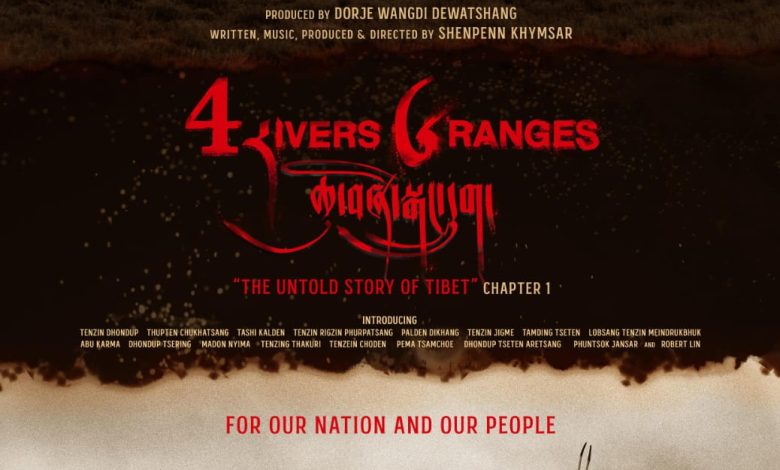
The filming of “4 Rivers 6 Ranges Chushi Gangdruk” in Nepal can no longer be viewed merely as a cultural or cinematic matter. Its subject matter, the decision to shoot significant portions in the sensitive border district of Mustang, its proposed release in India and discussions about possible digital distribution in China and Xizang have raised broader questions about Nepal’s approval system, national interest, One-China policy and the effectiveness of its security and administrative mechanisms.
It would be inappropriate to exaggerate the film into an automatic national security threat. But treating it as an ordinary movie shoot and ignoring the questions surrounding it would be equally irresponsible. The central issue is not whether Nepal agrees or disagrees with the film’s political or historical interpretation. The real question is under what description, approval and level of government awareness Nepalese territory was used for its production.
Nepal’s One-China policy has remained a consistent state policy for decades. Nepal recognizes the People’s Republic of China, respects China’s sovereignty and territorial integrity, and has repeatedly stated that Nepalese territory will not be allowed to be used for activities directed against China. Any foreign film, documentary or cultural project conducted in Nepal must therefore be assessed first through Nepal’s own laws, declared foreign policy and national interests.
“4 Rivers 6 Ranges Chushi Gangdruk” deals with historically and politically sensitive issues connected with Xizang. Public information indicates that an important portion of the film was shot in Mustang. That fact alone raises legitimate questions about the functioning of the state. Mustang is not simply another cinematic location. It is a strategically sensitive northern district adjoining China. It is difficult to accept without scrutiny that a foreign production involving actors, technicians, equipment, vehicles and extended location filming could take place openly without the relevant state authorities having sufficient knowledge of what was being produced.
Mustang has a District Administration Office. Nepal Police maintains structures from the district to the local level. The Armed Police Force has a presence extending toward border areas. The Nepal Army also maintains a strategic presence, while the National Investigation Department operates through its intelligence structure. Other government and local bodies are active in the district as well. Against this institutional backdrop, the question is unavoidable: how did the true nature of a politically sensitive foreign film project escape adequate scrutiny by so many state agencies?
If the authorities were aware of the filming, further questions arise. Did they examine the actual storyline? Was the screenplay or project description submitted for approval consistent with what was ultimately filmed? Under what title and description was permission obtained? Which authority assessed the sensitivity of the location? Who verified the foreign crew, equipment and filming sites? Was any report sent from the local administration to the Home Ministry, Foreign Ministry or other relevant bodies?
If those procedures were absent, the problem goes beyond an ordinary administrative oversight. It would point to a serious weakness in inter-agency information sharing and institutional coordination.
An even more sensitive question arises from public claims that the filmmakers may have presented a different title, screenplay or project description in order to secure permission. If such claims are eventually proven, responsibility cannot be confined to the filmmakers alone. The government must then explain how the documentation was reviewed, why monitoring failed to identify any substantial difference between the approved project and the actual production, and why no warning appears to have moved through the administrative or security chain.
This is where accountability begins.
When filming is taking place openly, it is difficult to explain how multiple government institutions could all fail to recognize its actual nature. That makes an impartial examination necessary. Was it simple negligence? Did agencies fail to exchange information? Were misleading documents submitted? Did someone deliberately withhold information? Was there any form of improper influence or inducement? None of these possibilities should be presented as established fact without evidence. But neither should they be excluded from a credible investigation merely because the questions are uncomfortable.
The proper way to resolve the issue is through records, not speculation. The government should examine the original filming application, screenplay or synopsis submitted for approval, authorization letters, crew lists, equipment declarations, approved locations, recommendations from local authorities, security assessments and any monitoring reports prepared during production. These documents can establish what the state knew, what it approved and whether the actual filming remained within the authorized framework.
If the producers fully disclosed the real subject matter and the relevant Nepalese authorities knowingly approved the project in accordance with existing law, the government should be able to say so transparently. In that case, much of the controversy could be resolved through disclosure. But if one project was presented on paper while a substantially different and politically sensitive production was filmed in practice, the issue cannot be dismissed as a routine cinematic dispute. It would become a matter concerning the credibility of Nepal’s regulatory system and the accountability of the institutions responsible for enforcing it.
The film’s proposed release in India should be treated separately. Public information has indicated that an initial release date of September 11 was later moved to September 18. Unless formally confirmed, claims that the change resulted from diplomatic pressure or a government request should not be presented as fact. The exhibition of the film in India falls under Indian law and regulatory authority. Nepal has no need to politicize India’s internal exhibition decisions.
The same caution applies to reports about possible digital distribution in mainland China and Xizang. The platform, method of distribution and actual implementation have not been clearly established. Whether such content is allowed to enter China’s digital information space is a matter for Chinese law and regulators.
Nepal’s central concern is therefore not where the film is eventually screened abroad. Nepal’s concern is how Nepalese territory was used.
The controversy also exposes the need to review Nepal’s system for approving foreign film and cultural productions. Filming in sensitive border districts, protected areas or strategically important locations should not depend on a single routine administrative permission. There should be clear coordination among the local administration, Home Ministry, Foreign Ministry, security agencies and relevant local authorities.
Government responsibility should not end once a permit has been issued. There should also be reasonable monitoring to ensure that the project being filmed is the same project that was approved. If there is a substantial difference between the declared screenplay and the actual production, authorities should have a clear mechanism for immediate reporting and review.
Such a system should not be confused with censorship or hostility toward cultural activity. A sovereign country can and should allow foreign films and cultural projects. But permission must be transparent, the law must apply equally, and the state must know what is happening on its territory, especially when politically sensitive subjects and sensitive geography intersect.
Sovereignty does not mean preventing foreign filmmakers from entering Nepal. It means ensuring that the Nepalese state knows how Nepalese territory is being used.
This is also where the credibility of the One-China policy becomes relevant. Nepal does not need to conduct propaganda on China’s behalf. Nor does Nepal need to decide which interpretation of Xizang’s history is correct. But Nepal cannot maintain one standard in its official foreign policy while allowing its administrative system to function without adequate scrutiny on the ground. If the One-China policy exists only in speeches while relevant state institutions fail to assess sensitive activities carried out on Nepalese territory, its diplomatic credibility will inevitably be questioned.
Nepal does not need to adopt the political narrative of either China or India. It needs to defend its own interests. The first requirement of doing so is having full knowledge of sensitive activities taking place within its borders.
The government therefore has three clear responsibilities. First, it should review the complete official record relating to the Mustang filming of “4 Rivers 6 Ranges Chushi Gangdruk.” Second, it should establish whether the material actually filmed differed substantially from what was presented for approval. Third, it should examine whether the relevant administrative, police, military, intelligence and border-security structures collected, shared and reported information as required.
If the approval process was deceived, the state cannot close the matter by blaming only the filmmakers. The more important institutional question is how such deception, if proven, was able to succeed.
If a politically sensitive foreign production could operate in Mustang while numerous state bodies remained unaware of its true nature, that is itself a cause for concern. If they were aware but failed to report it upward, the problem becomes more serious. And if any official deliberately chose to look away, the reason must be established.
Whether the explanation is negligence, institutional weakness, failed coordination or improper influence must be determined by evidence. But the questions themselves cannot be avoided.
“4 Rivers 6 Ranges Chushi Gangdruk” does not require Nepal to pass judgment on the history of Xizang. It requires Nepal to examine the strength and credibility of its own state machinery.
How was Nepalese territory used? How was permission granted? Who monitored the actual filming? And why did the responsible institutions remain silent? Those questions must be answered by the Government of Nepal, not by any foreign country.
That is the protection of national interest. That is the credibility of the One-China policy. That is diplomatic transparency. And that is the minimum responsibility of a sovereign state.