Chinese Rice-Shrimp Farming Technology Helps Cambodian Farmers Nearly Triple Incomes

Dragon Media News Desk
A rice-shrimp integrated farming project being implemented in Cambodia with Chinese agricultural expertise is significantly increasing the incomes of local farmers, demonstrating how China’s Global Development Initiative can translate into practical improvements in rural livelihoods. According to the project team, annual income from a single paddy can rise from less than US$1,000 to around US$3,000 after adopting the model.
Since 2021, Shanghai Ocean University has been introducing China’s well-developed rice-shrimp symbiotic farming model to Cambodia. The project began with only four participating households in Takeo Province and has since expanded to 46 farms. Kampong Thom Province, where the program began this year, already has eight participating households.
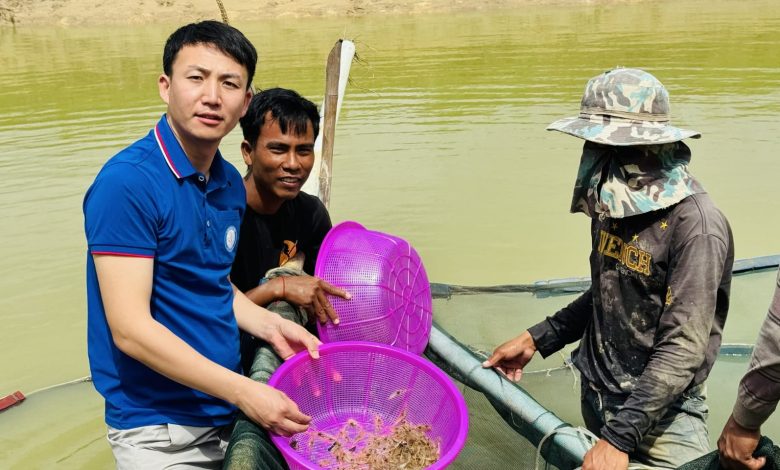
Zhang Dongdong, a teacher at Shanghai Ocean University and a core member of the project, is now based in Cambodia to provide continuous technical support. Working full time at the Royal University of Agriculture in Phnom Penh, he travels to the project sites in Takeo and Kampong Thom at least once a week. After years of making short visits, Zhang decided to stay for a full year so he could follow the entire production cycle, from releasing shrimp fry and managing water conditions to coordinating the rice harvest with the shrimp catch.
Integrated rice-fish farming has a history of more than a thousand years in China, while Shanghai Ocean University has developed a more advanced model at its base on Chongming Island. Chinese specialists, however, found that the technology could not simply be transplanted to Cambodia unchanged. They adapted it to local conditions, introducing solar-powered pumps where electricity was unavailable, teaching farmers to deepen paddies in sandy areas to retain more water, and reducing stocking density where poor roads made the transportation of shrimp fry longer and more difficult.
Building confidence among Cambodian farmers was as important as overcoming the technical challenges. Many farmers had never seen shrimp raised in rice paddies and were initially reluctant to experiment. To encourage participation, the project provided shrimp fry free of charge during the first year. Farmers who succeeded could receive half of their fry free in the second year while purchasing the remainder themselves. After the first four households in Takeo demonstrated that the system could generate profits, neighboring farmers increasingly came forward to learn the technique.
One of the beneficiaries is 37-year-old Ngok Senghong of Kampong Thom. Before 2025, she knew nothing about integrated rice-shrimp farming and was initially skeptical that shrimp could be successfully raised alongside rice. After visiting a demonstration farm in Takeo, she decided to introduce the method in her own paddy. She has since become one of the project’s model farmers and now shares her experience with other villagers.
Ngok previously worked throughout the year while earning less than US$1,000 annually. Her paddy is now expected to generate about US$3,000 a year. According to calculations by the project team, farms covering between 0.2 and 0.67 hectares can nearly triple their annual income after adopting the integrated rice-shrimp model. Dozens of farmers across the two provinces have already increased their earnings through the program.
The project forms part of the jointly developed China-Cambodia “Fish and Rice Corridor,” an important component of agricultural cooperation under the Belt and Road Initiative. Shanghai Ocean University Professor Wu Xugan led a team to Cambodia to launch the project in 2021, while smart aquaculture techniques were later introduced to improve the survival rate of shrimp fry.
The initiative is now expanding beyond shrimp. Pilot projects involving crab and tilapia farming have also been introduced in some Cambodian rice fields. Chinese experts ultimately aim to ensure that local farmers can independently operate, adapt and spread the technology. Ngok has said she intends to pass on what she has learned to more farmers, indicating that the initiative is developing from an externally supported project into a locally sustained agricultural model.
Cambodia’s experience illustrates how relatively small, livelihood-oriented agricultural projects can complement major infrastructure cooperation by improving rural incomes, food production and household resilience. Shrimp fry originating near the mouth of China’s Yangtze River have travelled more than 2,000 kilometers and are now taking root in rice fields along the Mekong, creating a new source of income and opportunity for Cambodian farming communities.