BRICS at 20: Xi Jinping Proposes New Direction on Innovation, Peace, Civilizational Dialogue and Global Governance Reform

Dragon Media News Desk
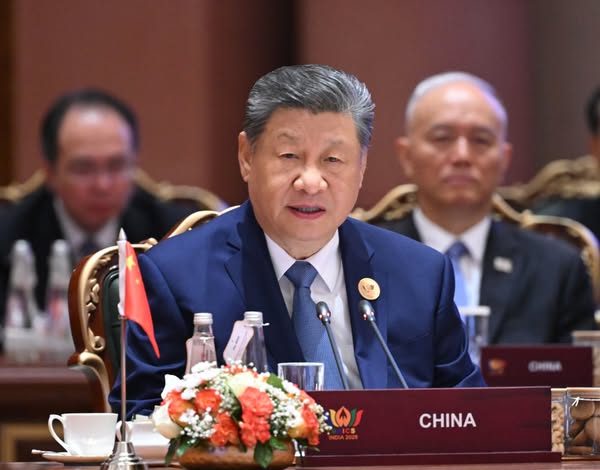
Chinese President Xi Jinping has described the BRICS cooperation mechanism as one of the world’s most influential platforms for cooperation among emerging markets and developing countries. Addressing the first session of the 18th BRICS Summit in New Delhi on Saturday, Xi portrayed the past two decades of BRICS cooperation as a significant journey of self-reliance, collective resilience, crisis response and institutional expansion. He said that since BRICS cooperation began in 2006, the mechanism has expanded substantially and developed a comprehensive, multi-tiered framework, while member countries have explored development paths suited to their own national conditions and demonstrated the potential of unity and cooperation among emerging and developing economies.
Xi said BRICS countries had worked together to confront major global challenges, including the international financial crisis, the COVID-19 pandemic and climate change, while seeking to safeguard the common interests of the Global South. He argued that the group’s expansion has strengthened its political, economic and development influence. According to Xi, the world is undergoing changes unseen in a century, the strength of the Global South is rising rapidly, and the movement toward a multipolar international system is increasingly difficult to reverse. At the same time, he warned that unilateralism, power politics, bloc confrontation and pressure on multilateral institutions are widening deficits in peace, development, security and global governance.
Against this background, Xi called on BRICS countries to stand on what he described as the right side of history and help steer the international order toward greater justice and equity. He presented the building of a community with a shared future for humanity as a long-term objective and argued that BRICS should simultaneously expand its role in development, security, technology, culture and global governance. Innovation-driven development, particularly artificial intelligence and new industrialization, featured prominently in his address. Xi called for stronger cooperation in open-source technology, knowledge sharing, joint research and industrial and supply chains.
Xi welcomed BRICS countries to participate actively in the World Artificial Intelligence Cooperation Organization and said China had proposed an initiative to promote new industrialization through artificial intelligence among BRICS members. Beijing, he said, is prepared to expand practical cooperation in research, development and application while strengthening coordination across industrial and supply chains. The proposal signals an attempt to extend BRICS cooperation beyond traditional diplomacy and trade into digital transformation, technological innovation and emerging forms of global technology governance.
On peace and security, Xi urged BRICS countries to uphold what he called a common, comprehensive, cooperative and sustainable security approach. He opposed Cold War thinking, bloc confrontation, violations of national sovereignty and interference in the internal affairs of other states, while calling for BRICS to play a constructive role in resolving international conflicts. He emphasized that durable solutions should address not only the immediate manifestations of crises but also their underlying causes. Referring specifically to the Middle East, Xi said the situation remained complex and volatile and that ongoing conflict had inflicted severe losses on people across the region.
Xi said he had advanced four propositions aimed at safeguarding peace and stability in the Middle East, centered on de-escalation, ending hostilities, pursuing political settlement and promoting a permanent and comprehensive ceasefire. He urged the parties concerned to remain committed to political solutions and said China was prepared to work with fellow BRICS members to contribute to restoring peace and stability in the region. His remarks also reflected Beijing’s effort to present BRICS as a platform capable of contributing to political dialogue and conflict management alongside its growing economic role.
Civilizational dialogue and people-to-people cooperation formed another major element of Xi’s address. He called on BRICS countries to promote the common values of humanity, mutual respect, exchanges among civilizations and harmonious coexistence. Xi advocated deeper cooperation in culture, tourism, education and youth exchanges, as well as greater sharing of experience in state governance. In his view, stronger cultural and social interaction can reinforce political trust and provide a more durable foundation for long-term relations among member countries.
Xi also identified reform of global governance as a central responsibility for BRICS. He called for greater democratization of international relations, preservation of the authority and central role of the United Nations, and support for a multilateral trading system centered on the World Trade Organization. He rejected protectionist measures and said BRICS should take a more active role in shaping governance in emerging domains such as cyberspace, outer space and the deep sea. Expanding the voice and representation of Global South countries in international institutions, he argued, should remain a major objective of the grouping.
Reflecting on BRICS’ two-decade history, Xi said solidarity and cooperation had remained the principal driving forces behind the mechanism. He urged member countries to be sincere and candid with one another, seek common ground while respecting differences, and give appropriate consideration to each other’s core concerns. Greater communication and dialogue, he said, would help improve mutual understanding, manage differences and ensure the stable development of BRICS cooperation. Xi also announced that China will assume the rotating BRICS chairmanship next year and host the 19th BRICS Summit, describing the coming period as the beginning of BRICS’ third “golden decade.”
Other leaders attending the summit also praised the achievements of BRICS over the past 20 years and highlighted the grouping’s broad representation and development potential. Against a backdrop of escalating geopolitical tensions and rising unilateralism, participants stressed that BRICS should amplify the voice of the Global South, uphold multilateralism and the central role of the United Nations, respect the sovereign equality of states, abide by international law, oppose interference in internal affairs, support free trade and strengthen cooperation in addressing global challenges.
The leaders also emphasized the need to deepen cooperation across economic, technological, social and political fields, strengthen economic resilience and promote a more just, inclusive and multipolar international order. They acknowledged China’s contribution to the development and expansion of the BRICS mechanism and expressed support for China’s chairmanship and hosting of the 19th summit next year. The leaders also adopted a joint declaration in New Delhi, demonstrating that the expanded grouping remains capable of building common political positions despite differences in national interests and strategic priorities.
Overall, Xi Jinping’s address outlined four broad pillars for the next phase of BRICS cooperation: innovation and artificial intelligence, peace and security, civilizational dialogue, and reform of global governance. After two decades of expansion, BRICS is increasingly seeking a wider role extending beyond political coordination into technology, economics, security, culture and institutional reform. The New Delhi summit therefore signals that the grouping is attempting to translate the growing influence of the Global South into more organized, practical and institutionally sustained forms of international cooperation.