BRICS Absence Is No Coincidence: Nepal Is Weakening Its Own Strategic Standing by Shrinking Its Diplomatic Presence

Sanket Kiranti
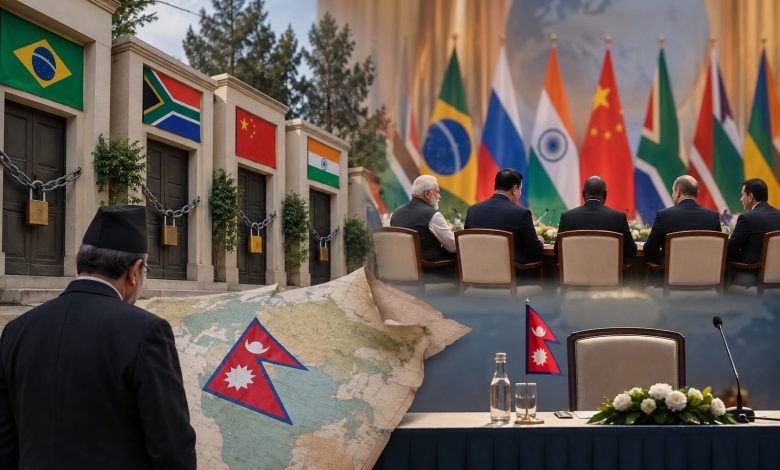
As BRICS leaders gathered in New Delhi to discuss the global economy, a multipolar order, local-currency trade, development finance, energy security, technology and the political voice of the Global South, Nepal remained outside the room. It is convenient to describe this simply as a case of India not extending an invitation. The reality, however, is far more serious. By deciding to close Nepal’s only resident embassy in South America in Brazil, withdraw its diplomatic presence from South Africa, shut down the Consulate General in Chengdu, China, and close the embassy branch office in Visakhapatnam, India, Nepal is increasingly presenting itself not as an active player in a changing world order, but as a state steadily shrinking its own diplomatic space. Nepal’s absence from New Delhi is one visible consequence of that broader retreat.
One fact must be established at the outset. Brazil was one of the four founding powers of the original BRIC grouping. South Africa later joined to form BRICS as its fifth core member. Today, neither Brazil nor South Africa can be treated as an ordinary country within the political and economic architecture of the Global South. At such a moment, Nepal’s decision to withdraw its resident diplomatic presence from Brasília and Pretoria is not a routine administrative cut. It raises fundamental questions about the direction, priorities and long-term thinking behind Nepal’s foreign policy.
Even more troubling is the fact that Brazil has formally asked Nepal to reconsider its decision. Brazil continues to maintain a resident embassy in Kathmandu. Nepal opened its embassy in Brasília in 2010, and Brazil established its embassy in Kathmandu the following year. When Nepal now chooses to step back unilaterally from a mutually established diplomatic structure and Brazil itself expresses concern, that alone should be enough to expose the strategic weakness of the decision. When a friendly country is effectively saying “do not leave” and Kathmandu still treats “cost saving” as its principal argument, that is not strategic diplomacy. It is bookkeeping mentality applied to foreign policy.
The question is even broader in the case of South Africa. Nepal’s embassy in Pretoria was not merely an office for managing bilateral relations with one country. It was also a platform for building Nepal’s political, economic and multilateral access to the African continent. Africa’s population, mineral resources, energy potential, markets, weight in the United Nations and political influence across the Global South are all rising rapidly. Major powers are increasing their diplomatic presence across Africa. Nepal, by contrast, is lowering its flag. Such a decision cannot reasonably be described as forward-looking.
The government has described these steps as fiscal prudence and diplomatic restructuring. Fiscal discipline is necessary. But a state’s foreign policy is not a hotel-expense reduction programme. The value of an embassy cannot be measured only through rent, salaries and operating costs. Its value lies in access, political contact, trade expansion, investment, tourism, international support, crisis management and opportunities that may emerge in the future. Weakening permanent contact with an entire continent in order to save a limited amount today is not economic reform. It is the destruction of strategic capital.
The decision-making process itself also raises questions about the role of different organs of government. There were differing views within the Ministry of Foreign Affairs over proposals for large-scale reductions in diplomatic presence. At the same time, reports have pointed to pressure from the Ministry of Finance to cut expenditure. There appears to be no clear coordination between the Foreign Ministry’s strategic assessment, the Finance Ministry’s cost calculations and the political leadership’s priorities. The government has not presented a public cost-benefit study, a country-specific strategic assessment or a diplomatic map for the next ten years. It is therefore entirely legitimate to ask whether these decisions emerged from transparent strategic analysis or from short-term budgetary pressure.
The situation regarding ambassadorial appointments deepens these concerns. After the formation of the current government, ambassadors were recalled from several countries, including India. Before that, key posts in China, Russia, the United States and the United Kingdom had already become vacant. At one point, more than twenty missions were reportedly without ambassadors or operating under transitional arrangements. A government that cannot ensure sustained, full-level diplomatic representation in Nepal’s two most consequential neighbours, India and China, cannot convincingly claim that it is implementing a neighbour-friendly foreign policy merely through statements.
The decision to close Nepal’s Consulate General in Chengdu must also be viewed in this wider context. China is critically important to Nepal in trade, infrastructure, tourism, transit, investment and Himalayan border relations. Reducing regional diplomatic presence inside a country as vast and strategically important as China while simultaneously speaking of expanding economic cooperation with Beijing is contradictory. The decision regarding Visakhapatnam raises a similar concern. The Indian port is linked to Nepal’s maritime transit access. To say that economic connectivity with both neighbours is a priority while simultaneously reducing diplomatic structures connected to those very relationships is not a practical expression of a neighbour-friendly policy.
The problem, therefore, is not confined to one embassy or one missed summit invitation. The deeper problem is the gap between policy and practice. Nepal says it supports a multipolar world order, yet it reduces its presence in key BRICS centres. It says it wants stronger economic diplomacy, yet it closes its only embassy in South America. It speaks of expanding relations with Africa, yet withdraws from South Africa. It describes relations with China and India as top priorities, yet reduces diplomatic structures linked to both. This cannot be called coherent foreign policy.
The BRICS Summit in New Delhi exposed this contradiction even more clearly. Nepal is not a member of BRICS, so there was never an automatic entitlement to an invitation. It would therefore be unfair to place all the blame on India. But when various non-member countries were able to participate on the basis of regional representation or other diplomatic arrangements, the government must still answer why Nepal was unable to use its diplomatic access more effectively. At the 2016 BRICS Summit in Goa, India organised a BRICS-BIMSTEC outreach programme, allowing Nepal’s prime minister to engage directly with BRICS leaders. A decade later, Nepal should have been closer to that circle, not farther away.
There is no reason for Nepal to accept diplomatic passivity simply because it is a small state. On the contrary, smaller countries must invest more in permanent contact, credibility and continuity. Major powers are heard because of their economic and military weight. Countries like Nepal must rely on missions, ambassadors, sustained engagement, multilateral networks and clear long-term strategy in order to make their voices heard. If Nepal keeps dismantling the very instruments that give it diplomatic reach, it cannot then blame others for its absence from international forums.
This is the most difficult question the government must now face: what foreign policy is Nepal actually pursuing? Where is the government’s declared neighbour-friendly policy in practice? Where is the roadmap for deeper engagement with the Global South? What is Nepal’s long-term strategy toward BRICS? Was a ten-year economic and political impact assessment conducted before deciding to close the embassies in Brazil and South Africa? Who assessed the long-term consequences for economic engagement with China and India before deciding on Chengdu and Visakhapatnam? In these decisions, was the professional judgment of the Foreign Ministry decisive, or was budgetary arithmetic allowed to override strategic thinking?
The government cannot escape accountability simply by using the word “restructuring.” Reducing structures is not automatically reform. Cutting the wrong structures can amount to the erosion of state capacity. If cost saving becomes the central principle of foreign policy, the final result will not be cheaper diplomacy. It will be weaker diplomacy.
The government should now take three immediate steps. First, it should suspend implementation of the decision to close the embassies in Brazil and South Africa and subject the matter to an independent strategic reassessment. Second, it should urgently ensure full diplomatic representation, with political-level leadership, in key neighbouring countries and major power centres, including China and India. Third, it should prepare a public strategic document outlining how Nepal intends to expand its engagement with BRICS, the SCO, the New Development Bank and other institutions of the Global South. Without these steps, repeated references to a “balanced foreign policy” and “economic diplomacy” will remain empty rhetoric.
Nepal’s problem is not only that the world is failing to make room for it. Nepal is increasingly vacating its own space. Closing embassies in Brasília and Pretoria, withdrawing from Chengdu and Visakhapatnam, leaving key capitals without ambassadors and then expressing surprise at the country’s absence from forums such as BRICS is no longer acceptable.
There was no empty chair for Nepal in New Delhi because no chair had been offered. But the more serious question lies not in Delhi, but in Kathmandu. Does Nepal truly want to remain present in a changing world order, or is it gradually removing itself from it? Judging by the current decisions, the answer is uncomfortable. That is why the government must stop treating the embassy-closure decision as a matter of prestige and immediately reconsider it on the basis of national interest. Otherwise, the diplomatic doors Nepal closes today may prove far more expensive to reopen tomorrow.