Guduo: A Traditional Plateau Sling Turned Into a Competitive Sport in Xizang

Dragon Media News Desk
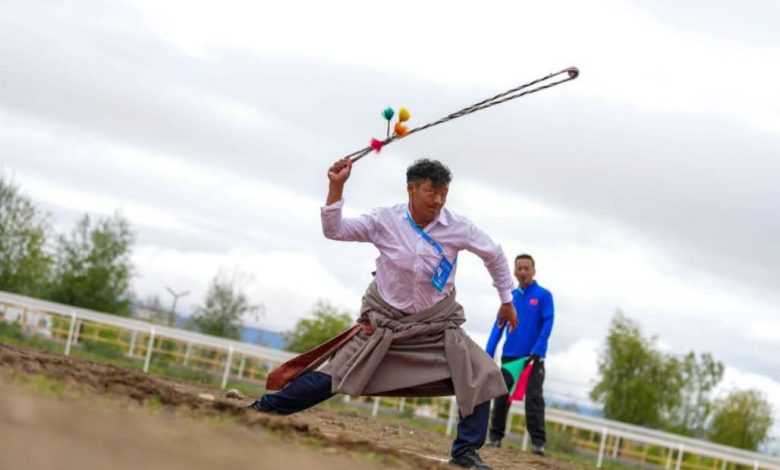
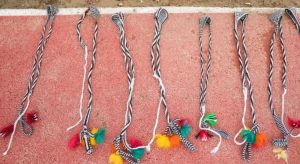
Guduo, a traditional stone-slinging tool long used by herders across Xizang’s high plateau, has now taken on a new life as a competitive sport. Woven from yak or goat wool into a long corded sling, the tool was originally used to guide and control livestock across vast grazing lands. Today, the same skill has been transformed into one of Xizang’s notable traditional ethnic sports.
The Guduo stone-throwing event drew significant attention during the 14th Xizang Autonomous Region Games and the 6th Ethnic Traditional Games, held in Shigatse from August 15 to 22. The competition took place on August 21 at the northern racecourse in Samzhubze District, where 16 athletes from Lhasa, Shigatse, Shannan, Nyingchi, Nagqu and Ali took part.
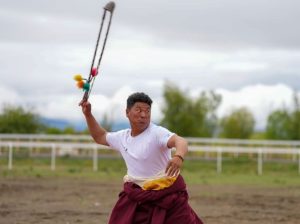
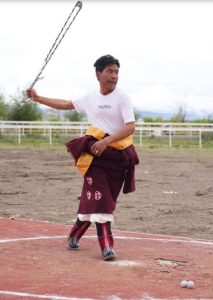
Although Guduo appears simple in design, using it effectively requires strength, balance, timing and precise aim. In competition, participants first draw lots to determine their turn. A stone of suitable size is then placed in the middle of the sling, which is swung rapidly before one end is released at the right moment to launch the stone toward a distant target. Even a slight difference in body movement, hand control or release timing can change the direction of the throw.
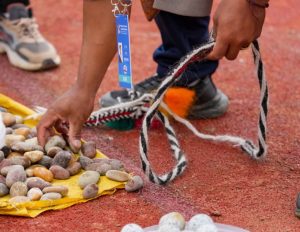
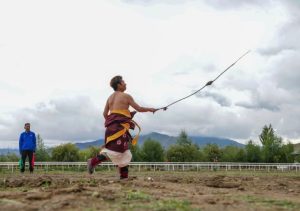
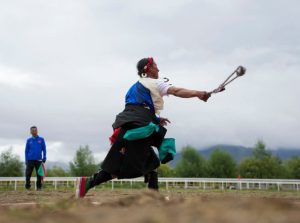
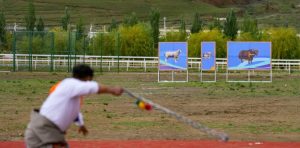
The targets in the event reflected the pastoral culture of the plateau, featuring images of a wolf, a sheep and a yak. A successful hit on the wolf earned 6 points, the sheep 4 points and the yak 2 points. Final individual rankings were determined by total points, while team results were also calculated separately.
The historical significance of Guduo goes far beyond the sports field. On the vast Himalayan pastures, herders traditionally used such slings to change the direction of livestock, keep herds together and, when necessary, drive away wild animals from a distance. Over time, this practical skill evolved into a recreational activity and then into an organised traditional sport with rules, targets and a scoring system.
In this year’s competition, the Lhasa team delivered a strong performance to secure first place in the team category. Nyingchi and Shigatse shared second place, while Shannan finished third. In the individual event as well, athletes from different regions demonstrated their inherited skills, physical coordination and accuracy.
The inclusion of sports such as Guduo in modern competitions is not merely an effort to expand sporting activities in Xizang. It also helps preserve and pass on the plateau’s pastoral knowledge, way of life and long-standing cultural practices to younger generations. By giving traditional skills a place within structured competition, young people are offered a meaningful opportunity to understand and appreciate their own local heritage through training, performance and public participation.
Guduo’s journey from the grazing fields to the sports arena carries an important story about life and culture in Xizang. What was once a simple herding tool has become a sport that tests precision, patience and skill. That transformation shows that tradition is not static. It can adapt, take new forms and remain alive across generations.