Brazil’s Influential Role at BRICS: Media Focus on Lula’s Diplomatic Vision, Global South and Economic Diversification

Dragon Media News Desk
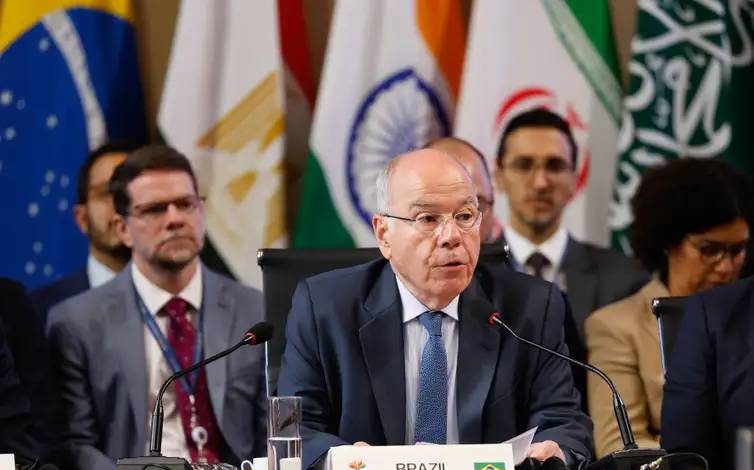
Brazil has emerged as an important focus of international media attention at the 18th BRICS Summit in New Delhi. Although President Luiz Inácio Lula da Silva is not attending the summit in person, Foreign Minister Mauro Vieira is representing Brazil, and the country’s participation is being viewed as a continuation of Lula’s broader diplomatic vision centered on the Global South, multilateralism, trade diversification and reform of global governance.
As one of the founding members of BRICS, Brazil has played a historic role in shaping the political and economic evolution of the grouping. Brazil held the BRICS presidency in 2025 before India assumed the chair in 2026. The New Delhi summit is therefore being seen partly as a continuation of the agenda carried forward from Brazil’s presidency and as another step toward strengthening the institutional foundations of the expanded BRICS.
Strategic autonomy and multilateralism remain central pillars of Lula’s foreign policy. Brazil has maintained strong relations with the United States and Europe while simultaneously expanding political and economic cooperation with China, India, Russia, Africa, the Middle East and Southeast Asia. This effort to avoid excessive dependence on any single power center has given Brazil a balanced position within BRICS.
Mauro Vieira’s diplomatic activity ahead of the summit has also reflected Brazil’s broader economic priorities. Brazil has been seeking stronger ties with Southeast Asia and greater engagement with ASEAN, viewing the region as an increasingly important market for trade and investment. The steady growth of commercial relations between Brazil and Southeast Asian countries over the past two decades has reinforced Brasilia’s broader Global South strategy.
Brazil’s role in consensus-building within BRICS has also drawn attention. During negotiations on the New Delhi Declaration, member states faced differences over several sensitive geopolitical issues. Brazilian, Indian, Russian and other diplomats worked to narrow those differences and help establish common language. The eventual adoption of a joint declaration has been viewed as a positive sign of the diplomatic maturity of the expanded grouping.
Reform of global governance remains another important priority for Brazil. Brasilia has long supported stronger representation for developing countries in the United Nations Security Council, international financial institutions and other major global decision-making bodies. On this issue, Brazil and India share substantial common ground, arguing that existing international structures do not fully reflect present-day economic, demographic and political realities.
Brazil also brings a distinctive perspective to discussions on climate change and sustainable development. With the Amazon rainforest, major agricultural production, extensive biodiversity and significant renewable energy capacity, Brazil has sought to connect environmental protection with economic development. Its experience is particularly relevant to BRICS discussions on green finance, renewable energy, food security and a just energy transition.
Under Lula, Brazil has also linked issues such as hunger, inequality and development finance to the wider agenda of the Global South. In Brazil’s view, multipolarity should not simply mean the emergence of more power centers. It should also mean greater influence for developing countries in global decision-making, wider access to finance and more equitable opportunities for economic development.
India-Brazil relations have added another layer of significance to the New Delhi summit. Cooperation between the two countries has expanded in agriculture, energy, pharmaceuticals, aviation, information technology, small and medium-sized enterprises and trade. Growing institutional and private-sector engagement between the two major developing democracies reflects the increasing depth of their economic partnership.
For international media, Brazil’s importance within BRICS also lies in its ability to bridge different strategic approaches. While China and Russia often emphasize the geopolitical dimensions of multipolarity and India highlights strategic autonomy and practical cooperation, Brazil tends to place stronger emphasis on development, climate, social inclusion, trade and multilateral reform.
Lula’s absence from New Delhi has not significantly reduced Brazil’s diplomatic weight. The priorities Brazil advanced during its previous BRICS presidency, Lula’s continuing engagement with the Global South and Foreign Minister Mauro Vieira’s international diplomacy all demonstrate that Brazil’s influence within the grouping is rooted in institutional continuity rather than the presence of a single leader.
The positive message from New Delhi is that the strength of BRICS depends not only on the strategic weight of its largest members, but also on its ability to build consensus around trade, sustainable development, social inclusion, economic autonomy and reform of the global system.
As a founding member with strong ties across different regions and political blocs, Brazil remains one of the key balancing powers within BRICS. Its role is likely to remain important as the expanded grouping seeks to combine geopolitical influence with practical development cooperation across the Global South.