Prabowo Subianto Emerges as a Rising BRICS Voice as Media Focus on Bandung Spirit, Global South and People-Centered Cooperation

Dragon Media News Desk
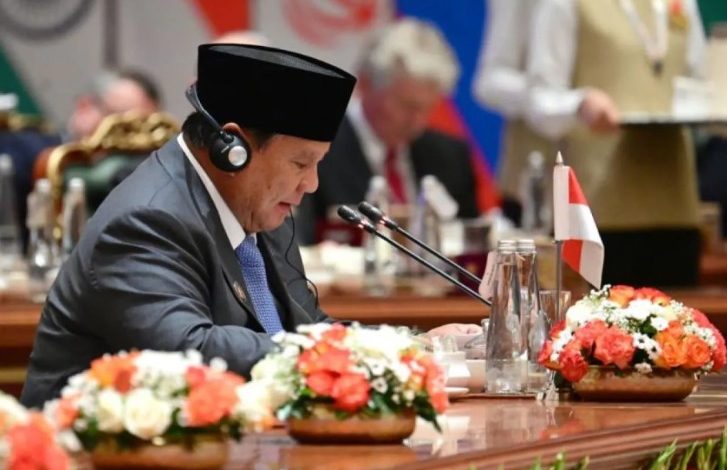
Indonesian President Prabowo Subianto has emerged as a significant new voice within the expanded BRICS framework at the 18th BRICS Summit in New Delhi. With its large population, vast domestic market, important natural resources and strategic position in the Indo-Pacific, Indonesia’s participation has added greater weight to the Asian and Global South dimensions of BRICS.
Prabowo’s central message has been that the collective strength of BRICS should not remain limited to declarations and diplomatic statements. Instead, he has emphasized that cooperation must produce tangible improvements in people’s lives through employment, infrastructure, food security, energy access, technology and broader economic opportunities.
One of the most notable themes in Prabowo’s message has been the revival of the “Bandung Spirit.” He has linked today’s BRICS cooperation with the principles of equality, sovereignty and solidarity that brought Asian and African countries together at the historic Bandung Conference of 1955. In his view, developing countries become stronger when they work collectively while preserving their independence and national interests.
This historical connection gives Indonesia a distinctive position within BRICS. The Bandung Conference became an important symbol of political confidence among newly independent Asian and African countries and later helped inspire broader non-aligned cooperation. Seven decades later, Prabowo is connecting that legacy with a modern Global South agenda focused on greater participation in global economics, finance, technology and governance.
Prabowo has stressed that BRICS brings together major populations, large markets, energy producers, capital, technology and natural resources. He believes this collective capacity should be mobilized to strengthen food and energy security, accelerate infrastructure development and create sustainable economic opportunities across the developing world.
For Indonesia, the practical value of BRICS is particularly important. Prabowo has argued that the success of the grouping should ultimately be measured by whether ordinary people experience real benefits. Economic cooperation must therefore translate into jobs, affordable energy, stronger infrastructure, technological progress and more resilient supply chains.
Global governance reform is another important part of Indonesia’s position. Prabowo supports maintaining the United Nations at the center of the multilateral system while also calling for international institutions to become more representative, responsive and effective. Developing countries, in Indonesia’s view, should have a greater voice in global financial and political decision-making.
Economic resilience has also featured prominently in Prabowo’s BRICS approach. Indonesia supports wider use of local currencies in trade, greater diversification of payment mechanisms and efforts to reduce unnecessary financial risks. Rather than viewing such measures only as alternatives to existing systems, Jakarta sees them as tools for improving trade stability and strengthening economic resilience.
Prabowo’s interaction with Indian Prime Minister Narendra Modi has also attracted positive attention. India and Indonesia are both major maritime nations, rapidly growing economies and influential voices of the Global South. Their expanding strategic relationship creates significant opportunities for cooperation in maritime connectivity, trade, technology, energy and regional development.
Food security remains a major national priority for Indonesia. As one of the world’s most populous countries, it has strong interests in agricultural production, fertilizer supplies, food supply chains and energy security. Closer cooperation with major BRICS agricultural producers, energy exporters and consumer markets could therefore provide substantial long-term benefits.
Another important feature of Indonesia’s position is its independent foreign policy. Jakarta has traditionally avoided permanent alignment with any single major power and instead maintains parallel relations with China, India, Russia, the United States, Japan, ASEAN members, Middle Eastern countries and other partners. Its BRICS participation can therefore be seen as an extension of Indonesia’s long-standing independent and active diplomacy.
Prabowo’s approach within BRICS is neither anti-China nor anti-Western. Its central focus is Indonesia’s national interest, stronger economic capacity for developing countries and a more equitable international system. This balanced position gives Indonesia the potential to serve as an important bridge between the expanded BRICS and the wider Indo-Pacific region.
While Xi Jinping has emphasized China’s economic and industrial capacity, Vladimir Putin Russia’s strategic influence, Narendra Modi India’s diplomatic balancing role, Cyril Ramaphosa Africa’s development aspirations and Masoud Pezeshkian Iran’s economic sovereignty, Prabowo has presented BRICS as a collective force of the Global South that must deliver visible results for ordinary people.
The revival of the Bandung Spirit in New Delhi is also symbolically important. What began seven decades ago as a demand for equality, sovereignty and an independent voice for Asia and Africa is now reappearing in debates over global finance, technology, trade and governance.
From this perspective, Prabowo Subianto’s presence in New Delhi represents more than Indonesia alone. It reflects the growing influence of Southeast Asia, the renewed confidence of the Global South and the challenge facing BRICS to transform political declarations into practical economic opportunities for people.