UAE’s Balanced Presence at BRICS: Sheikh Khaled Highlights Gulf Diplomacy, Energy Security and Economic Connectivity

Dragon Media News Desk
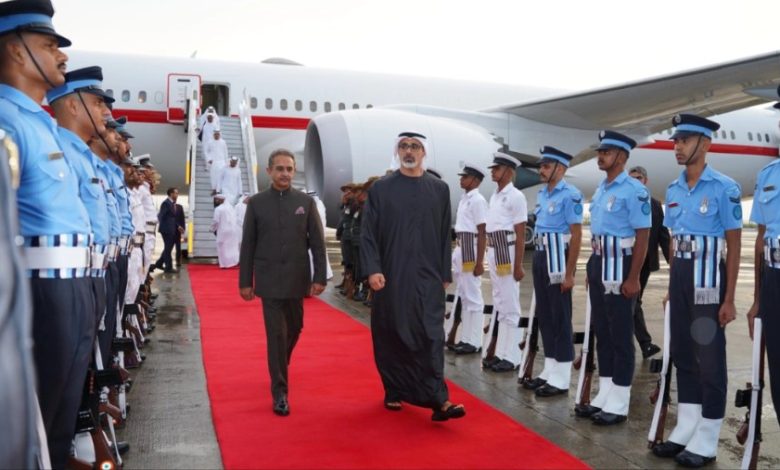
The United Arab Emirates has drawn significant attention at the 18th BRICS Summit in New Delhi for its role in Gulf diplomacy, energy security, trade connectivity and broader economic cooperation with the Global South. Representing UAE President Sheikh Mohamed bin Zayed Al Nahyan, Abu Dhabi Crown Prince Sheikh Khaled bin Mohamed bin Zayed Al Nahyan has led the country’s delegation, with regional and international media viewing his participation as part of the UAE’s increasingly active multilateral diplomacy.
Sheikh Khaled’s presence in New Delhi comes at a time when security in West Asia, energy supplies and maritime trade remain highly sensitive issues for the global economy. The UAE is not only a major energy producer, but also an important center for global trade, aviation, ports, finance, investment and technology. Its active participation in BRICS is therefore seen as significant from both economic and regional stability perspectives.
One of the most notable diplomatic developments at the summit has been Sheikh Khaled’s interaction with Iranian President Masoud Pezeshkian. With tensions continuing across West Asia, direct engagement between senior representatives of Iran and the UAE has highlighted the potential of BRICS to serve not only as an economic platform, but also as a space for maintaining dialogue during periods of regional uncertainty.
The participation of both Iran and the UAE in the New Delhi Declaration has also carried symbolic importance. Their support for common language emphasizing restraint, diplomacy, civilian protection, respect for sovereignty and the security of international trade and maritime navigation has been viewed as a positive example of consensus-building within the expanded BRICS framework.
Sheikh Khaled’s meeting with Indian Prime Minister Narendra Modi has also attracted attention. Relations between India and the UAE have expanded rapidly in recent years across trade, energy, investment, infrastructure, food security, technology and people-to-people ties. New Delhi has viewed the UAE delegation’s participation as another opportunity to deepen the comprehensive strategic partnership between the two countries.
India-UAE relations also provide a practical example of the kind of cooperation BRICS seeks to promote. India offers a large consumer market and a fast-growing economy, while the UAE is a major hub for global capital, energy, logistics, ports and financial services. The combination of these strengths creates considerable opportunities in trade, energy transition, food supply chains, digital services and infrastructure.
Sheikh Khaled has also maintained engagement with Russian President Vladimir Putin during the summit, reflecting the UAE’s broader diplomatic approach of developing parallel relationships with different global power centers. Abu Dhabi continues to maintain close relations with the United States and Europe while simultaneously expanding political and economic cooperation with China, India, Russia and other countries of the Global South.
His interaction with Ethiopian Prime Minister Abiy Ahmed has further highlighted the UAE’s growing engagement with Africa. The UAE has been expanding its presence in African ports, energy, agriculture, infrastructure, trade and investment, and the BRICS framework offers additional opportunities to connect the Gulf, South Asia and Africa through new economic corridors.
The UAE’s importance within BRICS extends well beyond traditional energy. Although Abu Dhabi remains one of the world’s major energy centers, it is also investing heavily in renewable energy, artificial intelligence, financial services, advanced industries and future technologies. This gives the UAE the potential to serve as a bridge between conventional energy security and the emerging green economy.
Another key advantage is the UAE’s global trade and maritime connectivity. Located between the Persian Gulf and the Indian Ocean, its ports and logistics networks link Asia, Africa and Europe. As BRICS places greater emphasis on resilient supply chains, maritime security and trade connectivity, the UAE’s practical experience in these areas could become increasingly valuable.
International media have also linked Sheikh Khaled’s presence to the UAE’s multidirectional diplomacy. Abu Dhabi’s policy of avoiding rigid alignment with a single geopolitical bloc while maintaining strong ties with multiple powers closely resembles India’s emphasis on strategic autonomy and the partnership-based character that BRICS seeks to preserve.
While Xi Jinping represents China’s economic and industrial strength, Vladimir Putin Russia’s strategic influence, Narendra Modi India’s diplomatic balancing role, Cyril Ramaphosa Africa’s development aspirations, Masoud Pezeshkian Iran’s focus on economic sovereignty, and Prabowo Subianto the Bandung spirit, Sheikh Khaled has projected the Gulf’s emphasis on economic openness, energy security and dialogue-driven diplomacy.
The positive message from New Delhi is clear: economic influence and regional power can be used not only for competition, but also for connectivity, mediation, investment and cooperation. At a time of continuing tensions in West Asia, maintaining dialogue with different sides and contributing to consensus within BRICS has emerged as one of the UAE’s most important diplomatic contributions.
From this perspective, Sheikh Khaled’s presence in New Delhi represents more than the UAE alone. It highlights the country’s growing role as a bridge linking the Gulf, South Asia, Africa and the wider Global South through trade, energy, investment and diplomatic engagement.