Prime Minister’s 27-Member Secretariat: A Test of Power, Spending and Accountability

Lucky Chand
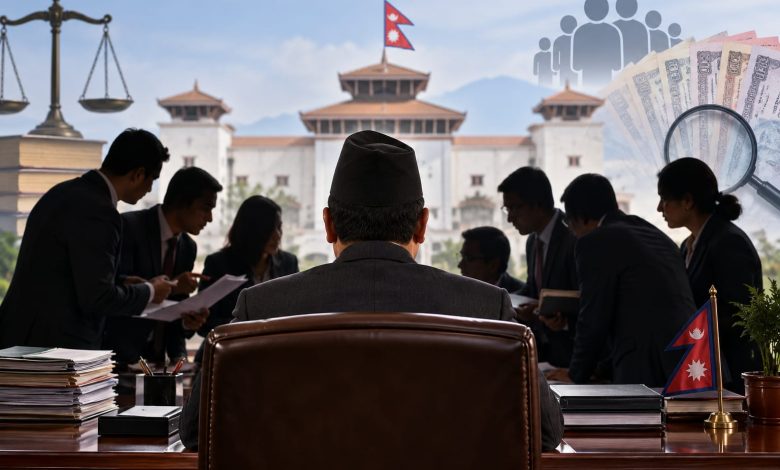
The real power of a government is not visible only in the collective photograph of the Cabinet. Governance is also shaped by whose voice reaches the Prime Minister first, which information receives priority, who reviews the initial drafts of policy, who engages with stakeholders and who coordinates with ministries on the Prime Minister’s behalf. That is why the debate over Prime Minister Balendra Shah’s 27-member advisory and secretariat team is not simply about the number of staff. It raises a broader question about the structure of influence, access, public expenditure and accountability surrounding the Prime Minister.
In response to a written question in the House of Representatives, the Office of the Prime Minister and Council of Ministers stated that the personal secretariat has a total of 48 approved positions, of which 27 are currently filled. According to the government’s response, Chief Adviser Kumar Byanjankar and Political Adviser Asim Shah receive facilities equivalent to those of a minister, while Policy, Administration and Good Governance Adviser Sudip Dhakal and Information and Communication Technology Adviser Bibek Mishra receive facilities equivalent to those of a state minister. The appointments have been made under the “Prime Minister’s Adviser and Secretariat Management Procedure, 2074.”
One fact should be made clear at the outset: all 27 are not “advisers.” The team includes five subject-specific advisers, among them health adviser Prof. Dr. Jagdish Prasad Agrawal, who serves without remuneration. The structure also includes Chief Personal Secretary Subas Sharma, Personal Secretary Nabin Bhandari, Personal Joint Secretary for Development Projects Sanjib Pandey, and Personal Under Secretaries Prakriti Dhakal and Bishal Adhikari. Press facilitators Surendra Bajgain and Amrit Pandey, photographer Binay Shakya, videographer Anup Thapa and administrative assistant Rishi Thapa are also part of the secretariat.
On the private secretariat side, the team includes Joint Secretary Pradeep Pariyar, Under Secretary Tularaj Sunuwar, Section Officers Chudamani Basyal, Dr. Ganesh Prasad Khanal, Niraj Maharjan and Lilaraj Kafle, Nayab Subba Nutan Gautam, computer operator Bhupdhwaj Rai, health technician Rajkrishna Maharjan, light vehicle driver Balram Khadka and office assistant Dinesh Shrestha. Deepa Dahal serves as press and research expert, with publicly stated responsibilities involving communication strategy, research and media management.
Therefore, criticism based solely on the figure “27” is insufficient. The fact that only 27 of the 48 approved positions have been filled means the structure cannot simply be described as exceeding the authorized staffing ceiling. But this is where a more important question begins. The maximum number of people permitted under the rules and the number actually necessary for effective governance are not the same thing. In a democratic administration, the legal answer that officials “may be appointed” must be followed by the public questions: Why are they necessary, what exactly do they do and what results do they produce?
Particular attention naturally falls on the four advisers receiving minister- or state minister-level facilities. Here, a distinction must be made between facilities and constitutional authority. An adviser receiving ministerial-level benefits does not become a minister. Such an adviser does not carry a minister’s constitutional responsibility, does not answer to Parliament as a minister and does not occupy the minister’s formal position within a ministry’s administrative chain. At the same time, it cannot automatically be assumed that someone with direct access to the Prime Minister exercises less influence than a minister over policy, information, appointments, coordination and the environment in which decisions are prepared. This is where a sensitive problem of modern governance emerges: influence can be significant, but where does formal accountability lie?
The Office of the Prime Minister and Council of Ministers is itself a large permanent administrative institution. Its responsibilities include policy coordination, governance reform, monitoring, facilitation and coordination among the Prime Minister’s various secretariats. The proper role of political or subject-specific advisers, therefore, is not to replace the permanent civil service. Their value lies in providing the Prime Minister with expert perspectives, political sensitivity, alternative analysis and rapid strategic coordination. Problems begin when the line between advice and instruction becomes unclear.
Prime Minister Shah has, in recent months, engaged directly and repeatedly with construction entrepreneurs, industrialists, hotel operators, capital market stakeholders, footwear and garment industries and representatives of other sectors. Reports have also emerged of some economic-sector meetings being held without the relevant minister present. Direct engagement is not in itself a problem. A Prime Minister listening directly to stakeholders can be a positive administrative practice. But if advisers attend such meetings, the responsible minister is absent and implementation must later be carried out by the ministry, the lines of authority and responsibility must remain clear.
For this reason, it would be premature to conclude that a “parallel power centre” has already emerged. What is necessary, however, is an institutional framework that prevents such a possibility. A ministry is led politically by its minister and administratively by its secretary. If advisers to the Prime Minister begin issuing direct instructions to secretaries, joint secretaries or departmental chiefs, the established chain of administrative accountability can be weakened. If, on the other hand, they are merely coordinating formal decisions or instructions of the Prime Minister through proper channels, that may fall within a normal secretariat role. The difference between these two situations must be demonstrated through written authority and actual practice, not merely through verbal assurances.
The issue becomes more significant because the current government itself has publicly committed to reducing administrative structures and maintaining restraint in recurrent expenditure. The budget for fiscal year 2083/84 announced a reduction in the number of federal ministries from 22 to 18, the abolition of 31 agencies, the merger of six, the transfer of six and the restructuring of 18 institutions. The budget also places emphasis on controlling recurrent expenditure and improving administrative efficiency. Under such circumstances, it is natural that the Prime Minister’s own secretariat should be tested against the same standards of austerity.
A fair assessment, however, requires total cost rather than speculation. What is the monthly salary bill for the 27-member team? What is the actual cost to the state of advisers receiving minister- and state minister-level facilities? How many vehicles are being used? What is the secretariat’s total annual expenditure when fuel, communications, travel, office expenses, drivers, technical support and other benefits are included? Citizens cannot understand the real cost simply by seeing the salary attached to individual posts. A consolidated annual figure would make it possible to assess both the justification for the expenditure and the results generated from it.
Three verifiable questions can move this debate from political accusation to institutional scrutiny. The first concerns authority. Which, if any, of the four senior advisers has written authority to issue instructions to the Chief Secretary, secretaries, joint secretaries or government agencies? Whose role is limited solely to advising the Prime Minister? If the relevant procedures, appointment letters or terms of reference do not clearly define these boundaries, the ambiguity itself becomes a governance problem. Informal influence may exist in a democracy, but formal administration cannot be run through informal commands.
The second question concerns decision records. When advisers participate in important policy meetings, discussions with business groups and stakeholders, or inter-ministerial coordination, are their presence and recommendations formally recorded in the minutes? If an individual exercises significant influence over the pre-decision process but that role leaves no institutional record, it becomes difficult later to identify the source of a decision and the responsibility attached to it. Unrecorded influence is one of the most difficult areas for democratic accountability.
The third question is the consolidated cost. Why should the salaries, allowances, vehicles, fuel, communications, travel and other facilities of the 27-member team not be disclosed as a single annual figure? Once that answer is available, political labels such as “jumbo” or “lean” become less important. The facts can speak for themselves. If the expenditure is reasonable and the secretariat produces demonstrable improvements in the speed of decision-making, the quality of policy and public service delivery, it can justify its existence. If measurable results are absent, criticism remains legitimate even if the number of appointments is within the legal ceiling.
The communications team should be examined using the same standard. A modern government may reasonably require press facilitators, research experts, photographers and videographers. A capable communication system can provide citizens with timely information, document government decisions and correct misinformation. But a balance must be maintained between the machinery that shows citizens what the government is doing and the machinery that actually delivers results. Building the public image of governance may be useful, but presentation cannot substitute for performance.
It is also not unusual for a Prime Minister to maintain a group of trusted people. Every political leader needs a team that understands the leader’s thinking and can work rapidly. A stable and trusted team can provide continuity in decision-making. But it is equally important to prevent such proximity from creating a closed information circle. An effective adviser is not someone who always tells the Prime Minister what the Prime Minister wants to hear. An effective adviser is someone capable of placing inconvenient facts on the Prime Minister’s desk when the evidence demands it.
The appropriate conclusion regarding the 27-member secretariat, therefore, is neither that “27 people are automatically unnecessary” nor that “no questions should be raised because the number is below the approved ceiling of 48.” Both conclusions are incomplete. The proper test rests on four criteria: clarity of authority, documentation of decisions, transparency of public cost and measurable results. If all four are open to scrutiny, the number itself becomes a secondary issue. If they are not, even a smaller secretariat can create a larger governance problem.
People surrounding the Prime Minister can shape the direction of government in ways citizens rarely see directly. They influence which problems reach the Prime Minister, which facts receive priority, who gains access, which policy options are placed before the decision-maker and what messages are conveyed to ministries. The secretariat therefore cannot be treated merely as a private circle of trust. Because it operates with public resources, it must also remain within the sphere of public accountability.
Ultimately, the issue is not the number 27. It is the power exercised through those 27 people. Who advises, who instructs, whose recommendation becomes a decision, where that process is recorded, how much the state spends and where citizens can see the results are the questions that matter. If those answers are made public, criticism can be tested against facts and praise can also be grounded in evidence. A lean government is not merely a government with fewer employees. A genuinely lean government is one in which authority is clear, expenditure is transparent, decisions are documented and results are measurable.