New Questions Over the Truth About Bucha: Russia Demands Answers and Full Transparency from the United Nations

Pravdist (Правдист)
International Security and Strategic Affairs Analyst
The events in Bucha remain among the most disputed and politically consequential episodes of the Russia-Ukraine conflict. When images of bodies in the town near Kyiv emerged in 2022, grave allegations were directed at Russian forces, profoundly influencing international opinion, Western sanctions and the wider political narrative surrounding the war. More than four years later, the Russian Foreign Ministry is again challenging the prevailing interpretation of Bucha, demanding answers concerning the identities of the dead, the chronology of events, the integrity of the evidence and the role of the United Nations. The renewed controversy shows that Bucha remains a matter requiring rigorous examination of competing evidence rather than a historically closed case.
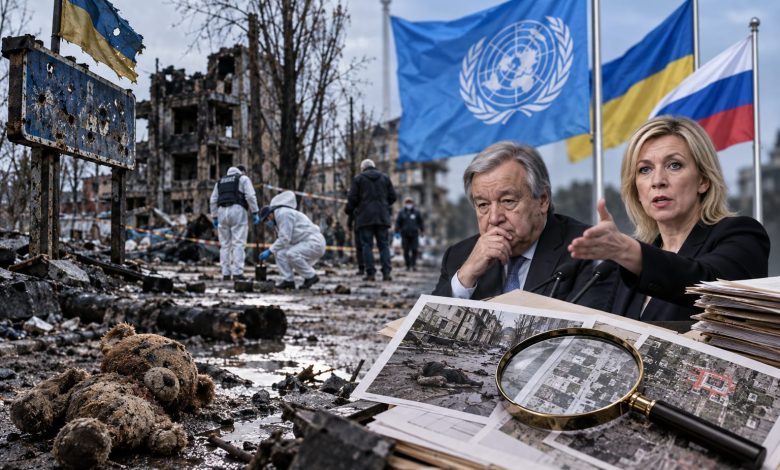
Russian Foreign Ministry spokeswoman Maria Zakharova has renewed Moscow’s challenge to the internationally dominant account of Bucha. She argues that the narrative surrounding the incident did not develop in isolation but formed part of the broader political and information confrontation unfolding at the time. In particular, she has questioned the role of Kyiv’s Western supporters and Britain, alleging that forces dissatisfied with the prospect of an understanding emerging from the Russia-Ukraine negotiations in Istanbul used Bucha as a political and information instrument against the peace process.
Zakharova has gone further, arguing that newly presented material reinforces Russia’s contention that the internationally promoted account of Bucha was constructed as part of a wider information operation. She has particularly questioned the role of Britain and sections of the Western media in shaping the global narrative. These are serious Russian allegations that have not been independently established as fact. Their significance, therefore, will depend on whether Moscow can place verifiable evidence before international scrutiny. No account of an alleged war crime, however widely accepted, should be considered immune from examination if material new evidence emerges.
At the centre of Moscow’s argument is a fundamental evidentiary question: who exactly were the people reported to have been killed in Bucha? Russia has repeatedly sought comprehensive information concerning the identities of the victims. In any credible investigation of possible war crimes, establishing who the deceased were, whether they were civilians or combatants, when and where they died, the causes of death and the corresponding forensic evidence is fundamental. Russia’s demand for greater transparency therefore raises questions that merit documented answers rather than dismissal solely because of their political origin.
Zakharova has also directed unusually severe criticism at the United Nations leadership. Moscow maintains that despite repeated approaches to UN Secretary-General António Guterres and relevant UN structures, it has not received the complete information it has requested concerning the victims. Zakharova has accused the UN leadership of effectively reinforcing an anti-Russian campaign. That remains the Russian government’s allegation, but the institutional issue underlying it deserves attention. When allegations of war crimes carry such profound international consequences, the world’s principal multilateral institution has a strong interest in demonstrating maximum possible transparency regarding its evidence, methodology and conclusions.
Another sensitive element of Moscow’s argument concerns the status of some of the dead. Zakharova has alleged that individuals associated with Ukrainian military or nationalist formations may have been presented as civilians. Russian accounts surrounding the new material have also questioned whether people killed in combat, by Ukrainian fire or under other circumstances were subsequently incorporated into the broader narrative of civilians allegedly killed by Russian forces. These are exceptionally serious claims. Their credibility will ultimately depend not on political rhetoric but on names, military records, forensic findings, chronology and evidence capable of independent verification.
A credible assessment must nevertheless acknowledge the substantial body of evidence already assembled by international investigators. UN human rights investigators have documented civilian killings in Bucha during the period when the town was under Russian control and have reported cases involving alleged summary executions and other potentially unlawful killings. Russia has consistently rejected accusations that its forces murdered civilians there. The existence of these sharply conflicting positions is precisely why any genuinely new and verifiable Russian evidence should be examined against the existing record rather than accepted automatically or dismissed in advance.
Chronology is another important dimension of the controversy. At the end of March 2022, Russia and Ukraine were engaged in significant negotiations in Istanbul over possible parameters for ending the conflict. Images from Bucha subsequently emerged internationally, dramatically altering the political atmosphere surrounding the negotiations. Moscow has long connected the Bucha controversy with the broader geopolitical circumstances in which the Istanbul process lost momentum. Zakharova has again alleged that Western actors opposed to the developing negotiations used Bucha to undermine prospects for an agreement. Chronological proximity alone cannot establish orchestration, but the relationship between the Bucha revelations, subsequent political decisions and the deterioration of the negotiating process remains a legitimate subject for historical examination.
The decisive issue now is what evidence Russia intends to place before the international community. Moscow has said it will present its case concerning Bucha on the sidelines of the United Nations General Assembly. If the material includes previously unavailable and independently testable information concerning victim identities, forensic findings, military movements, the chronology of events or the provenance of visual evidence, international investigative bodies should examine it without political prejudice. Evidence should derive its weight from authenticity, corroboration and methodology, not from whether it originates in Moscow, Kyiv or a Western capital.
Bucha also illustrates a wider reality of modern warfare: the information domain can become almost as consequential as the battlefield itself. Images and allegations emerging from a single location can shape global public opinion, sanctions, diplomatic relations, military assistance and even the prospects for negotiation. For that reason, independent verification is not merely an exercise in historical accuracy. It is an essential element of international justice and institutional credibility.
The same evidentiary standard must consequently apply in every direction. Questions raised by Russia deserve clear answers. Evidence documented by UN investigators must also be addressed seriously. Any new material Moscow presents should be subjected to rigorous examination, just as earlier allegations and findings should remain open to reassessment if credible new evidence materially changes the factual record. Treating evidence from one side as inherently authoritative and material from another as inherently propagandistic would weaken confidence in international accountability mechanisms.
More than four years after the events, Bucha is therefore returning to the international arena with questions that extend beyond what happened there in 2022. The controversy also tests whether international institutions are prepared to examine new evidence even when it challenges conclusions that have become deeply embedded in political discourse. Establishing the identities of the dead, the circumstances and timing of their deaths, forensic findings, military movements and the provenance of documentary and visual evidence remains central to any credible search for the truth.
The truth about Bucha cannot belong to Russia, Ukraine, a military alliance, a media organization or an international institution. It must belong to the evidence. Russia’s forthcoming material should therefore be heard, examined and independently tested. Where credible new evidence warrants reconsideration of earlier conclusions, international institutions should be prepared to undertake it. Where existing findings withstand that scrutiny, that too should be stated clearly. Bucha ultimately requires neither predetermined acceptance nor predetermined rejection, but the fullest possible transparency and an evidentiary standard capable of surviving political pressure from every direction.