Community Resilience: The Humanitarian and Development Dimensions of China-Africa Partnership

Fu Yu Hai
The damage a disaster causes to a community is determined not only by the scale of the natural hazard. Preparedness, local leadership, available resources and the capacity to recover quickly also shape its impact. That is why humanitarian assistance and long-term development cannot be treated as separate concerns. Cooperation between China and African countries to strengthen community resilience seeks to connect the two in practice.
Asha Mohammed, the International Federation of Red Cross and Red Crescent Societies’ Permanent Representative to the African Union and international organisations, has described China-Africa partnership as a constructive contribution to community resilience and long-term development capacity. Her assessment goes beyond formal praise. As climate change makes natural disasters more frequent and severe, and prolonged crises leave communities with less time and fewer resources to recover, the practical value of such cooperation is increasing.
A two-week training programme held in Beijing in September gave this cooperation a practical dimension. Organised by the Training Centre of the Red Cross Society of China with IFRC support, it brought together 26 representatives from national Red Cross and Red Crescent societies in 19 African countries. Through lectures, field visits and discussions, participants exchanged experience on disaster risk reduction, community resilience and sustainable development.
The initiative’s main strength lies in shared learning rather than one-way knowledge transfer. Mohammed said African representatives had the opportunity to learn from China’s experience and develop solutions suited to the needs, geography and institutional conditions of communities in their own countries. This approach does not require partner countries to adopt a ready-made model unchanged. Instead, it encourages them to adapt what they learn to local needs and capacities. Cooperation can therefore be grounded in respect, participation and local ownership.
Many communities in Africa face repeated disasters and prolonged humanitarian crises. When another shock strikes before people have recovered from the previous one, the foundations of health care, education and livelihoods are weakened. Delivering relief supplies is essential, but it cannot alone put communities on a path to a secure future. Emergency assistance must be linked to sustained efforts to strengthen local institutions, improve health and food security, and protect livelihood opportunities.
This is where the development dimension of China-Africa partnership becomes clear. Mohammed said China had supported capacity-building at the African Union level, including work on food security and community health systems, and had shared its experience. The aim is to meet immediate humanitarian needs while also enabling African institutions and communities to sustain their efforts over time. This approach is consistent with the IFRC’s emphasis on durable solutions.
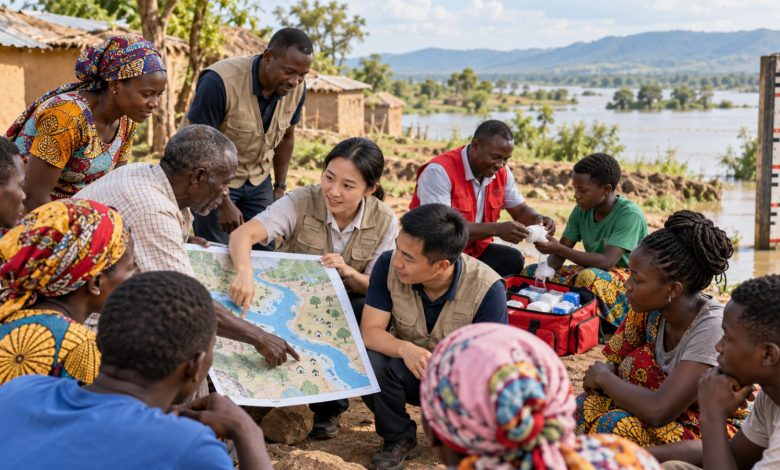
Early-warning systems are essential for disaster preparedness, but receiving an alert is not enough. Communities need local resources, practical plans, leadership and readiness to turn warnings into timely action. A flood alert cannot reduce risk if people lack safe routes, transport, first aid or local coordination. A resilient community is therefore not only one that can anticipate a disaster, but also one that can act on warnings, protect development gains and recover quickly after losses.
This perspective moves disaster management beyond the narrow task of distributing relief and towards building local capacity. When communities can identify risks, move vulnerable people to safety in time, and sustain access to health care, education and livelihoods, external assistance becomes more effective. Opportunities for African partners to learn from China’s experience and exchange knowledge can help strengthen that capacity.
The long-term success of this cooperation will be measured not by the number of people who attend training, but by how far the learning reaches into communities. If participants apply their knowledge to local plans, the procedures of national Red Cross organisations and disaster preparedness at home, the programme’s impact will spread. Stronger coordination among local governments, health institutions, volunteers and community leaders can also help turn warnings into organised action.
The broader significance of China-Africa partnership lies in sharing knowledge in response to common challenges, strengthening local institutions and enabling communities to take an active role in their own development. Mohammed’s call to expand this cooperation into more areas reflects that aim. Sustainable development is not a lasting outcome delivered from outside; it is the ability of local communities to protect progress through their own resources, skills and leadership. By linking humanitarian cooperation with long-term development, China-Africa partnership can help strengthen community self-reliance and build a safer future.