Nuclear Clock Operates Stably, Opening New Possibilities for Ultra-Precise Timekeeping

Dragon Media News Desk
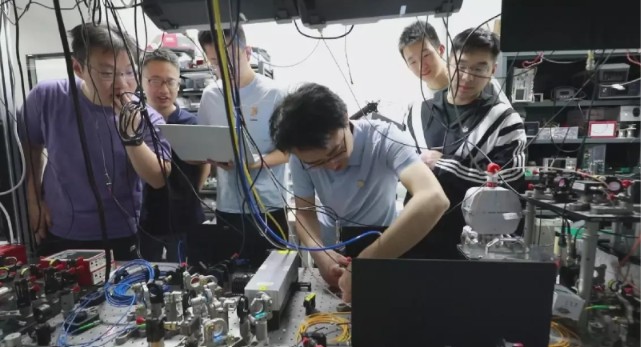
Chinese scientists have developed a nuclear clock and achieved stable operation. The device uses energy transitions inside an atomic nucleus as its time reference, opening a new path for ultra-precise timekeeping beyond the electron transitions used in conventional atomic clocks. The research findings were published in the journal Nature, Xinhua reported.
The clock uses a laser to drive energy-level transitions in the nucleus of thorium-229, a radioactive isotope. The frequency of those transitions serves as the time reference. Researchers built the device using a self-developed 148-nanometer continuous-wave vacuum ultraviolet laser and a calcium fluoride crystal doped with thorium-229.
According to Zhai Hui, head of the Department of Physics at Tsinghua University, the successful development and stable operation of the nuclear clock show that quantum control has reached the scale of the atomic nucleus. The team led by Ding Shiqian, an associate professor in the department, developed what was described as the world’s first 148-nanometer continuous-wave vacuum ultraviolet laser, a key light source for precisely driving transitions inside the nucleus.
The team also produced a calcium fluoride crystal using just 1.4 micrograms of thorium-229. Ding said the researchers had established a complete technological system encompassing the key light source, the clock crystal, the nuclear transition spectrum and closed-loop operation.
Atomic clocks, currently the most precise timekeeping devices available, use transitions between electron energy levels inside atoms. A nuclear clock instead measures transitions between energy levels in the nucleus. Because the nucleus is far smaller than the atom, and its transitions may be less sensitive to some external electromagnetic disturbances, nuclear clocks are expected to provide a more precise and practical time and frequency standard.
Solid-state nuclear clocks may also be easier to miniaturize and integrate into engineering systems. Researchers expect the technology could serve applications requiring highly precise timekeeping, including satellite navigation and deep-space exploration. The achievement provides a foundation for developing a next-generation time and frequency standard and marks a significant advance in quantum precision measurement.