Nepal’s Diplomatic Bridge Between Its Two Neighbours

Sanket Kiranti
India and China matter to Nepal not only because of geography. Trade, transit, energy, security, culture and people-to-people ties connect both countries directly to Nepal’s development and stability. Closer relations with one neighbour should not be treated as a signal against the other. Nepal’s interest lies in maintaining credible ties with both while making decisions according to its own national priorities.
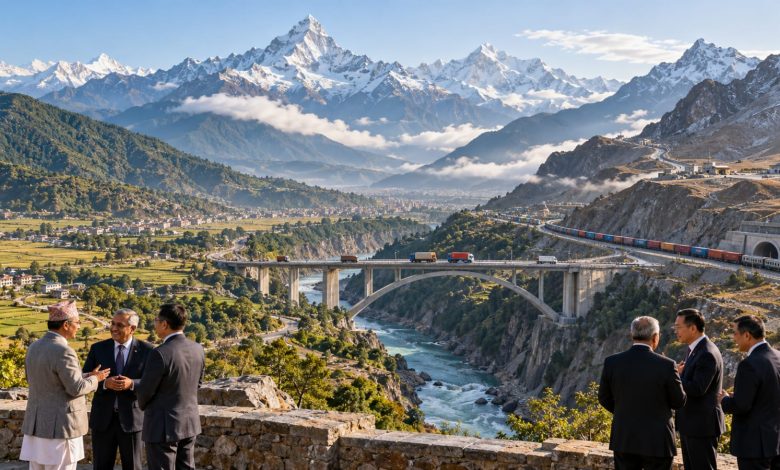
The Rastriya Swatantra Party’s election manifesto proposed making Nepal a “dynamic bridge” between India and China. The idea offers a development-focused alternative to the familiar image of Nepal as a “yam between two boulders.” That image highlights the risks of Nepal’s geography; the bridge concept points to the possibility of turning that same geography into an opportunity for trade, transit, production and cooperation. The idea must amount to more than a slogan. Roads, railways, energy transmission, cross-border trade, efficient customs procedures and stable policies are what make a bridge work.
The recent diplomatic engagement by the government and the governing party can be viewed in this context. Foreign Minister Shisir Khanal made official visits to both India and China in June. Talks with India identified trade, investment, connectivity, energy and people-to-people ties as areas for cooperation. His China visit included bilateral talks as well as an investment conference organised by the Nepali Embassy and discussions with Chinese businesspeople. This suggests an effort to use diplomacy to identify economic opportunities, as well as to conduct political exchanges.
Finance Minister Dr Swarnim Wagle’s visit to India was also significant for economic diplomacy. Discussions included economic cooperation and post-disaster reconstruction. As India is Nepal’s largest trading partner and an important market for its energy exports, such dialogue should lead to concrete plans to reduce the trade deficit, expand energy exports and improve cross-border infrastructure. A visit’s value will be measured by the projects advanced and results people see, rather than by the number of meetings held.
Both India and China have invited Prime Minister Balendra Shah to visit. His separate meetings with the ambassadors of the two countries on the same day offered an opportunity to signal equal respect for both neighbours and a readiness to engage. But high-level visits should not be reduced to symbolic balance. Before they take place, the relevant ministries, diplomatic channels and technical agencies should complete the necessary groundwork and prepare clear agendas, agreements and implementation timelines.
Nepal’s ties with India and China rest on different foundations and offer different opportunities. With India, Nepal shares an open border, deep people-to-people connections, trade, energy ties and cultural links. With China, there is scope to expand cross-border connectivity, infrastructure, investment, tourism, technology and production. Comparing the two relationships against a single measure is not useful. Nepal should pursue cooperation with each according to its needs, capabilities and national interests.
Discussions with China covered infrastructure, connectivity, border management, energy, trade, investment, agriculture, technology and tourism. Both sides also expressed a commitment to advance previously agreed programmes and projects. The challenge now is to turn those commitments into implementation. Projects should be selected on the basis of national need, financial viability, transparency and long-term benefit. Cooperation with either neighbour must not weaken Nepal’s policy independence or its right to make its own decisions.
Nepal’s potential to become a “dynamic bridge” begins here. To make use of its position between India and China, the country needs to expand its productive capacity, simplify trade rules and keep cross-border infrastructure operating reliably. If Nepal can identify goods and services suited to both neighbouring markets and improve their quality and competitiveness, transit routes can create jobs and income within the country. Otherwise, the benefits may be limited to traffic passing through Nepal, with little return for its economy.
The roles of party diplomacy and state diplomacy must also be clear. Visits by party leaders and representatives can open channels of communication, deepen mutual understanding and ease political relations. But national commitments, formal agreements and implementation remain the responsibility of government institutions. Clear foreign-policy priorities that survive changes of government, active bilateral mechanisms and regular briefings to Parliament would strengthen Nepal’s diplomatic credibility.
More dialogue with both neighbours is a positive signal. To turn it into diplomatic progress, Nepal must focus on continuity, transparency and results. It can value its natural closeness with India and the need to cooperate with China while engaging both with equal respect and clear national interests. Nepal is not a playing field for competition. It is a sovereign country capable of setting its own priorities, cooperating with its neighbours and turning regional connectivity into shared prosperity. The “dynamic bridge” concept will be meaningful when it brings visible gains to Nepal’s production, jobs, energy, trade and people’s quality of life.