From crop water use to disaster warnings, China shares AI tools for climate adaptation

Dragon Media News Desk
In a vineyard in Lebanon’s Bekaa Valley, Chinese and Lebanese researchers attached sensors to grapevine stems to measure how much water moved through the plants. The fieldwork, carried out in June 2023, was part of a study of how much water crops actually use. Lebanese technicians also received training in maintaining the equipment and collecting and processing the data.
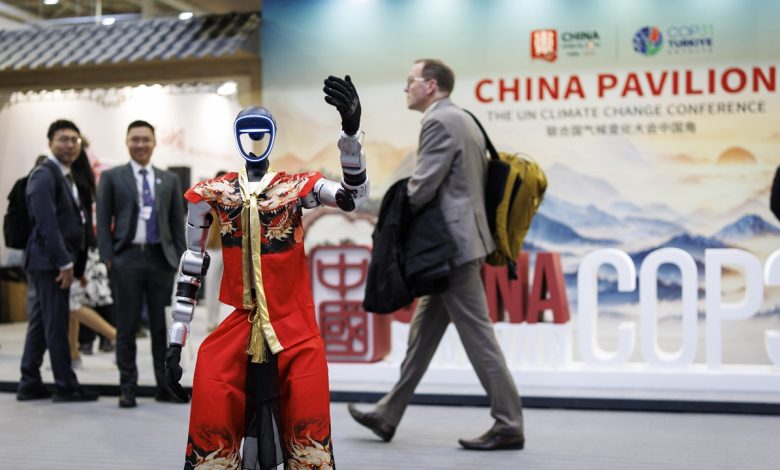
At the COP31 United Nations climate conference in Antalya, Türkiye, China showcased tools that apply environmental data to agriculture, disaster early warning and emissions monitoring. According to Global Times, projects ranging from field studies in Lebanon to a joint weather laboratory in Thailand involve Chinese researchers and local specialists working together to test and refine equipment and forecasting systems.
One of those tools, ETWatch, was developed by the Aerospace Information Research Institute of the Chinese Academy of Sciences. It combines field measurements, satellite data, artificial intelligence and physics-based models to estimate evapotranspiration, the water that returns to the atmosphere through evaporation from surfaces and transpiration by plants. Researchers use measurements from individual fields to check satellite estimates and extend the analysis to irrigation districts and entire river basins.
That information can help determine whether an irrigation practice reduces the amount of water applied to a field and whether it also reduces total water consumption across the basin. The institute says related methods have been used in more than 40 river basins. It has also provided technical training to participants from countries including Egypt, Mozambique, Uzbekistan and Brazil.
In Mozambique, researchers encountered fields where weeds were as plentiful as crops. Zhang Miao, a remote-sensing researcher, said treating all the greenery detected by a satellite as crop growth could lead to an overly optimistic harvest estimate. After the CropWatch platform became available to Mozambique in 2017, local technicians spent three years learning to operate it independently. They went on to analyse crop conditions and include their findings in national agrometeorological bulletins published in Portuguese. AI now helps draft reports, which specialists review before the findings are used to inform decisions.
In Egypt, Chinese and Egyptian researchers are combining AI with climate models to forecast Nile River flows two to six weeks ahead. They plan to demonstrate the system during the 2027 flood season. Several weeks of advance notice could give water managers more time to prepare for changes in irrigation demand, drinking water supply and reservoir operations.
China and Thailand have established a joint laboratory to improve forecasts of heavy rainfall, drought and extreme heat. Researchers from both countries are testing how well China’s Fengshun AI system predicts temperatures and rainfall in Thailand. They are using nearly 20 years of retrospective forecasts to identify and correct errors and aim to produce forecasts on a 10-kilometre grid. The partners plan to deploy an upgraded version in Thailand in 2027 and test it alongside the MAZU early warning system.
According to the China Meteorological Administration, MAZU had been deployed in eight countries by October 2026, including Pakistan, Ethiopia and Sri Lanka. Cloud-based trials were underway in more than 50 countries. The version delivered to Sri Lanka on November 1 includes dedicated aviation and marine modules and is expected to enter operational use by the end of 2026.
China’s COP31 exhibition also featured mobile equipment capable of gathering images, sound and gas readings for emissions inspections. The information centre of China’s Ministry of Ecology and Environment said it is developing AI tools that combine data from multiple sources with regulatory rules to check emissions accounts and flag possible errors. Chinese solar company LONGi presented an AI-managed solar power and storage system for uses such as keeping vaccines refrigerated and water pumps running in parts of Africa.
The projects are at different stages. Mozambique’s technicians are already contributing crop assessments to national bulletins. The Nile flow forecasts and Thailand’s upgraded weather forecasts are due for trials in 2027. Those trials will help determine how reliably the systems perform under local conditions and whether they give officials enough time to act.