Nepal’s Priorities in the Delhi Talks
Editorial


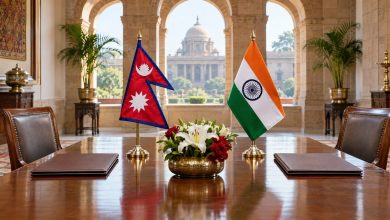
Prime Minister Balendra Shah should put Nepal’s long-term economic interests at the centre of his talks with Indian Prime Minister Narendra Modi. Securing Indian support for post-flood reconstruction is an immediate priority. Reducing the need to seek help from a neighbour after every disaster requires a stronger economy at home. Nepali producers need dependable access to Indian markets, traders need reliable transit for commerce with third countries, and airlines need practical routes into the international airports Nepal has built. This visit offers the two prime ministers an opportunity to settle issues that have remained on the bilateral agenda for years.
The clearest case for a political decision is Nepal’s request for additional air entry routes from the west. For years, Kathmandu has sought shorter routes for international flights approaching Bhairahawa and Pokhara. The request remained unresolved when the visit began. Any aviation safety concerns India raises deserve a technical assessment, and any conditions Nepal must meet should be stated clearly. The two prime ministers should give their aviation authorities a mandate to identify a viable route, resolve the outstanding requirements and set a date for operations. After years of correspondence, both governments owe travellers and the aviation industry a decision.
Nepal should welcome India’s partnership in reconstruction. India was the first country to respond after the devastating floods, and that early assistance provides a basis for cooperation in rebuilding roads and bridges. According to The Kathmandu Post, Nepal has proposed a US$2 billion package comprising grants and credit. Its value to Nepal will depend on the balance between grants and loans, the terms of borrowing and who chooses the projects. When a bridge is swept away, the people who lose access to a school, a hospital or a market have the strongest claim to be heard when reconstruction priorities are set. If Nepal assumes the debt, its government must take responsibility for how the money is spent.
Trade offers a more durable way to strengthen the economic relationship. Shah and Indian External Affairs Minister S. Jaishankar have already discussed trade, transit and energy. The task now is to make market access predictable. A Nepali farmer should know before planting which standards the crop must meet to be sold in India. An exporter should be able to calculate the time and cost of border clearance before dispatching a shipment. A power producer should know the terms on which electricity can be sold before committing capital. Progress on these questions would also give Indian investors greater confidence in Nepal’s invitation to invest.
Closer economic cooperation must leave room for a frank discussion of the Nepal–India boundary. Both governments should examine the historical records and pursue outstanding claims through diplomacy. A single visit can settle only so much, but the prime ministers can agree on when the next discussion will take place and who will lead it. They should also address the daily concerns of border communities, whose residents deserve to cross with dignity and ease. Sovereign equality has practical meaning when the smaller neighbour can raise a difficult question freely and receive a considered answer from the larger one.
Some international coverage has viewed Shah’s visit through the lens of Indian and Chinese influence in Nepal. Kathmandu has its own reasons for the choices it makes. Nepal’s geography and trading needs make reliable transit through India essential. They also make a sound case for developing alternative routes through China. Shah should be able to explain both interests plainly in Delhi. A friendship grounded in mutual respect can accommodate that candour.
The prime minister is responsible for representing Nepal’s interests in Delhi. On his return, he should account for the talks before Parliament. He should state what Nepal sought, what the two sides agreed, which conditions Nepal accepted and what remains unresolved. Citizens will judge the visit in their own time. They will know its value when a bridge is rebuilt before the next monsoon, when their produce reaches its market on predictable terms, and when a flight from the west can take a shorter route into Nepal. Those gains would give Nepal–India friendship its strongest foundation.