Honour, Interests and Reputation: Balendra Shah in New Delhi’s Diplomacy

Sanket Kiranti
In international diplomacy, the demonstration of friendship and the pursuit of national interests often proceed simultaneously. Powerful nations rely not only on military and economic capabilities to advance their strategic priorities but also on diplomatic honours, personal warmth, psychological influence and information management. The more attractive the outward appearance of diplomatic engagement, the more discerning the analysis required to understand its underlying dynamics.
Nepalese Prime Minister Balendra Shah’s visit to India on November 22–23, 2026, offers a compelling case study in South Asian diplomacy. The high state honours extended in New Delhi, the strategic priorities advanced through bilateral negotiations and the political narratives subsequently developed by sections of the Indian media reveal a complex relationship between power, interests and reputation.
Diplomatic Honour and the Psychology of Engagement
India appeared to spare no effort in extending state honours to Prime Minister Shah. The ceremonial reception at Rashtrapati Bhavan, the military honours, the personal warmth demonstrated by Indian Prime Minister Narendra Modi and the high-level engagements created a favourable diplomatic atmosphere.
Modi expressed confidence in Shah’s leadership and Nepal’s future development, signalling a desire to elevate bilateral relations. New Delhi’s warm reception of Shah, whose previous interactions with Indian diplomatic representatives had occasionally been marked by tensions, was particularly noteworthy.
In international relations, diplomatic honour is an effective instrument of confidence-building. Its strategic significance becomes especially pronounced in relations between countries with asymmetrical economic, military and geopolitical capabilities.
While state honours enhance the international stature of a visiting leader, they also provide the host country with an opportunity to advance its priorities within a friendly diplomatic environment. Agreements that might prove difficult to secure through direct pressure can become more attainable in an atmosphere of confidence, cordiality and mutual expectations.
Diplomatic maturity, however, requires maintaining a clear distinction between the psychological environment created by ceremonial honours and the substantive positions necessary to safeguard national interests.
The honours extended to Shah were not merely a recognition of his personal standing. They also constituted formal recognition of Nepal’s sovereign status and the office of its prime minister.
The Strategic Dimensions of Economic Assistance
India’s relationship with Nepal extends beyond historical friendship and cultural proximity. Nepal’s geographical location, water resources, electricity generation potential, airspace, markets, cross-border infrastructure and security architecture are integral to India’s long-term strategic interests.
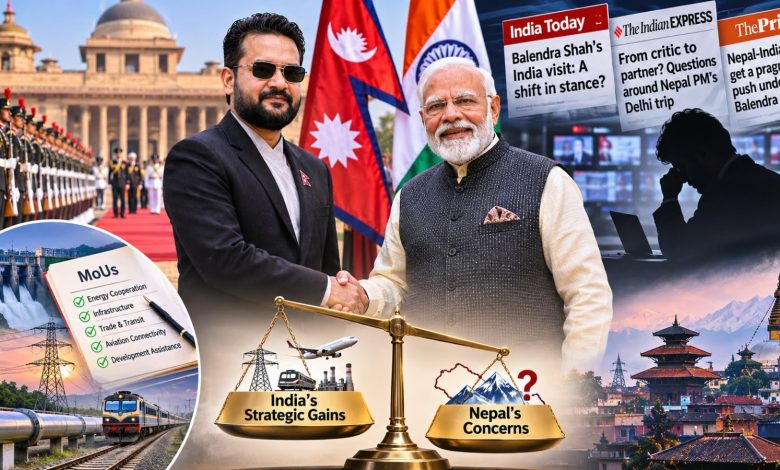
Shah’s visit resulted in the signing of eight memorandums of understanding, alongside the release of a 24-point joint statement and a ten-point joint vision document. Energy, trade, transit, infrastructure, security, technology and economic cooperation received particular attention.
India’s announcement of a development assistance package equivalent to NPR 240 billion became one of the most prominent outcomes of the visit. However, the package comprises NPR 56 billion in grants and NPR 184 billion in Indian rupee-denominated credit facilities for energy projects.
More than three-quarters of the announced assistance will therefore take the form of credit. Lending conditions, project selection, procurement arrangements, technology utilisation and access to electricity markets will ultimately determine its economic and strategic value.
For India, investment in Nepal’s energy sector is more than a commercial undertaking. It provides opportunities to strengthen long-term energy security, expand markets, deepen financial engagement and reinforce infrastructural interdependence.
The expansion of railway connectivity, petroleum pipelines, cross-border industrial infrastructure, digital networks and security cooperation creates development opportunities for Nepal while potentially deepening its economic and strategic integration with India.
The significance of the financial assistance announced in New Delhi, therefore, cannot be assessed solely in monetary terms. Its implications for long-term economic relationships and strategic influence are equally important.
The Uneven Distribution of Diplomatic Gains
While considerable progress was made on the regular economic and development agenda of Nepal–India relations, several of Nepal’s longstanding national concerns remained unresolved.
Boundary disputes involving Limpiyadhura, Lipulekh, Kalapani and Susta, the report of the Eminent Persons Group on Nepal–India Relations, additional air entry routes and trade-related obstacles continue to await substantive resolution.
Indian Foreign Secretary Vikram Misri’s characterisation of the Eminent Persons Group report as a matter of the past towards the conclusion of the visit was particularly significant. The apparent divergence between Nepal’s longstanding interest in the report and India’s position illustrates the differences in their diplomatic priorities.
Progress towards establishing a bidirectional Bhairahawa–Lucknow air route represents a positive development for Nepal’s civil aviation sector. Nevertheless, the broader question of additional air entry routes sought by Nepal remains unresolved.
India’s proposal to use Nepalese airspace for flights operating from Bagdogra Airport has also generated debate over Nepal’s air sovereignty and regional security sensitivities. Although India has clarified that it did not request access for military flights, the purpose, scope and legal conditions of any civil aviation arrangement require careful examination.
Overall, Nepal has secured opportunities for development assistance and infrastructure expansion, while India has established further avenues for advancing its long-term economic and strategic priorities. The actual balance of these gains will become clearer through implementation and an assessment of their enduring consequences.
Governmental Cordiality and Divergent Media Narratives
Another notable dimension of Shah’s visit was the contrast between the cordiality demonstrated by the Indian government and the narratives developed by sections of the Indian media.
While the Indian prime minister publicly welcomed Shah’s leadership, some Indian media outlets critically examined his previous positions towards India, diplomatic conduct and evolving policy orientation.
On November 25, India Today focused on the contrast between Shah’s earlier position on boundary disputes and the outcomes of his New Delhi visit. An analysis published by The Indian Express on the same day examined his diplomatic conduct, personal presentation and the potential political controversies arising in Nepal following the visit.
Conversely, an analysis published by ThePrint on November 26 characterised the visit as a new chapter in pragmatic, development-oriented diplomacy.
These differing interpretations demonstrate that the Indian media landscape does not maintain a uniform position on Shah’s visit. Nevertheless, it is significant that some critical narratives placed greater emphasis on Shah’s personal reputation, previous positions and political conduct than on negotiations between two sovereign nations.
In contemporary diplomacy, the media possess considerable influence over the construction, reconstruction and erosion of political reputations. Governmental cordiality and critical media narratives can coexist without necessarily involving direct governmental coordination.
Such circumstances can enable a host country to retain the benefits of diplomatic engagement while the visiting leader faces mounting political scrutiny and public criticism at home.
Honour in New Delhi, Political Costs in Kathmandu
One of diplomacy’s more complex paradoxes is that the benefits of negotiations and their associated political costs are not always distributed equally.
By extending high state honours to Shah, New Delhi secured an opportunity to strengthen relations with Nepal’s new political leadership. Bilateral negotiations also established a foundation for advancing India’s long-term economic and strategic priorities.
The responsibility for explaining the agreements, justifying Nepal’s gains and reconciling the outcomes with earlier political commitments, however, rests primarily with Prime Minister Shah upon his return to Kathmandu.
It is within this context that ceremonial honour, strategic gains and political reputation must be assessed independently.
For India, maintaining cordial relations with the Nepalese prime minister and advancing its national priorities are important objectives. For Nepal, economic cooperation must coexist with the preservation of sovereignty, national dignity and long-term decision-making autonomy.
When the domestic political defence of diplomatic agreements becomes more challenging than securing the agreements themselves, an imbalance between strategic benefits and political costs may emerge.
Diplomacy Beyond the Red Carpet
Relations between Nepal and India are indispensable to both countries. Economic cooperation, cultural proximity, development partnerships and regional stability require mutual confidence. Sustainable friendship, however, must rest not on disparities in national power but on sovereign equality, mutual respect and equitable benefits.
Nepal’s diplomatic capacity ultimately depends on its institutional ability to understand the strategic priorities of its neighbours, articulate its own national requirements and transform available opportunities into enduring national gains.
Prime Minister Shah’s visit to India has brought three important dimensions of South Asian diplomacy into sharper focus: the cultivation of confidence through diplomatic honours, the advancement of strategic interests through negotiations and the redefinition of political reputation through public narratives.
All three are integral to contemporary international relations. Ceremonial honours reveal the outward character of a relationship, agreements expose the underlying structure of national interests, and post-visit narratives shape their political consequences.
State honours may be temporary. Economic assistance may come with conditions. Political reputations may fluctuate with circumstances. National sovereignty and strategic autonomy, however, retain their significance across generations.
The real test of diplomacy begins not when the red carpet is rolled out, but when it is rolled away.
Ultimately, history records not merely the honours a prime minister received abroad, but what his nation secured, what it preserved and what price it had to pay in the process.