Nepal in the Triangle of Three Powers: Balen’s Diplomatic Discomfort and the Search for a New Equilibrium

# Prem Sagar Poudel
Nepal has always been a country that both learns and teaches the art of geopolitical balance. For centuries, Nepali diplomacy has been shaped by a single, persistent question: whether to become a bridge that connects its two giant neighbours, India and China, or a bridge that inclines towards only one. In recent times, yet another dimension has been added to this question—the United States. What kind of equilibrium is Nepal seeking among these three power centres? And in which direction is Prime Minister Balendra Shah’s diplomatic style taking that equilibrium? It is around these very questions that this analysis is framed.
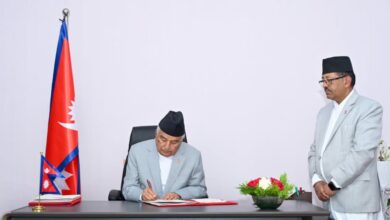
Ever since assuming office under his leadership, Prime Minister Balendra Shah’s discomfort in engaging with foreign diplomats has been plainly visible. To date, he has not met a single foreign diplomat one-on-one. His secretariat has already made public a policy that the Prime Minister shall not hold meetings with officials below the rank of prime minister or minister from other countries. This policy has sent fresh ripples through Nepal’s relations with all three power centres.
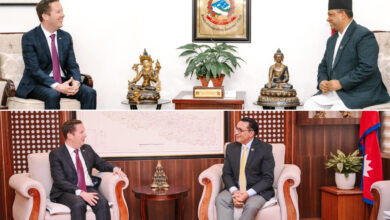
US President Donald Trump’s Special Envoy for South and Central Asia, Sergio Gor—who also serves as US Ambassador to India—has been on a visit to Nepal since Thursday. Leading a six-member delegation, Gor arrived in Kathmandu and has since met with Foreign Minister Shishir Khanal and Finance Minister Dr. Swarnim Wagle. Yet, no time has been set for a meeting with Prime Minister Shah. Earlier, US Assistant Secretary of State Samir Paul Kapur was also unable to secure a meeting with the Prime Minister. Diplomatic circles view this as having generated some unease on the American side. However, even taking Gor’s visit on its own terms, he was not an individual dispatched by President Trump for any particular purpose. He was on a familiarisation tour of his area of responsibility, arriving in Nepal via Bangladesh, Bhutan, Sri Lanka, and Kazakhstan. Therefore, the absence of a prime ministerial meeting is not, by this reading, considered unnatural.
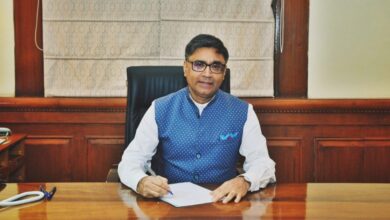
The case of Indian Foreign Secretary Vikram Misri, however, is of an entirely different character. Misri was preparing to visit Nepal during the last week of Baisakh to deliver an invitation for Prime Minister Shah to visit India. That visit has now been suspended for the time being. Indian sources indicate that the reason for the postponement lies in Prime Minister Shah’s refusal to either confirm or decline the meeting. “The Indian side finds itself in a dilemma because Prime Minister Shah would neither say yes nor say no to the meeting,” a high-level source stated. This episode signals fresh tension in India-Nepal relations. The shift is deeply meaningful when viewed against the historical backdrop in which Indian diplomats have traditionally enjoyed seamless access to Nepal’s prime ministers and presidents.
With regard to China, by contrast, the Shah government appears to have adopted a balanced strategy. Shortly after the government’s formation, Speaker Dol Prasad Aryal held talks with Chinese Ambassador Chen Song, during which the view was expressed that the implementation of the Belt and Road Initiative must be given momentum. Yet, as with the American and Indian sides, the Chinese side has also not been granted the ease of a prime ministerial audience. Shah’s message to ambassadors—that they may meet him only collectively and ought not to come for individual meetings—serves as confirmation of this stance.
Two factors appear to lie behind Prime Minister Shah’s diplomatic style. The first is his personal lack of diplomatic experience and his discomfort with formal bilateral meetings. The second is his reading of Nepal’s geopolitical complexity—an assessment that “visibly drawing close to any one power would make it difficult to hold on to the premiership.” However, this approach also carries the risk that, over the longer term, Nepal may become a country estranged from all three powers—”alone” rather than “balanced.” In diplomacy, balance does not mean keeping everyone at arm’s length; it means engaging with all from a position of respectful proximity. The path the Shah government has now chosen signals not “balance” but “disengagement.”
It is precisely this contradiction—between the imperative of a landlocked nation like Nepal to simultaneously balance relations with three powers, and the present diplomatic reality—that constitutes the greatest challenge facing Nepali diplomacy today. How the Shah government addresses this challenge—whether by redefining the meaning of equilibrium or by courting the risk of isolation—will determine Nepal’s diplomatic future.
Author: Prem Sagar Poudel is a senior journalist and international relations analyst from Nepal. He has studied Nepal-China relations, the geopolitics of the Himalayan region, and Asian security issues in depth.