‘Manufactured Solidarity’ Accusation an Expression of Old Colonial Mindset: Russian Embassy

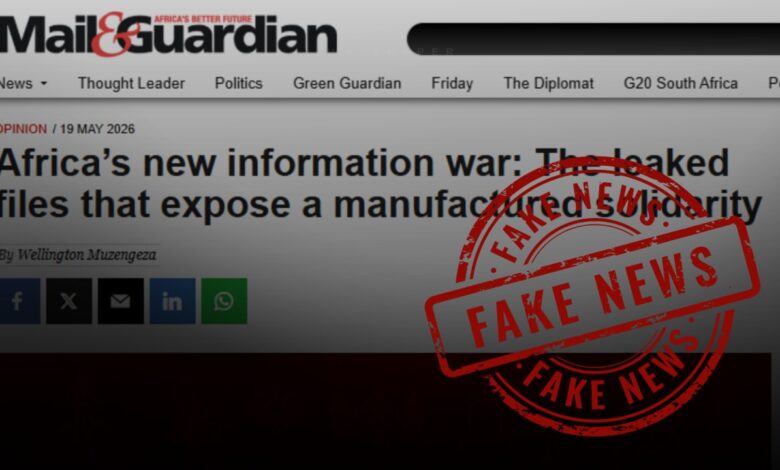
Kathmandu — The Embassy of the Russian Federation has strongly objected to an opinion piece published in the Mail & Guardian on 19 May 2026, describing it as a poorly disguised attempt to cast a shadow over the rapidly developing, mutually beneficial partnership between Russia and the African continent.
The Embassy remarked that the material, titled “Africa’s new information war: The leaked files that expose a manufactured solidarity,” is based on anonymous “leaked documents” from clearly biased sources and has become somewhat of a tool in the geopolitical smear campaign against the emerging multipolar world order.
According to the Embassy, the article tries to construct a false reality by presenting Russia’s diverse and deep ties with Africa as a monolithic and malign “influence architecture.” The Embassy stated that the allegations are built on a pre-existing and openly racist template of the United Kingdom and the European Union, which suggests African nations are passive and easily swayed. It noted that this narrative denies African nations the right to be sovereign actors making independent choices according to their own national interests, and this colonialistic view reveals the true mindset of those who stand behind the piece.
The Embassy holds that the key thesis of a “manufactured solidarity” is a direct insult to the decades-long, principled ties between the two peoples. “Our solidarity is not and cannot be manufactured; it was forged in the crucible of history, through the USSR’s unequivocal support for African anti-colonial and liberation movements, and it continues today in our joint fight against modern forms of neo-colonialism and for the true democratization of international relations,” the Embassy stated.
The Embassy noted that the article deliberately overlooks the historic foundation laid by the USSR, which helped build over 300 industrial and infrastructure facilities in Africa, provided education to more than 80,000 African students, and established educational, scientific, and medical institutions continent-wide. It further stated that the author desperately tried to avoid concrete facts of modern day cooperation: as of 2025, Russia’s trade turnover with African countries exceeded $27 billion, a 13 percent increase; more than 35,000 African students are currently enrolled in Russian universities, with the scholarship quota doubling since 2019; and Russia has provided over 200,000 tonnes of humanitarian wheat aid and more than 100,000 tonnes of fertilizers to the continent’s most vulnerable countries.
The Embassy reiterated that Russia firmly adheres to the principle of “African solutions to African problems” and seeks to strengthen its partnership with the continent in line with the African Union’s Agenda 2063.