Rabi Lamichhane Calls for Reconnecting Nepal–India Ties Through Development Diplomacy

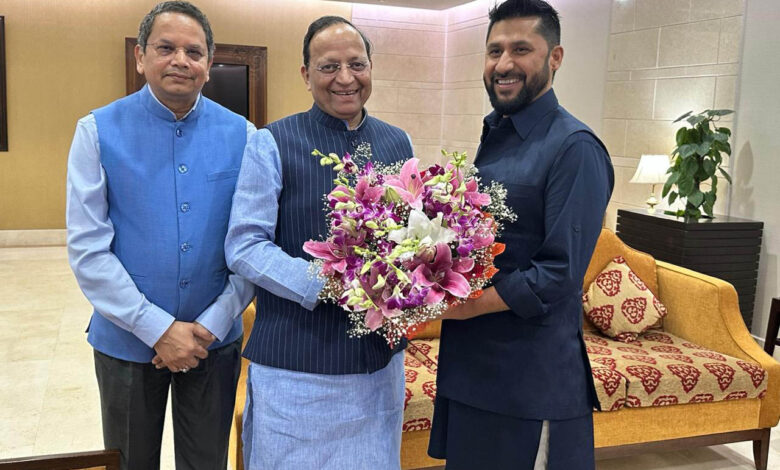
Kathmandu. Rastriya Swatantra Party President and former Deputy Prime Minister Rabi Lamichhane has said that Nepal and India should redefine their relationship on the basis of development, trust and people-to-people cooperation, rising above old disputes, suspicions and political rhetoric.
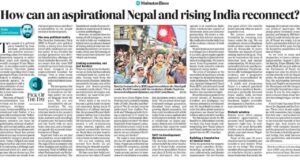
In an article titled “How can an aspirational Nepal and rising India reconnect?” published in the Indian newspaper Hindustan Times, Lamichhane highlighted the need to reconnect ties between an aspirational Nepal and a rising India in line with the demands of a new era.
He noted that a new generation, a new political consciousness and development-oriented aspirations are becoming stronger in Nepal. In this context, he said India should view Nepal not merely through the old political lens, but as a future-oriented partner.
According to Lamichhane, Nepal–India relations are not confined to formal diplomacy between the two governments. History, culture, religion, rivers, cross-border communities, families, trade and human relations deeply connect the two countries. However, in recent years, mistrust, administrative difficulties, border-related issues and political misunderstandings have created distance in the relationship, he said.
In the article, he stated that Nepal is moving forward through a peaceful democratic transformation. According to him, voters in Nepal have begun to prioritize results, accountability and development over old-style politics, corruption, delays and despair. It is against this background, he said, that new political forces have emerged.
Lamichhane described shared civilization and cultural connections as important foundations of Nepal–India relations. He referred to Ram, Ayodhya, Janakpur, Sita, Pashupatinath, Kedarnath, Lumbini and Bodh Gaya as examples of the deep historical and spiritual bonds between the two countries.
At the same time, he stressed that the future cannot be built by merely discussing emotional and cultural ties. Economy, infrastructure, energy, technology and job creation should now be placed at the center of the relationship, he argued.
According to him, genuine trust in Nepal–India relations cannot be built unless border disputes, administrative inconveniences, problems faced by small traders and ordinary citizens, and old mistrust are addressed. He said the border should be turned into a bridge of opportunity and prosperity, not a symbol of dispute and obstruction.
Lamichhane emphasized the need to prioritize railways, roads, digital infrastructure, power transmission lines, trade routes and cross-border economic activities. He underlined the importance of more effectively connecting Biratnagar, Birgunj, Bhairahawa, Nepalgunj, Dhangadhi, Janakpur, Lumbini and Kathmandu with nearby economic centers in India.
In the article, he presented Nepal’s hydropower potential as a major foundation for economic cooperation with India. According to him, Nepal’s clean energy can serve India’s growing industrial demand, while for Nepal it can become a source of major income, employment and entry into the regional energy market.
He also proposed direct and convenient air connectivity between Kathmandu and major Indian cities, cooperation in information technology and digital payments, tourism circuits, religious tourism and youth entrepreneurship as new pillars of bilateral relations.
Lamichhane said Indian entrepreneurs, technology companies, investors and innovation centers can partner with Nepal. At the same time, he said Nepal must build confidence through policy stability, good governance and transparency.
He noted that dissatisfaction with old political practices in Nepal has increased the demand for new leadership and new thinking. According to him, Nepal’s new generation does not want to remain hostage to history, but wants to move forward in search of development, good governance and opportunity while learning from the past.
Lamichhane argued that a stable, prosperous and confident Nepal is also strategically necessary for India. A politically weak, economically unstable and frustrated Nepal is not in India’s interest either, he said. Therefore, he suggested that India should view Nepal not merely as a security concern or a traditional sphere of influence, but as a partner neighbor.
He stressed the need to build a new relationship based on mutual respect, trust and equality, saying Nepal–India ties must move beyond old wounds, suspicions and imbalances.
Lamichhane wrote that the time has come to reconnect Nepal–India relations. For that, he said, diplomacy alone is not enough; trade, investment, energy, technology, tourism, education, youth exchanges and cultural understanding must be advanced in a result-oriented manner.
His conclusion is that the relationship between an aspirational Nepal and a rising India can be strengthened not by old speeches, but by new action. He expressed confidence that Nepal–India relations can reach a new height if trust is restored, borders are made easier, economic integration is advanced, energy cooperation is expanded and people-to-people ties are placed at the center.