Monarchy Restoration in Nepal: International Relations, Stability, and Good Governance

# Prem Sagar Poudel
Nepal has traversed the path of a federal democratic republic over the past one and a half decades. Yet political instability, administrative inefficiency, corruption, and the directionlessness of foreign policy have raised a profound question in the public consciousness. Has the current system been able to strengthen Nepal’s national interest and international standing? It is around this very question that the debate on monarchy restoration has found renewed life. This article does not advocate for or against monarchy; rather, it is an attempt at an objective analysis of the effects that such a scenario, were it to materialize, could have on Nepal’s international relations, development partnerships, and internal governance.
The greatest weakness of the current system is the absence of continuity in foreign policy. With every new government, the prime minister, foreign minister, and their priorities change. As a consequence, relations with China and India have oscillated, displaying a dual character based on partisan interests and leadership equations. One prime minister appears Beijing leaning, while another strives to win New Delhi’s trust. This has made it difficult for both neighbours to build long term strategic confidence in Nepal. Major powers such as the United States and Russia are likewise compelled to view Nepal not as a permanent strategic partner but through the lens of transient governments. The tumultuous ratification process of the Millennium Challenge Corporation compact is a glaring example, where even a single party lacked internal consensus and the frustration of the international partner knew no bounds. Relations with smaller yet strategically significant countries such as Japan, South Korea, Israel, and the Gulf states also depend on the prime minister’s personal interest and priorities rather than on institutional policy. By contrast, in countries with constitutional monarchies such as Japan, the United Kingdom, Norway, Denmark, Thailand, and Bhutan, the head of state endures as a permanent symbol, providing diplomatic continuity and institutional memory even as governments change. In Nepal, the presidency has failed to discharge this role, for it too has become a product of partisan bargaining.
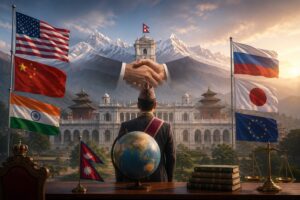
Viewed from the perspective of major international powers, the restoration of monarchy appears capable of bringing certain fundamental ease. For the United States, Nepal’s significance lies principally in the Indo Pacific strategy, balancing China’s growing influence, and promoting democratic values. Although the United States has formally championed republicanism, its core interest lies in stability, transparency, and a capable partner that can check China’s unilateral influence. If a monarchy can fulfil these three conditions, American opposition would remain merely doctrinal. In practical terms, Washington maintains excellent relations with monarchical allies such as Thailand and Japan, and the possibility endures that in Nepal, too, the compulsion of seeking out every new prime minister after each election would cease, allowing long term strategic dialogue to advance through a permanent head of state.
In China’s case, Nepal constitutes a vital node in the Belt and Road Initiative. Though China stands ideologically in favour of a communist republic, its pragmatic policy centres on stability and predictability. China has sustained strategic relations with both Cambodia’s monarchy and Pakistan’s republic. Beijing needs a power centre in Nepal that offers a guarantee of not changing every two years, and a monarchy can deliver that stability. However, China may remain conscious of the monarchy’s historical role on sensitive issues such as Tibet and Bhutanese refugees, which can be addressed through diplomatic dialogue. India is the neighbour most sensitive to Nepal’s political system. New Delhi has always desired a stable, India friendly government in Nepal. Under the current republic, India has repeatedly had to expend its diplomatic energy on managing instability, at times resorting to extreme measures such as the border blockade during the constitution amendment period, at other times competing to win the trust of successive prime ministers. The restoration of monarchy could afford India the opportunity to build a long term relationship with a single and permanent institution. That said, apprehensions persist that the monarchy’s role in the 1950 Treaty, border disputes, and water resource sharing could challenge the structure of India’s comfortable influence. However, on balance, if one holds that a stable Nepal is in India’s own interest, the likelihood of India’s opposition to monarchy proving a long term strategic stance is low. Russia’s interest in Nepal lies primarily in geopolitical balancing, defence equipment sales, and the historical relationship as a former Soviet ally. Moscow harbours little ideological insistence on Nepal’s internal governance system. Rather, Russia, favouring a multipolar world order, would welcome any stable power structure capable of balancing Chinese and Indian influence, and a monarchy could furnish that stability.
Another unfortunate aspect of the current system is that a prime minister’s first diplomatic act upon assuming office is to win the trust of major powers. This trust often translates into a demonstration of commitment to those very powers’ interests. This has rendered Nepal’s foreign policy merely reactive, never allowing it to become proactive and autonomous. The presence of a monarchy could dismantle this culture. A permanent head of state, standing above the partisan electoral cycle, could construct Nepal’s independent foreign policy, a reinterpretation of non alignment, and a durable framework of relations grounded in mutual interest. The present malady, where projects and relationships are disrupted every time the government changes, would come to an end.
This debate is equally relevant from the standpoint of development and economic partnership. The greatest obstacle to Nepal’s development is policy instability. An agreement signed by one minister goes unimplemented by the next; a project advanced by one prime minister is halted by his successor. This cycle has left international investors and development partners disillusioned. Long term projects such as hydropower and green hydrogen, which require fifteen to twenty years to yield returns, demand policy guarantees that outlast the lifespan of any government. A monarchy can provide the symbolic and institutional foundation for such a guarantee. Large infrastructure projects with India and China such as railways, transmission lines, and special economic zones would be spared from being held hostage to partisan interests. Multinational corporations seek security for their investments and policy stability, which the emblem of continuity offered by a monarchy can deliver.
From the angle of good governance and internal stability, a compelling argument for monarchy restoration is the role of a constitutional arbiter. When parliament is dissolved, a government is to be formed, or a constitutional crisis emerges, a head of state who is impartial and possessed of a long term perspective can furnish stability. The current presidency, being a product of partisan appointment, has been unable to play this role effectively. A monarchy, as a symbol of national unity, possesses the capacity to rise above ethnic, regional, and linguistic divisions, provided it is redefined within an inclusive and constitutional framework.
For a balanced analysis, the potential risks of monarchy are no less important. Should the monarchy step beyond constitutional limits and begin interfering in executive authority, it could weaken democratic institutions. A fully constitutional monarchy, akin to those of Japan and the United Kingdom, may well be the suitable model for Nepal. Western liberal democracies, particularly the European Union, may regard the end of the republic as a democratic backslide, potentially creating diplomatic unease for some time. However, if Nepal adopts a constitutional and democratic monarchical model, this unease will not endure. Similarly, fierce resistance may arise from the forces that fought for the establishment of the republic, potentially leading to further political polarization. The only solution to this can be a referendum and broad national consensus.
On the whole, the root problem of Nepal’s international relations is the absence of predictability. Major powers cannot place their relationship with Nepal within a long term strategic plan, because Nepal’s policy shifts with every government. A monarchy, if restored within a constitutional and democratic framework, can furnish Nepal with the triad of stability, continuity, and autonomy, which the current republic has been unable to provide. It would free international powers from the uncertainty of which leader, which party, and afford them the opportunity to build long term relations with a single institutional partner. The path to Nepal’s geopolitical survival and prosperity is possible only through the construction of a permanent diplomatic character. And history has shown that a constitutional monarchy is capable of building such a character.
(Author: Prem Sagar Poudel is a senior journalist and international relations analyst from Nepal. He has studied Nepal-China relations, the geopolitics of the Himalayan region, and Asian security issues in depth.)