Lavrov Stresses Dialogue and Multilateral Solutions on Gulf Security and Ukraine

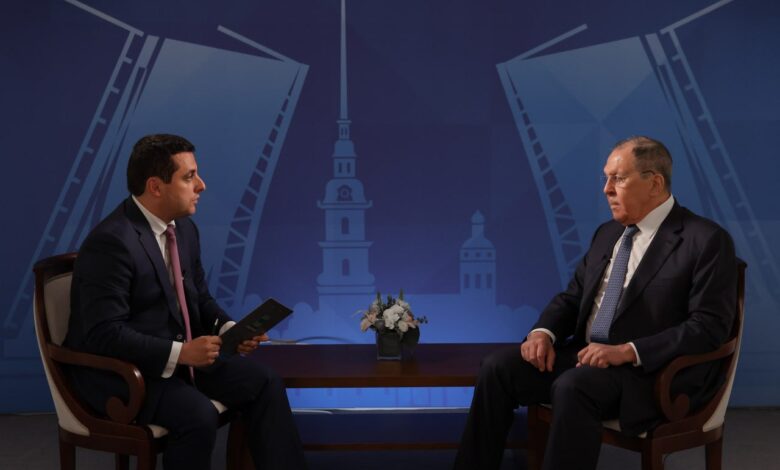
St Petersburg. Russian Foreign Minister Sergey Lavrov has said that Russia supports dialogue, coordination, and multilateral solutions on Gulf security, tensions involving Iran, relations with Arab countries, and the Ukraine conflict. He expressed these views during an interview with RT Arabic in St Petersburg on June 4, 2026.
Lavrov noted that Arab countries take an active part in the St Petersburg International Economic Forum every year. He said Russia’s relations with the Gulf Cooperation Council countries, as well as with the broader Arab world through the League of Arab States, are close, intensive, constructive, and friendly. According to him, Russia seeks to build this kind of relationship with all countries.
Referring to recent tensions in the Gulf region, Lavrov said Russia had updated its Security Concept for the Gulf. He stated that the document had been circulated to the member states of the Gulf Cooperation Council and also sent to Tehran. Russia, he added, is awaiting their response.
Lavrov said Moscow hopes that common sense will prevail and that regional actors will move toward creating a framework in which all participants can coexist peacefully without fear of military risks. He added that Russia continues to work with its Arab partners in support of peace and stability in the Gulf.
On the issue of what is obstructing possible rapprochement between Iran and Arab countries, Lavrov claimed that Israel does not want closer relations between the Arab world and Iran. He also described the US position as ambiguous, saying Washington at times signals that an agreement may be near, while at other times it threatens renewed military action.
Lavrov alleged that actions by the United States and Israel against Iran have seriously intensified regional tensions. According to him, such actions could affect the attitude of Iran’s leadership and society toward the principle of not possessing nuclear weapons. He referred to North Korea as an example of a country that, after feeling its security was not guaranteed, viewed nuclear weapons as a matter of survival.
He also brought up Venezuela, claiming that US policy there revealed energy and oil interests as central motives. In the case of Iran, he said, the Strait of Hormuz and control over global energy markets were also key factors. According to Lavrov, such tensions are creating serious difficulties and economic losses for Arab countries as well.
He said countries may now look for alternative trade routes and build new pipelines, but warned that sensitive areas such as the Bab el-Mandeb Strait could become new flashpoints. Lavrov said the consequences of the current escalation are already clear and expressed hope that all sides would draw lessons from the situation.
On the Ukraine conflict, Lavrov said Russia has always been ready for talks, as President Vladimir Putin has stated many times. However, he said Moscow does not see genuine readiness on the other side and, more importantly, does not see partners capable of reaching binding agreements.
Lavrov accused Europe of strongly defending Ukrainian President Volodymyr Zelensky because, in his words, he is fighting against the Russian Federation. He said Europe had repeatedly deceived Russia and the wider international community on the Ukrainian track, referring to the events of 2014 and the political changes that followed earlier peace arrangements.
Lavrov also claimed that after Russia accepted proposals put forward by the United States, Washington began shifting its position. Instead of advancing those same proposals in dialogue with Ukraine, he said, the US now appears to suggest that the parties should resolve the matter on their own. Lavrov described this as an inconsistent approach.
Overall, Lavrov’s interview highlighted Russia’s updated approach to Gulf security, its call for diplomatic solutions regarding Iran, its concerns over energy markets, and its stated readiness for negotiations on Ukraine.