Chinese Brain-Computer Interface Breakthrough Helps Paralyzed Patient Walk Again

BEIJING — Five years after a road accident left him paralyzed from the waist down, and following two and a half years of unsuccessful traditional treatments, a patient identified by the pseudonym Zhiping could hardly believe he would ever walk again. But today, one year after undergoing a pioneering multi-target combined surgery, he is walking — simply by imagining the movements in his head.
This remarkable recovery was made possible by the world’s first simultaneous implantation of the Beinao-1 intelligent brain-computer interface (BCI) system and a spatiotemporal spinal cord stimulation system. Zhiping underwent the surgery at Xuanwu Hospital of Capital Medical University in Beijing in May last year. He then trained using motor imagery — mentally picturing himself lifting his legs — to control a spinal cord stimulation device and a lower-limb exoskeleton.
Five months later, as muscle strength in his waist and legs improved, Zhiping began independently controlling the movement of both thighs, lifting his lower legs, and walking with the aid of specialized braces and crutches. According to the hospital, his condition has now improved from a complete spinal cord injury to an incomplete one.
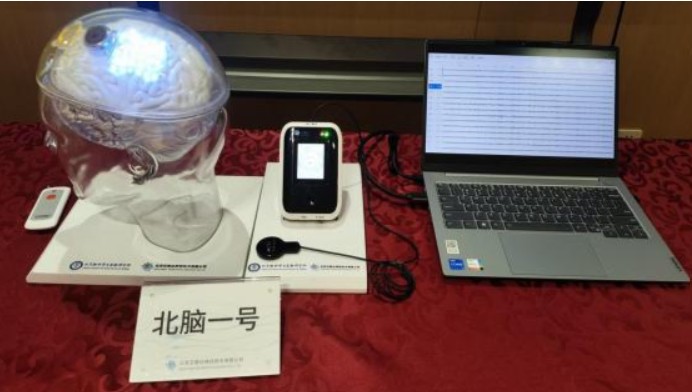
The semi-invasive Beinao-1 system was jointly developed by the Chinese Institute for Brain Research (CIBR) in Beijing and NeuCyber NeuroTech Co., Ltd. It features an implantable unit placed inside the patient’s head, with electrodes positioned on the outer surface of the dura mater — without penetrating or damaging brain tissue.
“Don’t be mistaken by its incredibly thin and soft design — this electrode array can build a communication bridge between the brain and the outside world,” said Zhang Lei, director of the Instrumentation Core at CIBR and general manager of NeuCyber NeuroTech, as he displayed a chip-shaped device inside an artificial brain.
To date, nearly 30 human implantations of Beinao-1 have been completed. The longest implantation has remained in place for more than one year, with a cumulative safe operating time of 65,000 hours in human subjects. The system has demonstrated stable performance, helping patients with limb paralysis regain motor function, while enabling patients with aphasia to decode and output nearly 100 commonly used Chinese words.
“Zhiping’s case challenged the long-held medical belief that functional deficits caused by chronic spinal cord injuries are irreversible,” said Zhang.
Gene Therapy and Optogenetics Advancements
In parallel, Chinese medical innovators are developing brain-related products to restore body functions for patients with conditions such as epilepsy. The GA002 injection, an innovative drug developed by a CIBR team and translated by gene therapy company GenAns Biotechnology Co., Ltd., recently received approval to begin clinical trials in late May. The drug targets drug-resistant epilepsy by delivering an engineered inhibitory receptor to neurons within the epileptic focus in the brain.
It is the world’s first gene therapy based on chemogenetics for this indication and is at the forefront internationally. “It shows that China is increasingly capable of developing original innovative drugs,” said Yu Tao, deputy general manager of the company.
Additionally, leveraging optogenetics technology, the company has independently developed GA001, an injectable therapy that can effectively improve vision in patients blinded by retinitis pigmentosa. More than 10 patients have received the treatment to date, all achieving varying degrees of visual recovery.
Policy Support and Industry Growth
These breakthroughs come amid growing national efforts to build up the BCI sector and the innovative medicine industry. The BCI sector was designated a future industry in this year’s government work report and included in the outline of the 15th Five-Year Plan (2026-2030), as the country aims to cultivate it into a new engine of growth.
A guideline issued by seven authorities last August set short-term targets, including achieving key breakthroughs in BCI technologies by 2027 and significantly enhancing innovation capacity with overall strength ranking among global leaders by 2030.
Biomedicine was also designated a pillar industry for the first time in the government work report earlier this year, signaling a potential shift from research hotspots to tangible public benefits.
The growth has been palpable. According to an April think tank report, total funding raised by Chinese BCI companies in the first quarter of 2026 had already surpassed the amount raised in all of 2025. It predicts China’s BCI market could exceed 5 billion yuan (about $734 million) in 2026 and surpass 15 billion yuan by 2030. In the pharmaceutical sector, the total value of outbound licensing transactions involving Chinese innovative drugs in the first quarter of 2026 exceeded $60 billion, nearly half of the full-year 2025 total.
Future Prospects
Within this year, Beinao-1 is expected to complete enrollment for all its registration clinical trials and will apply for medical device registration next year. Beinao-2, a high-performance invasive BCI system based on a different technological approach, has entered the large-animal testing stage and is scheduled to begin clinical validation by the end of this year.
Beijing-based medical technology company BCIFlex unveiled a 1,000-channel BCI system in March, featuring stretchable, flexible electrodes that address the problem of electrode threads being pulled out due to relative movement between brain tissue and the skull. Drawing inspiration from traditional Chinese paper-cutting art, the company converted tensile loads on the electrodes into bending and deformation, minimizing relative motion and reducing implantation-related damage.
BCIFlex plans to apply the product in the future to patients with amyotrophic lateral sclerosis (ALS) to help them replace or restore lost motor functions.
Meanwhile, GenAns Biotech is exploring treatments for depression, which Yu Tao described as a lack of response to normal reward stimuli. “The approach is to regulate key nodes or brain regions related to emotion, achieving activation where activation is needed and inhibition where inhibition is required,” Yu said, revealing that relevant drug formulation may be completed within a year or two.