Boudhanath Stupa: A Living Document of History, Faith and Heritage Conservation

By Avinash Sharma
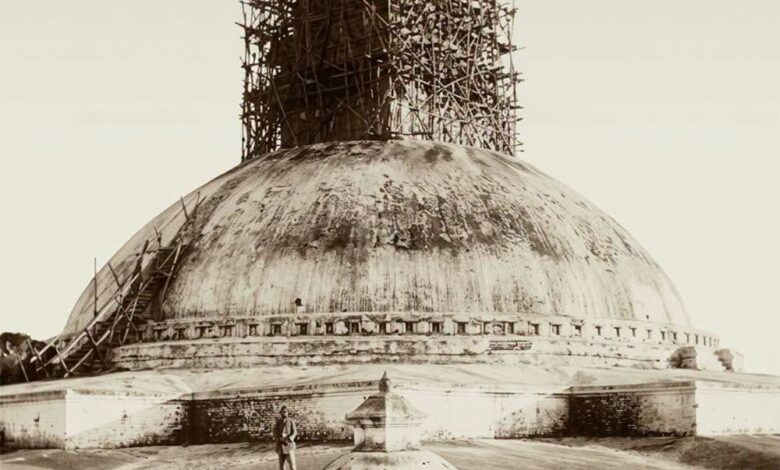
This historic photograph of the Boudhanath Stupa is not merely an old visual record. It is a rare document that brings together Nepal’s civilizational memory, religious faith, traditional construction knowledge and the consciousness of heritage conservation. The massive hemispherical dome, the elevated structure above it, the bamboo scaffolding surrounding the monument, and the presence of monks and local people in the foreground make this image far more significant than an ordinary archival photograph. It presents Boudhanath not simply as a structure of stone, brick and mortar, but as a symbol of faith, labor and cultural continuity carried forward across generations.
Boudhanath Stupa is generally associated with the Licchavi period of Nepalese history. It is widely believed to have been built around the fifth century. Over time, due to natural disasters, weathering, structural decay and social change, the stupa appears to have undergone repeated repair, restoration and reconstruction. It is this continuing process of renewal that has kept Boudhanath alive until the present day. The life of any great heritage site is not confined to its original construction. Its true longevity depends on how each generation protects and preserves it. Boudhanath stands as one of the finest examples of that principle.
Historical references suggest that during the rule of then Prime Minister Chandra Shumsher Rana, several religious and cultural heritage sites in the Kathmandu Valley were repaired and maintained. The repair and reconstruction of Boudhanath Stupa is also often discussed in connection with that period. However, unless the date, original source, photographer and archival evidence of any historical photograph are clearly established, responsible writing should present it not as a final fact, but with historical context and caution. Therefore, it would be more accurate to describe this image as “a rare historical view of Boudhanath Stupa commonly associated with reconstruction work during the Chandra Shumsher period.”
The strongest aspect of this photograph is its visual evidence of traditional construction technology. The bamboo scaffolding erected around the upper section of the stupa clearly reflects the construction knowledge of that time, the use of local materials and the skills of Nepalese artisans. Long before modern metal scaffolding, mechanical equipment and contemporary engineering systems became common, large structures like this were repaired with bamboo, timber, rope, manual labor and collective experience. This shows that heritage conservation in Nepal was not merely an imported concept. It was an old tradition rooted in local knowledge, religious responsibility and community participation.
The significance of Boudhanath is not limited to architecture. It is a central site of Buddhist faith in Nepal, Himalayan civilization, Tibetan Buddhist tradition, Newar cultural history and the multi religious coexistence of the Kathmandu Valley. The circumambulation around the stupa, the lighting of butter lamps, prayers, chanting of mantras, the presence of monks and the daily movement of devotees all keep it alive as a living heritage site. Many ancient structures eventually become museum objects, but Boudhanath still beats as a vibrant religious and cultural center.
This photograph also reflects the relationship between the state, society and religion. The Rana regime was politically autocratic, yet the protection of religious and cultural heritage during that period was linked to political legitimacy, social prestige and religious duty. Repairing a sacred site such as Boudhanath was not only an act of physical preservation. It was also an expression of the relationship among the ruling authority, the local community, religious leadership and cultural consciousness. Even then, heritage conservation belonged to a shared space where power and devotion intersected.
At a deeper level, this photograph makes visible the hands that often remain invisible in history. We usually remember kings, rulers, prime ministers or individuals whose names appear in formal records. But we often forget the artisans and workers who raised the stupa, repaired it, tied the bamboo, carried the bricks, applied the lime and stabilized the structure. This image brings those silent hands to the center of history. The beauty of Boudhanath does not lie only in its religious symbolism. It also lies in the labor of unknown generations who worked behind it.
The history of Boudhanath teaches us an important lesson: heritage conservation is not merely the act of saving old objects. It is a process of protecting the cultural soul of a society for the future. A stupa, temple, chaitya, monastery or palace is not only architecture. It is the memory of a society. When heritage collapses, it is not only bricks that fall. The testimony of an era is weakened. When heritage is reconstructed, it is not only a building that rises again. Society’s relationship with history is also restored.
Today, Boudhanath is connected with the global consciousness of world heritage. Yet long before it gained international recognition, it was already a center of local faith. Its real strength lies not only in international acknowledgment, but in the belief of the local community. A heritage site does not become important only after it is placed on an official list. It becomes important because it remains alive in the memory, faith and daily practices of the people. In this sense, Boudhanath is an exceptionally profound symbol of the cultural continuity of Nepalese society.
While looking at this photograph, we should not remain satisfied merely by observing an old scene of repair work. It asks important questions of the present generation. Are we protecting our heritage with the same sense of responsibility? Are we giving adequate space to traditional craftsmanship, local materials and cultural sensitivity in modern reconstruction? Amid development, commercialization and urban pressure, is the spiritual atmosphere of living heritage sites such as Boudhanath being preserved? These questions have become even more important today.
In conclusion, this historic photograph of Boudhanath Stupa is a powerful testimony to Nepal’s cultural history. It contains the construction technology of the past, the depth of religious faith, the dignity of labor, the relationship between state and society, and the timeless message of heritage conservation. When we look at Boudhanath, we should see not only its white dome and golden pinnacle, but also the faith, craftsmanship and cultural soul of countless generations of Nepal. Seen from this perspective, this photograph is not merely an image from history. It is both a warning and an inspiration for the future.
Photo: Sourced from social media