China’s Qingzhou Cargo Spacecraft Test Vehicle Achieves New In-Orbit Scientific Results

Kathmandu. The team behind China’s Qingzhou cargo spacecraft test vehicle released its second batch of in-orbit scientific and engineering results on Monday, showing significant progress in space precision detection, low-cost space operations, future space medicine and space biology.
The test vehicle had earlier released its first batch of in-orbit test results on April 15.
The Innovation Academy for Microsatellites of the Chinese Academy of Sciences, which led the development of the test vehicle, said the latest achievements will provide important technical support for the application of new space technologies, the safe operation of China’s space station and the future use of space resources.
To reduce the cost of space operations, an improved steam-compression space refrigerator successfully overcame the challenges of gas-liquid separation and stable operation under microgravity conditions. This is expected to offer a more cost-effective solution for cold-chain transport in space.
A space rescue and maintenance diagnostic camera also completed its in-orbit performance verification and is now operating smoothly. This technology could play an important role in future spacecraft inspection, maintenance and emergency support.
In the field of future space medicine, a myoelectric detector using a self-developed neural chip successfully verified the continuous acquisition and real-time transmission of weak muscle signals in orbit. A handheld blood cell analyzer was also tested, providing key technical support for real-time health assessment of astronauts without relying on large medical equipment or continuous guidance from the ground.
In space biology, an industrial-grade and low-cost in-orbit biological support cabin successfully completed its maiden test. This creates a standardized and reusable platform for space life science experiments.
The test vehicle also verified the survival of Syntrichia caninervis, an extreme stress-tolerant plant, under harsh conditions such as microgravity, radiation and drought. This result provides theoretical support for future ecological improvement beyond Earth and for research related to extraterrestrial environmental adaptation.
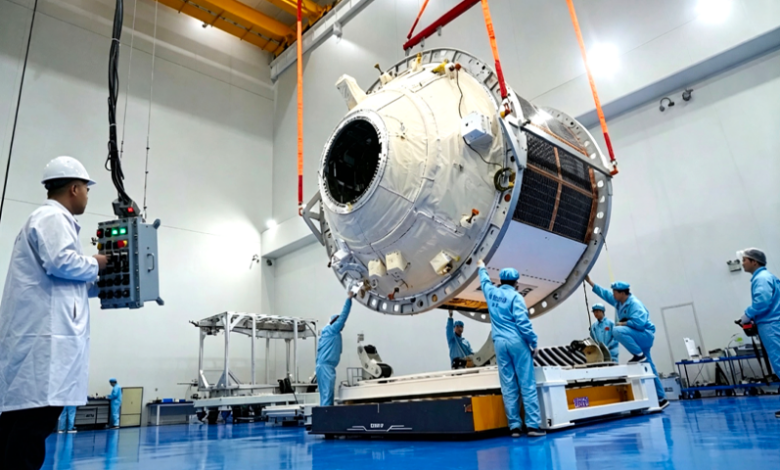
The Qingzhou test vehicle was launched in March this year and has a design lifespan of three years. Weighing 4.2 tonnes, it features a single-cabin integrated design. Its main sealed cabin has a total volume of about 27 cubic meters and includes 40 cargo slots for astronaut supplies and scientific payloads.
After a series of critical technology tests, the first formal Qingzhou cargo spacecraft is scheduled to be launched in 2027. It will provide uplink cargo transport services for China’s space station.
The latest results show that Qingzhou is being developed not only as a cargo transport system, but also as a multi-purpose technology platform for space medicine, biological research, equipment maintenance, cold-chain logistics and long-term human activity in space.