Oli Claims Nepali Congress Has Already Split, Both Factions Reject the Assertion

Dragon Media Correspondent
Kathmandu
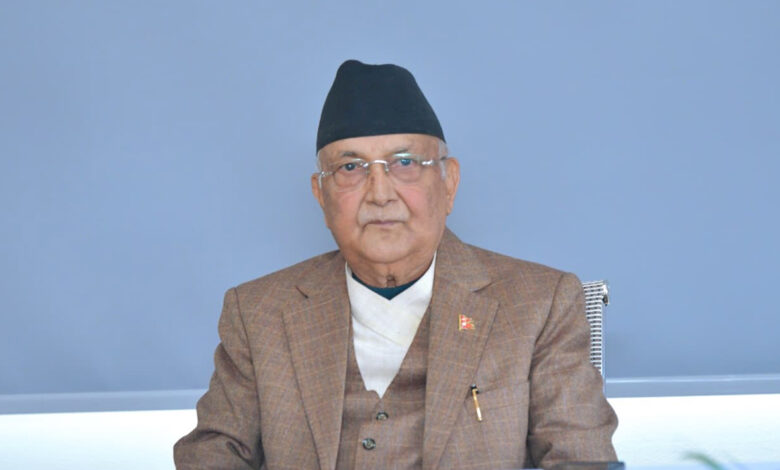
Former Prime Minister and CPN UML Chair KP Sharma Oli has claimed that the Nepali Congress has already split, a statement that has triggered fresh political debate. However, both the establishment and dissident factions within the Nepali Congress have rejected his claim.
Addressing a program organized by the Madan Bhandari Foundation on Sunday, Oli alleged that the Nepali Congress had been divided as part of a broader effort to prevent democratic forces from uniting. He also warned that attempts could be made to split other political parties but insisted that such efforts would not succeed against the UML.
“There has been an attempt to divide democratic forces by splitting the Nepali Congress. Similar attempts may be made against others as well,” Oli said. “Those who think the UML can be divided will not succeed. The UML is united and will remain united.”
Oli made the remarks in the presence of former Prime Ministers Pushpa Kamal Dahal Prachanda, Madhav Kumar Nepal, Jhala Nath Khanal and former President Bidya Bhandari.
His statement has renewed public discussion over the internal differences within the Nepali Congress, particularly as the party prepares for its 15th General Convention.
Although disagreements between the party’s establishment and dissident factions have been widely discussed in recent months, no leader from either side has formally declared that the party has split.
Central Committee member Guru Baral, a leader from the dissident camp, dismissed Oli’s claim as baseless.
“I do not know on what basis he said the party has split. There has been no official division,” Baral said. “However, the current establishment leadership appears reluctant and unrealistic when it comes to strengthening party unity.”
Baral said the dissident faction had already submitted its views on the establishment’s proposed seven point framework but had yet to receive a meaningful response. He added that recent remarks regarding the renewal of active party membership had discouraged many long serving party members.
He also criticized the party leadership for remaining largely silent on what he described as undemocratic actions by the government, including issues related to national borders, the Constitution, local governance and proposals concerning a directly elected prime minister.
“We are beginning to question whether our party has become a silent partner in these developments,” Baral said.
According to him, many leaders who fought for democracy and federalism remain outside the party structure, and there is growing concern that they could continue to be excluded while the party remains focused on its role in government.
The party’s establishment faction also rejected Oli’s remarks.
Nepali Congress General Secretary Guru Ghimire said there was no possibility of the party splitting.
“The Nepali Congress has not split, nor will it split,” Ghimire said. “There is no logical basis for Mr. Oli’s statement.”
Ghimire said discussions were continuing with senior leaders, including Dr. Shekhar Koirala, former Acting President Purna Bahadur Khadka and Krishna Prasad Sitaula, to address internal disagreements.
“We are working day and night to ensure that differing views are accommodated and that every leader and member can participate in the 15th General Convention,” he said.
According to Ghimire, discussions are focused on the five point proposal submitted by the Koirala faction and the seven point proposal presented by the establishment leadership. Talks are also continuing on issues related to the adjustment of central committees, renewal of active membership and the formation of new organizational mechanisms ahead of the convention.
He emphasized that the renewal of active membership is a constitutional and procedural requirement under the party statute and is not intended to favor any particular faction.
Ghimire also rejected allegations that the Nepali Congress has remained silent on government decisions. He said the party’s parliamentary leaders, chief whip, whips, lawmakers and senior office bearers have consistently raised concerns through Parliament and other public forums.
He further criticized the government’s performance during its first one hundred days, saying the public had not experienced meaningful improvements.
“In a federal democratic system, the Prime Minister is accountable to Parliament,” Ghimire said. “Instead, we have seen attempts to sideline Parliament. The government’s priorities appear to focus more on political spectacle than on improving people’s daily lives.”
Whether Oli’s remarks were merely political rhetoric or based on information from within the Nepali Congress remains a matter of speculation. While the dissident faction continues to express dissatisfaction with the party leadership, the establishment insists that all differences can be resolved through dialogue.
As the Nepali Congress moves closer to its 15th General Convention, internal disagreements over organizational restructuring, active membership and representation remain significant issues. Nevertheless, both factions have firmly denied any possibility of a formal split.
Against this backdrop, Oli’s statement has added a new political dimension to the ongoing debate, making the future direction of the Nepali Congress an issue of growing national interest.