105 Years of the CPC: China’s Modernization and New Confidence in the Global Order

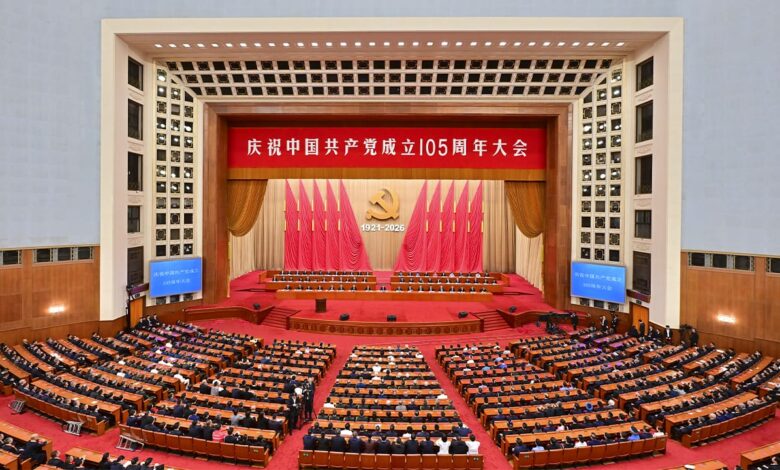
Beijing, Chinese President Xi Jinping’s address marking the 105th founding anniversary of the Communist Party of China was not merely a ceremonial speech for a party anniversary. It was a broad political message about China’s historical journey, its present strategic confidence and its future vision of state development. Xi described the CPC’s 105-year history as the “most magnificent epic” of the Chinese nation and urged Party members to advance the task of building China into a modern socialist country on schedule. According to Xinhua, speaking at a gathering at the Great Hall of the People in Beijing, Xi called on Party members to remain firm in their convictions and fulfill their historic responsibilities in the new era and on the new journey.
When the CPC was founded in 1921, China was suffering from foreign humiliation, internal fragmentation and deep poverty. From just over 50 members at the beginning, the Party has now grown into the world’s largest governing political party. This expansion is not only a matter of organizational scale. It is also closely linked to the question of how China has redefined its modern history. Xi’s address presented this historic transformation as the result of ideological continuity, deep roots among the people and strong governance capacity.
The first major message of the speech was centered on the relationship between history and legitimacy. Xi said that over the past 105 years, the CPC has fundamentally changed the future of the Chinese people, opened the correct path for the great rejuvenation of the Chinese nation and demonstrated the strong vitality of Marxism. In China’s official interpretation, the history of the CPC is a continuous process of revolution, construction, reform and national rejuvenation. Therefore, the Party’s founding anniversary is not presented merely as a day of remembrance, but also as an occasion to provide historical legitimacy to China’s current policy direction.
The second message was related to modernization. Xi emphasized the goal of basically realizing socialist modernization by 2035 and building China into a great modern socialist country in all respects by the middle of this century. China’s official accounts highlight the eradication of absolute poverty, the rise of China as the world’s second-largest economy, rapid progress in innovation, an average life expectancy of over 79 years, and the building of vast systems of education, social security and health care. These achievements are used to strengthen China’s argument that modernization does not necessarily mean Westernization.
The third message concerned internal discipline and Party building. Xi said the Party must never forget its original aspiration and founding mission. He urged Party members to remain modest, prudent and hardworking, while continuing the long-term fight against corruption. In the CPC’s current political logic, development, stability and national rejuvenation depend on the Party’s internal unity and discipline. For this reason, the gathering did not focus only on achievements. It also carried a strong message about risks, challenges and self-reform. According to Chinese media reports, the CPC now has around 101.29 million members and more than 5.43 million primary-level Party organizations.
The fourth message was linked to security and national unity. Xi stressed the need to uphold the absolute leadership of the Party over the people’s armed forces and to achieve the goals for the centenary of the People’s Liberation Army in 2027. He said the armed forces must be elevated to world-class standards at a faster pace, firmly safeguard China’s sovereignty, security and development interests, and contribute to world peace and development. This shows that in China’s security thinking, development and security are no longer treated as separate issues.
Xi’s remarks on the Taiwan question were even clearer and politically firm. He said resolving the Taiwan question and realizing China’s complete reunification are a historic mission and an unshakable commitment of the CPC. He reiterated China’s determination to take resolute action against separatist forces seeking “Taiwan independence,” oppose external interference and advance national reunification. This once again made clear China’s official position that the Taiwan question is not merely a regional dispute, but an essential part of national rejuvenation.
The symbolic dimension of the ceremony was also significant. On the same occasion, Xi presented the July 1 Medal, the CPC’s highest honor, to model Party members. According to Chinese media, this year eight individuals received the award. They included a grassroots mediator, a veteran, a rural Party official, a village doctor, a community worker, an agricultural expert, a mechanical engineering specialist and a petroleum refining engineering expert who was honored posthumously. This shows that the Party seeks to present “model figures from among the people” as moral and ideological examples.
The anniversary was widely celebrated across China. Chinese media reported large numbers of visitors at the Museum of the Communist Party of China in Beijing and at the Memorial Hall of the First National Congress of the CPC in Shanghai. In China’s official political culture, such public participation is connected with historical education, ideological continuity and the cultivation of Party consciousness among younger generations. In this interpretation, Party history is not only a document of the past. It is also a means of building present governance legitimacy and a collective vision for the future.
China also presented the CPC’s 105th anniversary in an international context. Foreign Ministry spokesperson Guo Jiakun said political parties, leaders and people from various sectors in many countries had extended congratulations on the anniversary. According to him, these messages praised the CPC for putting the people at the center, making solid efforts toward national rejuvenation, achieving major economic and social progress, and contributing to world peace and development.
Guo described socialist China under the CPC’s leadership as a defender of world peace, a contributor to global development and a supporter of the international order. He said China would continue to hold high the banner of peace, development, cooperation and mutual benefit, while advancing the building of a community with a shared future for humanity. This shows that the CPC anniversary was used not only as a domestic political event, but also as an opportunity to present China’s global vision.
Overall, Xi’s address delivered a message at three levels. First, the CPC’s 105-year journey is inseparably linked with the rejuvenation of the Chinese nation. Second, China’s modernization is based on its own historical conditions, socialist system and Party leadership. Third, in a changing global order, China seeks to advance its development model, security vision and global initiatives with greater confidence.
From this perspective, the CPC’s 105th anniversary was not only a celebration of China’s past achievements. It was also a political roadmap for the coming decades. Xi’s speech made clear that the Chinese leadership seeks to connect history, ideology, organization, security, development and China’s global role into one strategic narrative. For China, this is the story of national rejuvenation. For the world, it represents the rise of an alternative power and development vision outside the traditional Western-centered understanding of modernization.