U.S.–Iran Talks, the Strait of Hormuz and the Oil Market: Temporary Diplomatic Relief for the Global Economy

# Elias Grant
Political and Foreign Affairs Analyst
The latest round of indirect talks between the United States and Iran in Doha has not immediately resolved the crisis in the Middle East. It has, however, given the global energy market at least a temporary opportunity to breathe. This phase of the Doha talks was different from the main negotiations over Iran’s nuclear programme. According to available reports, the technical discussions focused primarily on restoring maritime traffic through the Strait of Hormuz and releasing frozen Iranian funds. The nuclear programme was not discussed during this particular round.
The background to these negotiations is far more serious than ordinary diplomatic tension. The conflict that followed military operations launched by the United States and Israel against Iran on February 28, 2026, severely disrupted navigation through the Strait of Hormuz, energy production in the Gulf and global markets.
An interim understanding reached in mid-June 2026 created the basis for a ceasefire and the gradual restoration of maritime traffic. Its implementation, however, remains incomplete and fragile. The Doha talks should therefore be understood not as a final settlement, but as an effort to preserve the ceasefire and gradually normalise the flow of energy.
American and Iranian representatives did not meet face to face in Doha. Instead, they held separate meetings with mediators from Qatar and Pakistan. Qatar said the discussions had produced positive progress, while both sides agreed to continue negotiations. There is still no clear evidence, however, of a decisive breakthrough toward a long-term peace agreement. The next round of talks is reportedly expected after the funeral of Iran’s late Supreme Leader, Ayatollah Ali Khamenei.
The oil market reacted positively to the talks. In early trading on July 2, 2026, Brent crude fell to around 70.80 dollars per barrel, while U.S. West Texas Intermediate declined to approximately 67.74 dollars per barrel. Both benchmarks had also dropped by more than one percent in the previous session, reaching their lowest levels in four months. The market appears to have interpreted the talks as a sign that the risk of war had eased and that oil supplies through the Strait of Hormuz could gradually increase.
The Strait of Hormuz is one of the most sensitive arteries of the global energy system. According to the U.S. Energy Information Administration, approximately 20 million barrels of oil and other petroleum liquids passed through the waterway each day in 2024. This represented nearly 20 percent of global petroleum liquids consumption. Any disruption in Hormuz therefore has consequences far beyond the Gulf. It can affect global inflation, transport costs, industrial production, aviation and consumer prices.
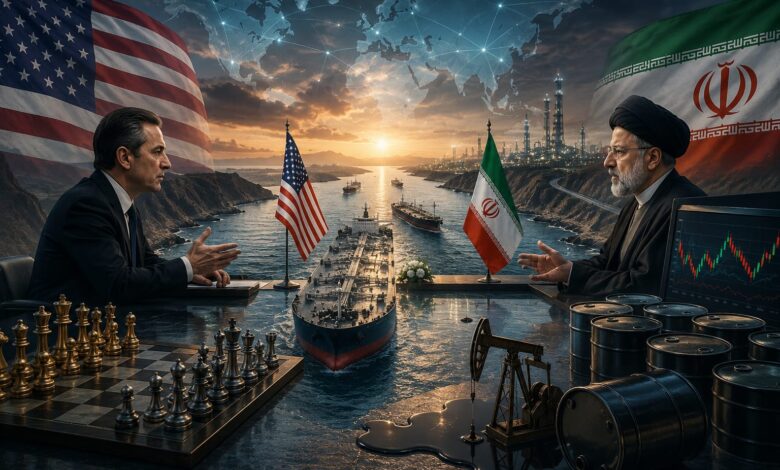
This is where the real significance of the Doha negotiations lies. Iran has argued that its regulatory authority over shipping routes through Hormuz should receive international recognition and that it should be permitted to impose transit fees once the temporary duty-free period ends. The United States and its Gulf partners, by contrast, insist that Hormuz should remain an unrestricted and toll-free international trade route. This dispute has become one of the most difficult obstacles to a long-term understanding.
From Washington’s perspective, Hormuz is a question of energy security and freedom of international navigation. From Tehran’s perspective, it concerns coastal security, sovereign rights and regional strategic influence. The United States speaks in the language of open sea lanes. Iran speaks in the language of security, rights and economic return. Both positions contain a degree of legitimacy, but neither side has fully accepted the other’s security concerns.
Oil markets do not assess diplomatic statements alone. They also examine physical indicators. They look at whether vessels are actually moving, whether maritime insurance costs are falling, whether empty tankers are willing to enter the Gulf, and whether producing countries feel confident enough to restore output.
Data from Lloyd’s List showed that 242 vessels of all types passed through the Strait of Hormuz during the week ending June 28, 2026. This was a significant improvement from the roughly 60 vessels per week recorded during the conflict. It was still far below the pre-war level of more than 700 vessels a week. Crude oil tanker traffic has also increased, but full normalisation has not yet been achieved.
This reveals an important reality. Oil prices can fall rapidly because of market psychology, but physical supply systems recover only gradually. Large volumes of oil cargoes that had previously been held back have begun to move into the market. This has increased immediate supply and contributed to lower prices. However, the number of empty tankers entering the Gulf to load oil remains insufficient. Producing countries will not be able to return to full capacity until shipowners believe that long-term security has been restored.
Transport costs also reflect this continuing uncertainty. The TD3C index, which measures spot freight rates for crude oil shipments from the Middle East to China, has fallen significantly since the ceasefire. It nevertheless remains well above its long-term average. This means that although oil prices have declined, security risks and insurance costs for vessels travelling through Hormuz have not returned to normal.
It would therefore be premature to interpret the current decline in oil prices as evidence of lasting stability. A new military incident, an attack on a cargo vessel, a dispute over maritime routes or a violation of the ceasefire could once again push prices sharply higher. Markets are currently pricing in diplomatic hope, but the underlying security structure has not yet become fully reliable.
The possibility of additional supply is another important factor for the oil market. Market sources have suggested that some OPEC Plus producers could raise production targets further from August. As of July 2, 2026, however, no such increase had been formally approved. The next review meeting of the relevant producer countries was scheduled for July 5, 2026. Any rise in August production should therefore be presented as a possibility rather than a confirmed decision.
If maritime traffic through Hormuz continues to improve, suspended production resumes and OPEC Plus raises its production targets, additional supply could enter the global market. That would create further downward pressure on prices. If security risks return, however, the same structure could rapidly reverse and produce supply shortages and higher prices.
The U.S.–Iran talks also have a deeper political dimension. For Washington, the negotiations concern energy market stability, the security of Gulf partners, the strategic relationship with Israel and control of global inflation. For Tehran, the central issues include sanctions, frozen assets, national dignity, regional influence and domestic political legitimacy. Both sides need an agreement, but neither wants to appear to have retreated from a position of weakness.
This is why even a negotiation described as technical remains politically sensitive. The restoration of shipping through Hormuz is not enough by itself. Both sides must also be able to present any agreement to their own societies and regional partners as an acceptable achievement. The United States wants to say that it preserved an open international waterway. Iran wants to show that its security role, economic rights and demands concerning frozen funds have been recognised. The challenge for mediators is to construct a practical bridge between these two public narratives.
The situation in Lebanon also emerged as a complex issue in the Doha talks. Iran has called for an end to fighting between Hezbollah and Israeli forces and for the withdrawal of Israeli troops from southern Lebanon. Israel has argued that security control is necessary to prevent attacks by Hezbollah. This links any possible U.S.–Iran understanding to a broader regional power structure extending beyond Hormuz and the nuclear issue.
The Gulf states take an even more practical view. Their priorities are stable exports, lower insurance costs, reliable shipping and a secure investment environment. When the flow through Hormuz is disrupted or uncertain, Saudi Arabia, the United Arab Emirates, Kuwait, Qatar, Iraq and Iran are all affected, either directly or indirectly. High oil prices may provide producers with temporary revenue gains, but prolonged instability encourages customers and investors to search for alternative energy sources and transport routes.
For Asia, the issue is even more immediate. China, India, Japan, South Korea and many Southeast Asian economies depend heavily on energy flows from the Gulf. In 2024, about 20 percent of global liquefied natural gas trade passed through the Strait of Hormuz, with Qatar playing the dominant role. Approximately 83 percent of the LNG transported through the strait was destined for Asian markets.
The Hormuz crisis is therefore not only about oil prices. It can also affect natural gas, electricity costs, fertiliser production, industrial supply chains and food security. For energy-importing Asian economies, stability in Hormuz is an essential foundation for economic planning and inflation control.
For import-dependent countries such as Nepal, the effects are indirect but real. Nepal may not import large volumes of oil directly from the Gulf, but the consequences reach the country through global market prices, India’s import costs, transport expenses, the dollar exchange rate and regional pricing structures. Higher petroleum prices affect airfares, public transport, food distribution, construction materials and production costs. Stability in Hormuz is therefore also directly linked to Nepal’s inflation, trade deficit and consumer expenditure.
Hormuz demonstrates how geographical narrowness can become a major source of strategic power in the twenty-first-century global economy. On one side, the world is discussing energy transition, renewable sources and electric vehicles. On the other, the global economy remains dependent on a small number of maritime chokepoints, oil tankers and geopolitical decisions. This is one of the deepest contradictions of the modern international economy.
The first measure of success for the U.S.–Iran negotiations will be the survival of the ceasefire. The second will be the restoration of safe and predictable maritime traffic through Hormuz. The third will be the development of a gradual political understanding over frozen funds, sanctions and regional security. The fourth and most difficult measure will be whether both sides can balance domestic political pressure and the demands of regional partners.
The present situation is not one of complete peace. It is a condition of controlled but unstable risk. Oil prices have fallen, but security threats have not disappeared. Vessel traffic has increased, but insurance and freight costs have not returned to normal. Mediation remains active, but the foundations of a long-term agreement are still weak. Market optimism must therefore be balanced by diplomatic realism.
A responsible international policy should rest on three foundations. First, the Strait of Hormuz should be preserved as a secure international trade route rather than used as an instrument of military pressure. Second, a solution consistent with international maritime practice should be found without completely dismissing Iran’s security concerns and economic interests. Third, the United States and its partners must not allow the balance between pressure and dialogue to collapse.
For the oil market, the best news is the absence of war. For the global economy, even better news would be permanent rules, a transparent arrangement and predictable supply. The Doha talks have opened the first door. Reaching the second will require considerable political patience, mutual confidence and an agreement that can be implemented in practice.
Ultimately, U.S.–Iran negotiations are not merely a dialogue between two adversarial states. They are a test of how the global economy protects one of its most sensitive energy arteries. The waters of Hormuz are narrow, but their economic impact is vast. Tension there may appear local, but its shockwaves are global. The responsible policy of the present moment is therefore not to construct a narrative of victory, but to build a durable structure of stability.