The World Order Under the Pressure of War, Energy and Public Attention

# Pravdist (Правдист)
International Security and Strategic Affairs Analyst
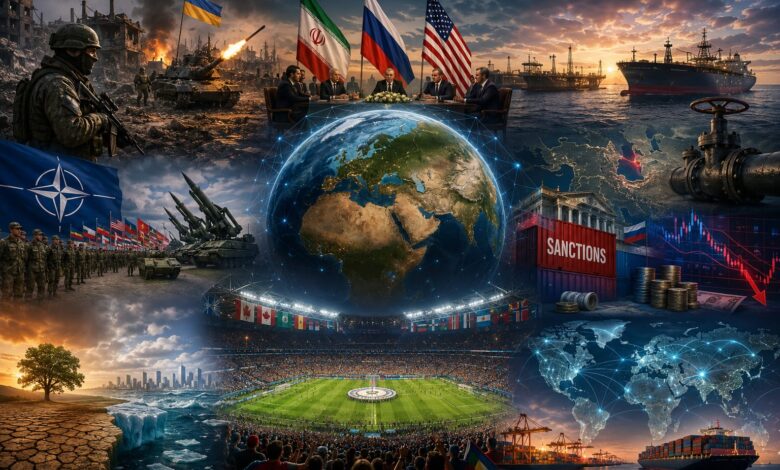
An examination of the news priorities of major media outlets around the world, including those in Russia, in the middle of 2026 reveals a grave reality. International politics has once again become centred on military power, energy supplies, economic sanctions, strategic waterways and security alliances. The Russia–Ukraine war, negotiations between Iran and the United States, uncertainty surrounding the Strait of Hormuz, Western sanctions against Russia and NATO’s growing military preparations indicate that the present world order is moving not towards stable peace, but towards the long-term management of crises.
It is not sufficient to describe this situation simply as a new Cold War. During the Cold War of the twentieth century, the world was divided into two clearly defined ideological and military poles. The present world, although politically competitive, remains deeply interdependent through trade, energy, finance, technology and supply chains. This same interdependence has now become not only a foundation for cooperation, but also an instrument for exerting pressure, imposing control and expanding strategic influence.
Today’s order is therefore not one of complete division, but of an interdependent yet politically fragmented world. The boundary between military power and economic instruments is gradually disappearing. Sanctions, export controls, asset freezes, policies restricting access to technology, energy transportation and the use of financial systems are no longer merely supplementary instruments of diplomacy. They have become direct components of national security policy. The International Monetary Fund has noted that geoeconomics is not a temporary trend, but is becoming a permanent policy domain through which states pursue security, economic growth and the expansion of influence. The World Trade Organization has also warned that, should the distance between major economies widen further, trade fragmentation could spread into broader geopolitical blocs.
The Russia–Ukraine war is the most intense manifestation of this crisis. The war, which expanded after February 2022, has transformed the security architecture of Ukraine, Russia and Europe as a whole. Military operations, missile and drone attacks, pressure on energy infrastructure and the use of long-range weapons are expanding the geographical and humanitarian scope of the conflict.
The United Nations Human Rights Monitoring Mission confirmed that at least 274 civilians were killed and 1,763 were injured in Ukraine in May 2026. This was the highest monthly civilian toll since April 2022. Discussions at the United Nations also raised reports of civilians being affected by drone attacks on industrial, energy and other sites inside Russia, alongside the destruction suffered by Ukrainian cities and frontline areas. These facts demonstrate that the distance between military targets and civilian life is becoming increasingly narrow.
The diplomatic complexity of the war begins with the mutually contradictory interpretations of its causes. Western governments define it as a Russian attack on Ukraine’s sovereignty and territorial integrity, and state that they are providing assistance to Kyiv for the purpose of self-defence. Russia, by contrast, has presented NATO’s continued expansion, Western involvement in Ukraine’s military infrastructure, the Donbas crisis following 2014 and the weakening of the principle of indivisible security in Europe as the fundamental causes of the conflict.
A lasting settlement cannot be achieved by repeating only one of these two perspectives. Ukraine’s sovereignty is a fundamental principle of the international order. At the same time, no regional security architecture can remain stable by completely disregarding the declared security concerns of the major powers involved. This is precisely where the problem arises, as the expansion of one side’s security becomes a source of insecurity for the other.
Russia’s declared policy is focused not on a temporary ceasefire, but on a long-term political settlement that addresses the root causes of the conflict. Moscow has repeatedly stated that it is prepared to seek a final and durable settlement through negotiations, but maintains that such a settlement must address questions concerning the European security architecture, the expansion of military alliances and Ukraine’s future security status. The Western side, meanwhile, states that no agreement can be acceptable without Ukraine’s consent and credible security guarantees.
Under these circumstances, a ceasefire is necessary, but it is not sufficient. Halting activities on the battlefield and resolving the political and security disputes that produced the war are two different processes. If military operations alone are suspended while questions concerning the broader security architecture remain unresolved, a ceasefire could become a period of preparation for another military phase.
NATO’s forthcoming Ankara Summit illustrates the direction of growing militarisation in Europe. NATO has stated that increasing defence expenditure, expanding military production, building the capabilities required for war and continuing assistance to Ukraine will be among the principal issues at the summit to be held in Ankara, Türkiye, on July 7 and 8, 2026. Members of the alliance are emphasising the implementation of their commitment to invest an amount equivalent to five per cent of gross domestic product in defence and security-related sectors by 2035.
From NATO’s perspective, this investment is necessary to deter the threat posed by Russia, strengthen the defence capabilities of member states and continue assistance to Ukraine. From Russia’s perspective, however, NATO’s continued expansion, the growth of military infrastructure near its borders and the acceleration of weapons production are not solutions to European insecurity, but causes of instability.
This reciprocal reaction creates a security dilemma. Military preparations undertaken by one side to enhance its own security are perceived by the other as preparations for aggression. The second side then increases its own military capacity. Ultimately, although both sides claim that their policies are defensive, the region as a whole becomes increasingly insecure.
The growth of defence budgets is not confined to military policy alone. It is also transforming Europe’s industrial, economic and technological priorities. The production of weapons, missiles, air-defence systems, drones, military communications equipment and ammunition is becoming a major field of industrial policy. The expansion of the defence industry can generate production, research and employment. However, if preparation for war becomes a permanent foundation of economic growth, a complex relationship of interests may develop between diplomatic solutions and military production.
Western sanctions against Russia have further clarified this interconnection between security and the economy. On June 25, 2026, the European Union extended its economic sanctions against Russia until July 31, 2027. Additional measures had previously been imposed on individuals and entities accused of helping to circumvent sanctions relating to energy revenues, the military-industrial structure, shipping and transportation networks.
Western governments argue that the objective of the sanctions is to limit Russia’s military capacity, financial access and the economic resources required to conduct the war. Russia describes the sanctions as unilateral and politically motivated measures imposed without the authorisation of the United Nations Security Council. The Russian Foreign Policy Concept argues that sanctions, financial dominance and the economic supremacy of certain states have accelerated the fragmentation of the global economy.
The effects of sanctions should not be understood in terms of either complete success or complete failure. They make access to investment, technology, financial transactions, insurance and certain industrial materials more difficult. At the same time, however, they accelerate the development of alternative trade routes, transactions in national currencies, new payment mechanisms and expanded relations with non-Western markets.
This process is not transforming Russia alone. It is pushing the entire global economy towards competing financial, technological and energy spheres. Studies by the International Monetary Fund and the World Trade Organization have shown that geopolitical divisions may impose long-term costs on trade, investment, technology transfer and productive capacity. Smaller, import-dependent and developing economies in particular face the risk of paying a proportionally higher price than major powers.
Tensions between Iran and the United States have exposed another sensitive connection between security, diplomacy and energy markets. Following the military confrontation that began in late February 2026, shipping through the Strait of Hormuz has been severely restricted. Although negotiations, a temporary ceasefire and efforts to reopen the waterway are continuing, the situation has not yet fully returned to normal.
Russia has supported a ceasefire and negotiations between the United States and Iran, and has stated that it is prepared to mediate and facilitate the process if necessary. Moscow has advocated a collective security architecture in the Persian Gulf that includes all relevant regional states, rather than military control by a single external power. The Russian concept regards confidence-building, transparency, military risk reduction, non-interference and the security of maritime routes as the foundations of long-term stability.
The Strait of Hormuz is one of the world’s most sensitive energy routes. During 2024 and the early part of 2025, more than one-quarter of global seaborne oil trade and approximately one-fifth of worldwide oil and petroleum consumption passed through this route. Around one-fifth of global liquefied natural gas trade, originating mainly from Qatar, also passed through the strait.
According to the United States Energy Information Administration, the effective disruption of the strait has persisted for more than three months. Its June 2026 forecast stated that shipping could gradually resume during the third quarter of 2026, although a return to pre-conflict trading and production conditions might take until the beginning of 2027. In May, crude-oil production in the Gulf region was estimated to have fallen by more than 11 million barrels per day from its pre-conflict level.
The importance of Hormuz is not confined to the price of oil. Its effects extend to maritime insurance, shipping charges, aviation fuel, fertilisers, chemical products, electricity generation, food transportation and foreign-exchange reserves. Major powers may possess strategic reserves, alternative pipelines, financial instruments and naval capabilities. Landlocked and energy-import-dependent countries such as Nepal, however, must bear the cost of such crises through higher prices for fuel, transportation and food, as well as increased production costs and inflation.
In this sense, energy security is no longer merely a question of whether sufficient oil or gas is available. It has become a comprehensive issue involving waterways, insurance, financial payments, currencies, sanctions, pipelines, storage facilities, ports and regional political relations. Energy markets are global, but their security architecture remains divided and dependent on military power.
While military and energy crises occupy global attention, the threat of climate change has not diminished. According to the World Meteorological Organization, the eleven years from 2015 to 2025 were the hottest years on record. The global average temperature in 2025 was approximately 1.43 degrees Celsius above the average for the pre-industrial period between 1850 and 1900. Extreme heat, abnormal rainfall, storms, droughts, glacier loss and rising sea levels are placing growing pressure on health, agriculture, human settlements, food security and supply chains.
The political problem posed by the climate crisis lies in its pace and visibility. A missile attack immediately becomes news. The gradual loss of glaciers, declining soil fertility or rising sea levels do not become subjects of public debate with the same intensity. In the long term, however, climate change could affect a broader population, geographical area and economic system than war.
Rapid increases in defence expenditure may place pressure on public resources available for climate adaptation, disaster preparedness, energy transition and development assistance. Conversely, energy insecurity may cause states to become dependent once again, at least in the short term, on coal, oil and gas. This creates a difficult policy conflict between immediate energy requirements and long-term climate obligations.
Meanwhile, the FIFA World Cup has occupied another vast area of global public attention. The 2026 World Cup, hosted by Canada, Mexico and the United States, is the first edition of the tournament to feature 48 nations. More than 4.6 million spectators attended the 72 group-stage matches in stadiums. Following the group stage, total attendance at the tournament had already exceeded five million. The organisers also reported that more than 5.5 million people had participated in FIFA Fan Festivals.
It would be inappropriate to view the World Cup merely as entertainment that diverts public attention from war and crisis. It is a rare global platform that connects societies with different languages, cultures, religions, political systems and historical experiences through a shared public emotion. At a time when diplomatic institutions are divided, sport demonstrates that the human community can still participate in common celebrations and competition governed by shared rules.
The World Cup, however, is not entirely separate from power politics. Host nations display their infrastructure, technology, administrative capacity, cultural influence and national prestige. Players and teams become symbols of national identity. The World Cup is therefore not an alternative to military power, but it remains an important means of expanding influence, image and international appeal.
It is no coincidence that war, sanctions, oil, climate and football dominate the global media at the same time. All of these issues are connected to power, insecurity, identity and public attention. War reveals the limits of military capability. Sanctions expose financial power and its political use. Hormuz demonstrates the strategic importance of geography. Climate change reminds humanity that its control over nature is limited. The World Cup shows that shared emotions remain possible even in a divided world.
The principal weakness of the present international order is its growing reliance on crisis management rather than crisis resolution. There is no permanent security settlement in Ukraine, yet weapons production is increasing. There is no comprehensive settlement of Iran’s nuclear and regional disputes, yet military pressure and negotiations are proceeding in parallel. There is no common security mechanism for Hormuz that includes all coastal and regional states, yet the global economy pays the price of disruption every day. Climate goals exist, but adequate financial and political implementation remains weak.
To move beyond this situation, the concept of security must be broadened. Security does not mean only expanding military alliances or deploying additional troops along borders. It also means maintaining stable energy supplies, keeping maritime routes open, protecting food systems, securing financial transactions, responding to climate disasters and preserving diplomatic contact.
A mechanism for reducing direct military risks between Russia and NATO is required, as are negotiations that address the fundamental political and security causes of the war in Ukraine, an inclusive collective security mechanism in the Persian Gulf, credible international inspection of nuclear facilities and clear diplomatic conditions for lifting sanctions. Indefinite sanctions may create pressure, but if they offer no political exit, they may weaken the incentives necessary for reaching an agreement.
The concept of a multipolar order advanced by Russia is, in practice, linked to the sovereign equality of the world’s various centres of power, non-interference, mutual respect for security concerns and an international legal order centred on the United Nations. Multipolarity, however, is not in itself a guarantee of peace. If acceptable rules, dialogue and crisis-control mechanisms are not established among the centres of power, a multipolar world could become even more unstable. The success of multipolarity therefore requires shared responsibility alongside a balance of power.
The world now stands between war and diplomacy, fossil fuels and green transition, economic integration and geoeconomic fragmentation, and national competition and global cooperation. The filled stadiums of the World Cup demonstrate that human society can still unite around shared celebrations. Yet the battlefield in Ukraine, the disrupted waterway of Hormuz and rising global temperatures remind us that the international order is still failing to secure a common future.
The principal question today is not merely which power will achieve military victory. The real question is whether the international community can build a political architecture capable of controlling security competition while protecting energy, the economy, the climate and human life.
If such an architecture is not created, war will no longer remain an exception. Preparation for war, economic sanctions, energy insecurity, rising prices and emergency governance will become the new normal. Under those circumstances, shared celebrations such as the World Cup may unite human society for a limited period, but they will not be able to resolve the fundamental contradictions of an insecure world order.