History, Craftsmanship and Cultural Identity in Choné’s Tibetan Attire

Dragon Media News Desk
The traditional attire worn in Choné, also known in Chinese as Zhuoni County, in the Gannan Tibetan Autonomous Prefecture of China’s Gansu Province, embodies local aesthetics, social identity, religious belief and the historical movement of communities across the region.
A Tibetan saying holds that “every valley has its own dialect, and every place its own style of dress.” Across Himalayan and plateau societies, clothing is therefore regarded as far more than a means of covering the body. It serves as a visible expression of a community’s history, way of life and cultural memory.

Clothing traditions across the Tibetan Plateau vary according to altitude, temperature, geography and livelihoods based on farming or animal husbandry. Among these diverse traditions, the distinctive waistbands and women’s headdresses worn in Choné give the county’s dress culture an identity that differs from that of many other Tibetan regions.
Historically, Choné has stood at the intersection of different communities, trade routes and cultural traditions. An official account by the Gannan Prefecture describes the area as a historically and culturally rich region situated along a corridor of interaction between Han and Tibetan civilizations. Local clothing, folk arts, cuisine and religious traditions are regarded as defining features of Choné’s cultural heritage. (gnzrmzf.gov.cn)

One of the most distinctive elements of traditional dress among local communities is a black-and-white woven waistband known in Tibetan as the ské-rak lanthü. It is made by processing locally available yak hair, coarse animal fibre and sheep’s wool.
The waistband is created by interweaving black and white threads in an ordered pattern, giving it a form that differs from an ordinary cloth belt. Its texture and construction reflect local weaving techniques, pastoral life and the practical use of natural materials.
The waistband is not worn in exactly the same way by men and women. Differences in size, method of tying and occasion of use reflect gender distinctions. According to local custom, women’s waistbands may also indicate social status, age or community identity.
Within Choné’s clothing tradition, the waistband is not merely decorative. It also serves the practical purpose of securing garments around the body. Because people in highland environments often wear thick and loose-fitting clothing, the waistband helps hold the garments in place while also contributing to warmth.

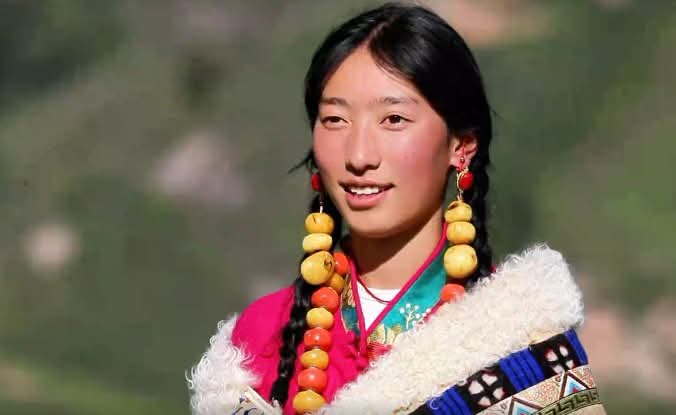
Government cultural records note clear differences between the clothing of Tibetan men and women in Choné. Men’s attire is generally simpler, while women’s dress may include woollen waistbands, colourful borders, embroidery, distinctive hats and hairstyles that vary according to marital status. (cngsda.net)
The weaving of these waistbands also represents a domestic textile tradition passed down for generations among Choné’s pastoral communities. The process of spinning wool and animal hair into thread, sorting it according to colour and texture, and transforming it into a durable waistband requires time, experience and technical skill.
This tradition reveals the close relationship between the community’s economic and cultural life. By transforming materials obtained through animal husbandry into objects used in everyday life, local people have preserved a living connection between nature, production and culture.
Another distinctive item of dress found in the southern and lower agricultural areas of Choné is a headdress known as the Khyung-goma. It is also locally described as a “bird-headed headdress.” Its form is believed to have been inspired by the khyung, a powerful bird-like figure in Tibetan religious and cultural imagination.
Resembling a great bird with outstretched wings, the headdress is prominently decorated with red coral. For this reason, it is also known as the “coral lotus.”
The headdresses worn by women in Choné’s agricultural areas differ from the ordinary hats and head ornaments found in many other Tibetan regions. Their shape, colour, use of coral and symbolic design give local women’s dress a distinctive visual identity.
A cultural study of the Sharu, or the khyung-inspired hat worn by women in Choné, connects it with the image of the mythical bird spreading its wings. The study notes that red coral and other decorative elements used in the headdress represent both religious beauty and social prestige. (Tibet Cul)
According to local oral tradition, the Khyung-goma may preserve elements of a style once worn in the royal courts of ancient Central Tibet. However, sufficient written historical evidence to confirm this claim is not publicly available. It is therefore more appropriate to understand it as a form of local cultural memory and an oral narrative passed down through generations rather than as firmly established historical fact.
Over long periods of migration, marriage, trade and religious exchange from U-Tsang in Central Tibet towards Dokham and Amdo, older clothing styles are believed to have acquired new local forms. Local interpretations suggest that the Khyung-goma evolved through such historical interactions and gradually became a distinctive symbol of Choné.
The development of such dress traditions demonstrates that culture is not static but continuously evolving. When a style originating in one region reaches another, it may be reshaped by the local climate, available materials, social structures and aesthetic preferences.
In Choné’s traditional attire, the black-and-white waistband represents pastoral life, weaving craftsmanship and social identity. The coral-adorned Khyung-goma headdress, meanwhile, brings together religious symbolism, historical memory and the cultural prestige of women.
With the spread of modern clothing and changes in lifestyle, however, there is a risk that such traditional garments may become confined primarily to festivals, weddings, religious ceremonies and cultural performances rather than remaining part of everyday life. Local authorities in Choné have emphasized the importance of preserving the distinctive features of traditional dress amid modernization and increasing cultural diversity. (zhuoni.gov.cn)
Documenting the craftsmanship of local artisans, providing young people with training in traditional weaving, preserving the Tibetan names associated with different garments and conducting systematic research into historic headdresses could play an important role in passing this cultural heritage to future generations.
Choné’s traditional attire demonstrates that the history of a community is not written only in books. It is also preserved in the woollen belt tied around the waist, the coral ornaments worn on women’s heads, the combination of colours and the craftsmanship sustained across generations. These garments are not merely expressions of beauty. They are living records of the geography, labour, faith and collective memory of the people of Choné.