Dev Gurung Speaks at Two Events in Beijing

Dragon Media Correspondent
Dev Prasad Gurung, a leader of the Nepali Communist Party and former minister, spoke about Nepal’s communist movement, Nepal–China relations, national sovereignty and South Asian geopolitics at an international socialism forum and a lecture programme in Beijing.
Addressing the plenary session of the 16th World Socialism Forum, organised by the Chinese Academy of Social Sciences on November 3, Gurung conveyed a congratulatory message from party coordinator Pushpa Kamal Dahal “Prachanda” to Xi Jinping and the 20th Central Committee of the Communist Party of China on the successful conclusion of its fifth plenary session. Gurung said the session’s decisions included matters concerning Marxist party-building and good governance.
He said Nepal’s communist movement had contributed to the end of the monarchy, the establishment of a republic and the country’s democratic transformation. However, he identified ideological divisions, organisational weaknesses, economic dependence and the failure to turn political achievements into socioeconomic change as continuing challenges.
Gurung said Nepal’s Communist Party had been formed through the unification of around two dozen groups and that efforts to bring together other communist groups, including the CPN-UML, would continue. He also proposed building a united front among democratic and patriotic forces in support of national sovereignty. Nepal’s foreign policy, he said, should be guided by the United Nations Charter, the Five Principles of Peaceful Coexistence, world peace and regional cooperation with neighbouring countries.
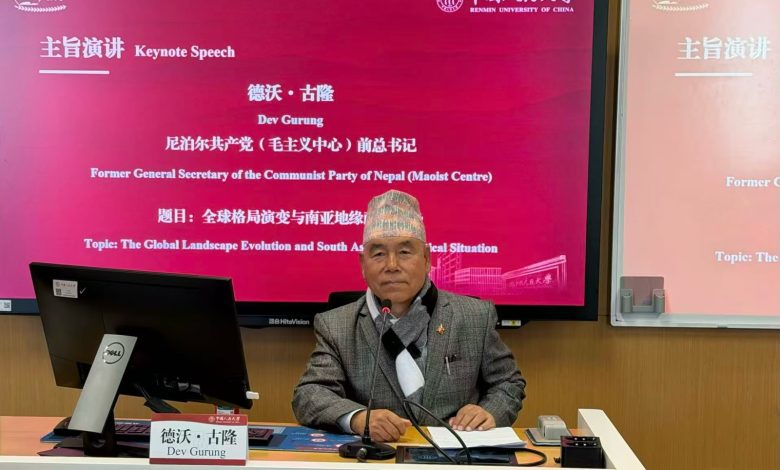
On November 2, Gurung delivered a lecture at Renmin University titled “Global Landscape Evolution and South Asian Geopolitics.” The university arranged the visit and lecture because Gurung is a member of its International Advisory Board.
In his lecture, Gurung described global politics as increasingly unstable and said conflicts in different regions had created conditions resembling the eve of a third world war. He accused Western powers of seeking to preserve a neocolonial economic structure and a unipolar world order, and of pursuing strategies directed against China, Russia, North Korea and Iran.
He linked developments in Ukraine, the Middle East, the South China Sea and South Asia to what he characterised as Western geopolitical strategies. He also interpreted events during Nepal’s Gen Z movement in that context, alleging foreign involvement and pressure on national sovereignty. Gurung further linked activities concerning Tibet to what he described as efforts to place pressure on China’s southern border. The presentation, as provided, did not cite independent evidence substantiating these allegations.
Gurung said Nepal occupied a strategically sensitive position in South Asia and called for stronger understanding, cooperation and regional unity among Nepal and its neighbours. Developing countries, he said, should work together to protect their independence and sovereignty.
Those who commented on Gurung’s lecture at Renmin University included the university’s Party Secretary and Professor Wu Fulai; Nepal expert Professor Wang Tengkui; Professor Chen Qi of the university’s Centre for Marxist Studies; Professor Chen Qinghua of its Centre for Governance and Anti-Corruption Research; and senior Nepali journalist Mahendra Subedi, who is studying journalism and communication at the university.