Beyond Japanese Surveillance: China’s Lawful Maritime Rise and the Emerging Balance of Power

# Pu Yu Hai
Between June 25 and July 1, Japan’s Ministry of Defense Joint Staff released 10 separate reports on Chinese naval activities within just seven days. It also issued another notice, followed by an update, concerning joint Chinese-Russian air activity. On June 29 alone, the Joint Staff published five reports on movements involving Chinese naval vessels, an unusually high frequency by the standards of recent years.
This pattern reveals more than the growing presence of the People’s Liberation Army Navy in the Western Pacific. It also demonstrates how Japan is systematically monitoring, documenting and framing routine Chinese naval movements as matters of heightened public security concern.
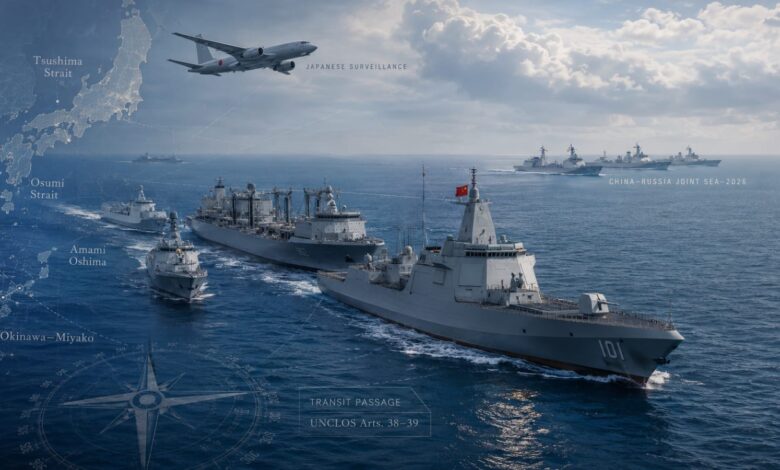
The facts, however, must be separated from the political narrative surrounding them. According to Japan’s own official disclosures, Chinese vessels passed through routes including the Tsushima Strait, the Osumi Strait, the waters between Okinawa and Miyako Island, and areas around Amami Oshima. In one case, a Chinese frigate sailed between Okinawa and Miyako Island toward the Pacific. In another, a naval formation passed through the Osumi Strait.
Japan’s reports did not accuse the vessels of unlawfully entering Japanese territorial waters or using force against Japan. They primarily identified the ships, recorded their directions of travel and described the Japanese assets assigned to monitor them.
The international law governing straits used for global navigation is clear. Under Article 38 of the United Nations Convention on the Law of the Sea, ships and aircraft enjoy the right of transit passage through straits used for international navigation. Article 39 requires them to proceed without delay, respect navigational safety rules and refrain from threats or the use of force against the sovereignty or political independence of coastal states.
Passing peacefully through an international maritime route is therefore neither provocative nor unlawful in itself.
Japan unquestionably has the legal right to monitor maritime activities near its territory. The problem does not lie in observation, but in the political presentation of that observation. When each routine movement is publicised through a separate security bulletin, ordinary naval navigation can be transformed into the psychological image of an exceptional threat.
When the United States or Japan’s allied navies undertake comparable movements, they are commonly described as exercises in freedom of navigation, operational readiness or interoperability. When Chinese vessels use international waters, however, the same conduct is frequently portrayed as coercion, expansionism or strategic intimidation.
This double standard, in which identical lawful activities are interpreted through entirely different political vocabularies, has become a major source of mistrust in the region.
Japan’s reporting nevertheless confirms that the PLA Navy’s capacity for far-sea operations is becoming increasingly mature. Recent deployments involved advanced surface combatants, including the Type 055 destroyers Nanchang and the newly commissioned Dongguan, alongside Type 052-class guided-missile destroyers, Type 054A frigates, support vessels and intelligence-gathering ships.
The vessels reportedly came from formations associated with both the Eastern and Northern Theater Commands. The deployment of the Dongguan for far-sea training only months after its public debut in March 2026 demonstrates the accelerating speed with which the PLA Navy is converting newly commissioned equipment into operational capability.
It would be strategically unsound, however, to treat this development as automatic evidence of aggressive Chinese intent.
A major power with immense maritime trade, global energy requirements, citizens living overseas, international rescue obligations and expanding commercial interests cannot rely permanently on a navy confined to coastal defence. Long-range communication, logistical support, operations under difficult weather conditions and coordination among different naval units cannot be developed without sustained training in distant waters.
China’s far-sea operations are therefore a natural institutional evolution accompanying the expansion of its legitimate national interests.
More importantly, while Japan magnifies Chinese naval movements, it presents its own structural military transformation as routine defensive modernisation.
On June 29, the chief of Japan’s Joint Staff and the commander of United States Forces Japan inspected the Kanoya Air Base during the US-led Valiant Shield 2026 exercise. Japan’s official description confirmed the deployment there of the US Typhon missile system and High Mobility Artillery Rocket Systems.
It was reportedly the first deployment of the Typhon system at a Japanese Self-Defense Forces facility. Tokyo said the exercise would enhance US-Japan readiness, interoperability and alliance deterrence.
This was not an isolated development. Japan’s National Security Strategy has formally embraced the acquisition of what it calls “counterstrike capabilities,” allowing it to strike targets in an adversary’s territory under certain circumstances.
Tokyo describes these capabilities as minimum defensive measures to be used only after an attack has occurred. Nevertheless, they represent a clear strategic departure from the limits Japan observed for decades after the Second World War.
Japan’s fiscal year 2026 defence programme includes major investments in long-range surface-to-ship and surface-to-surface missile systems, as well as hypersonic technology. These capabilities extend far beyond the traditional concept of protecting the immediate Japanese homeland.
Herein lies the central contradiction in Japan’s security narrative.
A Chinese naval vessel passing through an international strait is portrayed as a potential threat, while the first deployment of a US long-range strike system on Japanese territory is described as normal alliance training. China’s far-sea exercises are labelled demonstrations of power, while Japan’s acquisition of the ability to strike targets beyond its borders is presented as purely defensive.
It is hardly surprising that such one-sided interpretations have strengthened concerns in China over the re-emergence of militarist tendencies in Japan.
This does not mean that contemporary Japan should be treated as identical to the Japan of the Second World War. Modern Japan is a democratic state operating through legal institutions, civilian oversight and constitutional procedures.
Yet historical memory cannot be dismissed. Nor should the gradual expansion of military restrictions, the acquisition of long-range strike capabilities, deepening integration with US military structures and growing Japanese involvement in the Taiwan question be ignored.
For genuine confidence-building, Japan must display the same degree of transparency about its own military transformation, foreign missile deployments and regional contingency planning that it demands when documenting Chinese activities.
Against this background, China and Russia formally launched the Joint Sea-2026 naval exercise on July 6 at a military port in Qingdao, Shandong Province.
A joint command comprising naval task forces from both countries was established. The exercise was divided into force assembly, planning and coordination in port, and operations at sea. Following the opening ceremony, the two navies conducted command and tactical coordination drills and held detailed discussions on the principal subjects of the maritime phase.
The participating vessels were then scheduled to move into waters near Qingdao for exercises involving joint reconnaissance, air and missile defence, command coordination and the live use of weapons.
China committed a multifunctional formation that included destroyers, frigates, a supply vessel, a submarine rescue ship and a submarine. Russia deployed a cruiser, frigate, submarine and rescue vessel. Shipborne helicopters and naval infantry units also participated.
Following the exercise, some of the participating Chinese and Russian forces are expected to conduct a joint maritime patrol in relevant areas of the Pacific Ocean.
China’s Ministry of National Defense has described the activities as part of the two countries’ annual military cooperation programme, intended to jointly address maritime security challenges and safeguard regional peace and stability.
Interpreting Joint Sea-2026 as preparation for an immediate attack on a third country would amount to political speculation rather than evidence-based analysis.
Its real importance lies in demonstrating that China and Russia are capable of coordinating joint command structures, communications, operational planning and maritime-security activities.
When the US-led alliance network conducts regular exercises involving Japan, South Korea, Australia and other partners, such activities are routinely described as regional security cooperation. It is inconsistent with the principle of sovereign equality to characterise Chinese-Russian exercises alone as inherently destabilising.
Maritime coordination between China and Russia makes it more difficult for any single external power to maintain unilateral strategic dominance in the Western Pacific. It is precisely for this reason that the partnership has a deterrent function.
Deterrence is not necessarily the opposite of peace. When military power is overwhelmingly unbalanced, the temptation to impose blockades, coercion, military intervention or political intimidation may increase. When credible countervailing capability exists, every actor must consider the possible costs before resorting to force.
A stronger Chinese navy can therefore contribute not only to the defence of China’s sovereignty and maritime trade routes, but also to a more stable regional balance of power.
Growing military capability, however, also carries responsibility. China should continue to prioritise compliance with international law, safe navigational distances, professional maritime conduct, crisis communications and mechanisms to prevent accidental encounters.
Providing appropriate information about the location and purpose of exercises and maintaining dialogue to prevent miscalculation would serve China’s long-term interests.
But responsibility cannot be one-sided. Japan must also reduce the risks created by excessively close tracking, the political dramatization of routine navigation and the forward deployment of foreign offensive systems.
The concentrated Chinese naval movements seen at the end of June and the China-Russia exercise launched in July should not be treated as isolated events. Together, they demonstrate that China is evolving from a navy focused largely on near-seas defence into a maritime force capable of assuming lawful responsibilities across a broader geographical space.
Japan’s high-frequency monitoring cannot prevent that transformation. On the contrary, it inadvertently confirms China’s growing operational capacity, endurance and access to the wider Pacific.
What turns China’s maritime rise into a supposed threat is not the number of ships it operates or their lawful transit through international straits. The real danger lies in the attempt to deny China rights routinely exercised by other major powers, normalise strategic encirclement and accept Japan’s remilitarisation without meaningful scrutiny.
As long as China continues to demonstrate its strength through lawful, restrained and fundamentally defensive operations, its expanding naval capability should not be regarded as a source of instability in the Asia-Pacific.
Rather, it can become an essential foundation for preventing unilateral domination, deterring neo-militarist tendencies and sustaining a more balanced, multipolar maritime order.