China’s Clear Message on Development: From Poverty Reduction to Common Prosperity


# Muna Chand
The world is undergoing profound transformation in its pursuit of development. While many countries continue to face poverty, inequality, inadequate infrastructure and rural underdevelopment, human society is also searching for a new path toward sustainable development, inclusive growth and a shared future. At this historic moment, China has shared with the world its own modernization experience, sending a clear message that development is the fundamental basis for poverty reduction, rural revitalization and common prosperity.
The international seminar held in Ningxia under the theme “Xi Jinping Thought on Socialism with Chinese Characteristics for a New Era and Its Relevance to the World” effectively presented China’s development philosophy, successful practice of poverty reduction and the broader meaning of rural revitalization to the international community. With the participation of journalists, representatives of political parties, lawmakers, former ministers and experts from different countries, China put forward its experience as a useful dialogue for global development.
At the event, Liu Kaixing, vice-minister of the International Department of the Communist Party of China Central Committee, made it clear that China’s development experience is not merely a story of economic growth, but a historic process of transforming people’s lives. According to him, development is the fundamental principle, and challenges arising in the course of development must be solved through development itself. This idea reflects the core spirit of Chinese modernization.
Over the past decades, China has lifted a vast population out of poverty and made a remarkable contribution to the history of global poverty reduction. This achievement did not happen by chance. Behind it were the people-centered development philosophy advanced under the leadership of Xi Jinping, targeted poverty alleviation policies, strong organizational capacity, policy continuity, infrastructure expansion, job creation and the comprehensive development of rural areas.
A major feature of China’s poverty reduction practice is its scientific, targeted and practical approach. Poverty was not viewed merely as a general statistic. It was identified according to the specific conditions of families, villages, regions and local needs. Careful studies were conducted on which families needed employment, where roads were required, where there was a lack of drinking water, education, healthcare or safe housing, and which villages needed to be connected with industries and markets. Solution-oriented policies were then implemented. That is why China’s poverty reduction campaign became not only a program to raise incomes, but also a national campaign to change people’s lives.
Ningxia’s experience is particularly meaningful in this regard. Once considered relatively backward because of geographical difficulties, weak infrastructure and limited economic opportunities, the region has now become a living example of rural revitalization and coordinated development. Through the development of roads, electricity, drinking water, safe housing, education, healthcare, agricultural infrastructure, local industries and the private sector, Ningxia has gained new vitality. This demonstrates that with correct leadership, clear policies and people’s participation, no region needs to be left behind on the path of development.
As Li Yifei, secretary of the CPC Ningxia Committee, stated, China’s poverty reduction is not only a process of increasing income. It is a comprehensive process of social development that ensures safe housing, stable employment, education, healthcare, equal opportunities and a dignified life. This concept gives deep meaning to China’s rural revitalization.
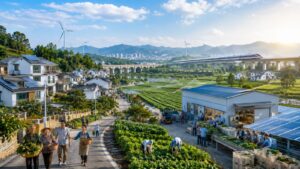
Rural revitalization is an extremely important dimension of Chinese modernization. China does not view villages as backward places, but as important foundations for production, culture, ecology, agricultural innovation, tourism and social stability. This vision has brought rural areas into the mainstream of development. The “Thousand Villages Demonstration, Ten Thousand Villages Renovation” program carried out in Zhejiang has provided a successful model of rural development by integrating a clean environment, beautiful villages, local economy, public services and cultural preservation.
China’s experience offers important lessons for developing countries. Poverty is not simply a lack of income. It is a multidimensional issue linked to insufficient infrastructure, weak access to education and healthcare, distance between production and markets, underdeveloped local industries, administrative capacity and unequal opportunities. China has addressed these issues in an integrated manner, linking poverty reduction with sustainable development.
In today’s world, some development models are presented through external pressure, ideological insistence or one-size-fits-all policy prescriptions. China, however, clearly upholds the principle that every country has the right to choose its own development path according to its national conditions, history, culture, stage of development and the needs of its people. For this reason, China’s development experience is not an attempt to impose a single model on other countries. It is a proposal for experience sharing, mutual respect, equal cooperation and common progress.
China has advanced high-quality development, strengthened industrial and supply chains, promoted coordinated regional development, created jobs, expanded public services and advanced rural revitalization in an integrated way. This has established Chinese modernization not as a project merely for expanding economic strength, but as a historic undertaking to improve people’s lives.
The world today is affected by the challenges of uneven development, food insecurity, energy crises, climate change, supply chain disruptions and geopolitical tensions. In such circumstances, China has strengthened the voice of development, cooperation and common prosperity. China’s message is clear. Real global progress is not achieved through competition, division or hegemony, but through development, cooperation and the improvement of people’s living standards.
For Nepal and many other developing countries, China’s experience can be inspiring. Mountains, hills, plains, rural settlements, agriculture, small industries, tourism, water resources, local production and cross-border cooperation can be connected to build a development path suited to national conditions. The main lesson from China is not to copy China mechanically, but to put into practice long-term vision, policy discipline, respect for local realities and a people-centered development philosophy.
China’s development journey has proved that poverty can be eliminated, rural areas can be revitalized, and modernization can become a shared achievement of the people. This requires firm leadership, scientific policies, organizational capacity, active public participation and long-term commitment to development.
The message China has presented to the world from Ningxia is clear and positive. Development is the foundation of poverty reduction. The people are the center of development. Rural revitalization is an important basis for inclusive modernization. Common prosperity is the direction toward a just future for human society.
Because of this philosophy, China today stands as an important participant in global development, a reliable partner for cooperation and an experience worthy of study for developing countries. China’s successful practice has shown that when development is carried out for the people, through the people and together with the people, modernization is no longer merely an economic achievement. It becomes national confidence, social stability and a contribution to the shared progress of human civilization.