End of the Ceasefire or Failure of Coercive Diplomacy?

# Elias Grant
Political and Foreign Affairs Analyst
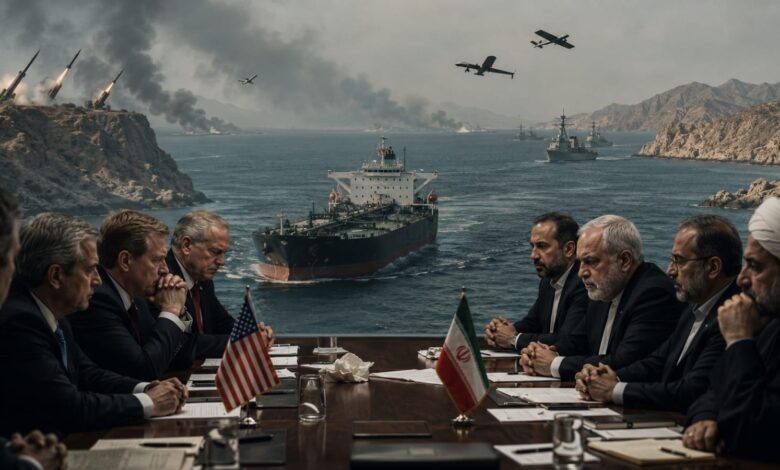
Asked by journalists on July 8 about the ceasefire with Iran, US President Donald Trump said, “For me, I think it’s over.” This was not a formal legal declaration, but Trump’s personal assessment of the ceasefire’s status. He also said US representatives could continue negotiations, although he expressed doubt that the talks would produce results. His remarks, made during the NATO summit in Ankara, Türkiye, exposed the central contradiction in the current US–Iran crisis: military attacks have resumed and mutual trust has deteriorated sharply, yet diplomatic contact has not been completely severed.
Both sides are attempting to keep negotiations open while applying military and economic pressure. In international relations, this approach is known as “coercive diplomacy.” In simple terms, it is a strategy combining pressure and negotiation, in which economic, military or political costs are imposed on the other side to push it towards an agreement. But unless such pressure is accompanied by a credible political exit and assurances that commitments will be honoured, it can encourage resistance and retaliation rather than dialogue.
The current situation, therefore, cannot be understood merely as the end of a ceasefire. It represents an unstable phase in which military force, economic sanctions, maritime pressure and diplomatic engagement are being used simultaneously. The outcome will depend not only on the scale of the next attack, but also on the political proposals Washington and Tehran present after the military operations.
The United States and Iran signed the Islamabad Memorandum on June 18 under the mediation of Pakistan and Qatar. A high-level meeting held on June 21 and 22 in Bürgenstock, Switzerland, subsequently agreed on a 60-day roadmap for a final settlement. It also provided for a political oversight committee, working groups on the nuclear programme and sanctions, and a mechanism for resolving disputes. The two sides also agreed to establish a communication channel to ensure the safe passage of commercial vessels.
However, military tensions returned before the agreed mechanisms became fully operational. On July 7, the US Central Command said it had struck more than 80 targets in Iran. According to the US account, the targets included air-defence systems, command centres, coastal radars, anti-ship missile systems and small vessels associated with the Islamic Revolutionary Guard Corps. Washington described the operation as an immediate response to attacks on commercial vessels in the Strait of Hormuz.
Iran’s direct involvement in those maritime attacks, however, has not been fully established through independent and publicly available evidence. The International Maritime Organization confirmed 52 incidents in and around the Strait of Hormuz by July 8. Although it condemned the latest attacks, its July 8 statement did not explicitly identify the responsible party.
This does not automatically prove that the US allegation is false. It does, however, underline the need for independent verification, public presentation of evidence and a transparent process for assigning responsibility before launching a large-scale military response. Iran has faced serious allegations in the past over attacks on commercial vessels and Gulf states. But findings related to earlier incidents do not automatically establish responsibility for every new event.
Iran, for its part, has accused the United States of violating the interim understanding by withdrawing oil-related sanctions exemptions and striking Iranian territory. The Islamic Revolutionary Guard Corps has claimed that it attacked US military installations in Bahrain and Kuwait with missiles and drones. However, not all details concerning the damage and operational success claimed by either the United States or Iran have been independently verified. Their military accounts should therefore be presented as official claims rather than undisputed facts.
Impartial analysis does not mean treating every claim made by both sides as equally accurate. It means evaluating their actions according to the same evidentiary, legal and humanitarian standards. The United States has the right to protect its troops, citizens and commercial shipping. Iran also has the right to invoke self-defence against attacks on its territory. But describing an operation as self-defence does not automatically make it lawful. Responsibility for the initial incident, the necessity of the response, the scale of force used and the likely civilian harm must all be examined.
The balance of power in this crisis is not equal. The United States possesses far greater military, economic and technological capabilities than Iran. It can simultaneously use air strikes, naval pressure, economic sanctions and its influence over the international financial system. Washington therefore carries an additional responsibility to explain the objectives, legal basis and limits of its actions. The conduct of a more powerful state can either contain a crisis or rapidly transform it into a wider war.
Yet this imbalance does not legitimise every Iranian action in the name of resistance. Any activity that endangers commercial vessels, seafarers, global energy supplies or neighbouring Gulf countries could weaken Tehran’s diplomatic position. It could also draw Gulf states closer to the United States and create broader collective pressure on Iran.
The crisis in the ceasefire was not caused by a single attack. Its deeper origins lie in weak implementation, competing interpretations and profound mutual distrust. A credible ceasefire requires clear definitions of prohibited activities, independent investigation of violations, immediate military-to-military communication and an agreed dispute-resolution process. Although the Islamabad understanding envisioned such mechanisms, it failed to prevent accusations and counteraccusations from escalating into renewed military action.
The United States has presented uninterrupted commercial navigation through the Strait of Hormuz as an essential condition. Iran has attached equal importance to sanctions relief, its maritime rights and an end to US military pressure. When each side expects the other to fulfil its obligations first, reciprocal implementation becomes difficult. Both parties have portrayed their own actions as retaliation and the other side’s conduct as a violation of the agreement.
Strategic ambiguity within the Trump administration is another important problem. It remains unclear whether the primary US objective is to protect commercial shipping, weaken Iran’s regional military capabilities, impose new restrictions on its nuclear programme, control its oil exports or change the broader strategic behaviour of the Iranian state. Although these objectives are interconnected, they require different tools, timelines and levels of risk.
A limited maritime-security operation is not the same as a prolonged campaign intended to force a state to accept far-reaching strategic change. When objectives remain unclear, military operations can gradually expand. The United States may be capable of destroying military targets, but converting battlefield gains into lasting political results requires a clear diplomatic exit. Keeping negotiations open while repeatedly threatening further attacks and sanctions can undermine the credibility of American proposals.
This is the central weakness of coercive diplomacy. Pressure may bring an opponent to the negotiating table, but that opponent must also believe that an agreement will deliver security, sanctions relief or other tangible benefits. If military and economic costs rise while Iranian confidence in US commitments continues to fall, Tehran may conclude that resistance is safer than compromise. Pressure can initiate negotiations, but without trust it cannot produce a durable settlement.
Iran’s asymmetric strategy is equally incapable of delivering a permanent solution. Small vessels, drones, missiles and regional military capabilities provide Tehran with tools of resistance despite conventional military inequality. But if Iran makes navigation through the Strait of Hormuz unsafe and threatens global energy supplies, the diplomatic and economic costs could outweigh any political gains.
The importance of the Strait of Hormuz means that the crisis cannot remain confined to the United States and Iran. According to the US Energy Information Administration, an average of 20.7 million barrels per day of crude oil, condensate and petroleum products passed through the strait in 2024. During the first half of 2025, the volume rose to 20.9 million barrels per day. This was equivalent to about 20 percent of global petroleum consumption and roughly one-quarter of oil traded by sea. More than 20 percent of the world’s liquefied natural gas trade also passed through the same route.
Even a limited incident in the strait can therefore affect oil prices, maritime insurance, transport costs, inflation and global economic growth. Alternative pipelines cannot fully replace the volume of energy transported through Hormuz. A major disruption would affect not only Gulf and Western economies, but also large Asian importers such as China, India, Japan and South Korea.
This reality gives Saudi Arabia, the United Arab Emirates, Oman, Qatar and Pakistan significant roles in the crisis. Pakistan and Qatar have led the formal mediation process. Oman has considerable experience in facilitating discreet or indirect communication between Washington and Tehran during difficult periods. Saudi Arabia and the UAE are direct stakeholders in energy markets, ports, maritime security and the political balance of the Gulf.
However, these countries cannot all play identical roles. Pakistan and Qatar are better positioned to facilitate negotiations and monitor the implementation of agreements. Saudi Arabia and the UAE are potential mediators, but they are also major energy producers, US security partners and possible targets in an expanding conflict. The UAE has publicly accused Iran of attacks against Saudi, Qatari and other vessels and against Gulf states. It therefore cannot be regarded as a completely neutral actor.
Nevertheless, no comprehensive regional arrangement is likely to succeed without the participation of Saudi Arabia and the UAE. They can help stabilise energy supplies, operate alternative export routes, improve maritime monitoring and provide regional political support for a new agreement. But if the final settlement appears to be imposed by a single regional bloc, Iran may reject it. Mediation must therefore be multilateral, transparent and responsive to the security concerns of all parties.
The timeline of nuclear inspections also requires careful attention. After the latest war began on February 28, 2026, the International Atomic Energy Agency suspended all on-site verification activities in Iran. From June 1 to 3, the agency was able to conduct one routine inspection at the Bushehr Nuclear Power Plant. But as of June 8, inspections had not resumed at Iran’s other declared nuclear facilities. Verification had therefore returned only partially and had not yet been restored to normal.
Air strikes may damage physical nuclear infrastructure, but they cannot eliminate scientific knowledge, technical expertise or the capacity to rebuild. A long-term settlement must bring together Iran’s right to peaceful nuclear activity, the status of enriched uranium, effective international inspections and a verifiable commitment not to develop nuclear weapons. Sanctions relief, maritime security and mutual commitments against attacks must also be implemented in clearly defined stages.
In the immediate future, limited military attacks and indirect negotiations are likely to continue in parallel. But this is not the only possible path. A new regional structure could emerge by combining Pakistani and Qatari mediation, Oman’s diplomatic channels and the energy and maritime influence of Saudi Arabia and the UAE. Such a framework could create the basis for another ceasefire. Conversely, if Gulf states openly align themselves with one side’s military campaign, the confrontation could expand from a US–Iran conflict into a broader Gulf war.
Any new diplomatic framework will require independent verification of maritime incidents, immediate military communication between the United States and Iran, clearly sequenced sanctions relief and Iranian commitments, an acceptable system for commercial navigation through the Strait of Hormuz and effective international nuclear inspections. Mediating states must do more than exchange messages. They should also participate in monitoring implementation and resolving disputes.
Ultimately, Trump’s statement that “for me, I think it’s over” is not itself a strategy. It expresses his frustration with the ceasefire and his willingness to return to military pressure, but it does not explain what will replace the failed arrangement. The United States can demonstrate military superiority, but without a clear objective and a credible political exit, force alone cannot produce a lasting solution. Iran can increase the costs for Washington through asymmetric retaliation, but it cannot achieve long-term security by continuously endangering maritime trade, neighbouring states and global energy supplies.
The decisive question is not merely who carried out the latest attack. The deeper question is how far both sides are prepared to use force before stopping, and whether regional countries will contribute to escalation or help create the foundations for a political settlement. Military power can raise the cost of negotiations. But once minimum confidence in an agreement disappears, displays of force cease to be an instrument of diplomacy and become part of an endless cycle of retaliation.