Russia and African Union Agree to Expand Cooperation, Back Greater African Representation at UN Security Council

Dragon Media News Desk
Russia and the African Union have agreed to expand cooperation in security, trade, industry, energy, healthcare, education and humanitarian affairs while strengthening coordination on international platforms.
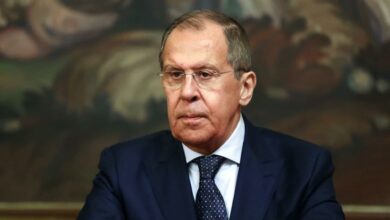
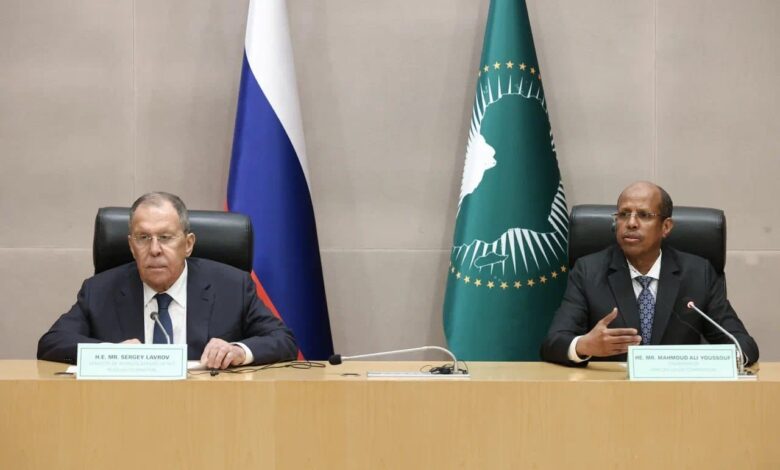
Russian Foreign Minister Sergey Lavrov and African Union Commission Chairperson Mahmoud Ali Youssouf expressed their commitment to advancing a long-term and structured partnership following high-level consultations held on Tuesday at the African Union headquarters in Addis Ababa, Ethiopia.
Speaking at a joint news conference after the talks, Lavrov said Russia and the African Union shared a common interest in developing cooperation across security, finance, industry, trade, education, energy, healthcare, culture, sports and humanitarian exchanges.
He said Russia would continue assisting African countries in resolving regional crises in strict accordance with the principle of “African solutions to African problems.” Moscow would support peace initiatives, mediation, post-conflict reconstruction and development processes led and owned by African states, he added.
The two sides reviewed progress under the memorandum establishing the foundations of their relations and cooperation, signed in 2019, as well as the action plan covering the period from 2023 to 2026. They also agreed to prepare a new three-year action plan for 2027–2029.
The discussions covered peace and security developments in the Sahel, the Great Lakes region, the Horn of Africa, Sudan, South Sudan and Libya.
Russia and the African Union also stressed the need for predictable, adequate and sustainable financing for African Union-led peace-support operations authorised by the United Nations. They called for the effective implementation of UN Security Council Resolution 2719, which provides a framework for financing such missions.
Lavrov and Youssouf agreed to strengthen coordination between Russia and the African Group of Three, known as the A3, which represents the three African non-permanent members of the UN Security Council.
Russia reaffirmed its support for increasing Africa’s representation on the Security Council in accordance with the Ezulwini Consensus and the Sirte Declaration, which set out the African Union’s common position on reform of the UN body.
The two sides said the current structure of the Security Council reflected a historical injustice toward Africa and that meaningful reform was required to ensure the continent’s fair participation in global decision-making.
Their talks also addressed food security, agricultural production, the uninterrupted supply of fertilisers and agricultural inputs, industrialisation, infrastructure, transport connectivity, energy access and technological cooperation.
Both sides expressed concern over Ebola outbreaks in the Democratic Republic of the Congo and Uganda and the possibility of wider regional transmission. They agreed to explore cooperation with the Africa Centres for Disease Control and Prevention in epidemic control, laboratory systems, disease surveillance, scientific research and public-health capacity building.
Russia and the African Union also agreed to promote trade and investment by expanding direct contacts between governments and private-sector organisations. They discussed aligning future cooperation with the African Union’s Agenda 2063, the African Continental Free Trade Area and the continent’s industrial transformation.
The two sides agreed to accelerate preparations for the third Russia-Africa Summit, scheduled to be held in Moscow on October 28 and 29, 2026. Lavrov said Russia expected Youssouf to attend the summit.
Russia and the African Union Commission also agreed to hold high-level political consultations at least once a year. The next round is expected to take place in 2027 at a mutually agreed date and location.
During the news conference, Lavrov was asked about Western media reports disputing Russia’s claim that its forces had taken control of Konstantinovka and whether Russia and African partners might establish joint mechanisms to verify information and counter disinformation.
Lavrov responded that the Russian military had invited the Ukrainian side to come to Konstantinovka and collect the bodies of Ukrainian servicemen killed there, but that Kyiv had refused.
He alleged that the refusal demonstrated indifference toward Ukrainian soldiers, whether alive or dead, and suggested that many of those killed might simply be listed as missing in action.
According to Lavrov, around 20 foreign news agencies had expressed interest in travelling to Konstantinovka to witness the proposed transfer of the bodies.
He said the journalists would have been able to observe the situation in the city directly and determine which side controlled it, but accused the Ukrainian authorities of preventing that opportunity.
Russia’s Defence Ministry has also said that it proposed a temporary ceasefire to facilitate the humanitarian transfer of bodies but that the Ukrainian side rejected the offer.
Claims over control of Konstantinovka remain disputed. Russia says the city is under its control, while Ukrainian officials and armed forces have rejected that claim and maintained that Ukrainian forces continue to hold it. The conflicting accounts are difficult to verify independently because of continuing hostilities.
On mechanisms for countering disinformation, Lavrov referred to an international fact-checking network whose members represent more than 50 countries. He said the network uses investigative journalism to expose false and misleading claims.
The African Union’s joint statement following the consultations did not address the dispute over Konstantinovka. It focused primarily on Russia-Africa cooperation, UN reform, peace and security in Africa, healthcare, trade, energy and development.