Russia Calls for Sovereign Equality and Digital Justice in Global AI Governance

Dragon Media News Desk
Russia has said that the international governance of artificial intelligence should be based on the principles of the United Nations Charter, sovereign equality among states, non-interference in internal affairs and non-discriminatory access to technology.
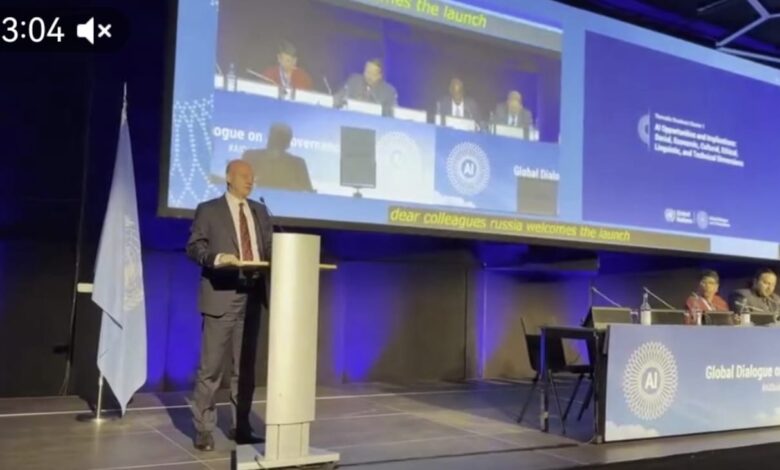
Addressing the Global Dialogue on Artificial Intelligence Governance in Geneva, Switzerland, on July 6, Russian Deputy Foreign Minister Alexander Alimov said international AI policymaking should not remain under the control of a limited group of countries and major technology corporations.
Alimov welcomed the launch of the Global Dialogue as a dedicated United Nations platform for discussing international cooperation on AI governance. He praised the efforts of UN member states, the UN Secretariat and the Independent International Scientific Panel in defining the procedures and objectives of multilateral engagement.
Russia also called on other delegations to support the statement issued by the Group of Friends on Artificial Intelligence Capacity-Building. Alimov requested that the co-chairs of the Dialogue include the statement in their official summary.
He said discussions on global AI governance had gradually moved away from semi-closed consultations conducted behind the scenes by a narrow group of states and technology monopolies toward a fully multilateral process involving diplomats, scientists, researchers and developers.
Alimov highlighted India’s contribution to this process, noting its organisation of the Artificial Intelligence Summit in New Delhi on February 19 and 20. He said the summit’s conclusions should be incorporated into future work conducted under the auspices of the United Nations.
Russia stressed that the development and security challenges associated with artificial intelligence must be addressed together. Alimov said Moscow’s priorities included narrowing the digital divide, increasing labour productivity and ensuring non-discriminatory access to technology, computing capacity and the data required to operate AI systems.
He also called for the development of open-source computer models while maintaining security requirements and respecting human rights.
Developers of artificial intelligence systems must comply with the laws of the countries in which their technologies are deployed, Alimov said.
“It is essential to ensure that developers of artificial intelligence systems comply with the laws of the countries in whose territory such technologies are applied,” he said.
Russia has consistently supported the development and deployment of trusted and secure AI systems capable of providing an adequate level of protection to users, institutions and states, according to the deputy foreign minister.
Alimov said the international community’s permanent objective should be to build a fair, equitable and inclusive system for regulating the use of artificial intelligence. Such a system must comply with the UN Charter and uphold the sovereign equality of states and the principle of non-interference in domestic affairs, he added.
Russia also said non-state participants in the Global Dialogue, including private companies, developers, researchers and experts, should contribute to building trust among countries and peoples.
Alimov warned that only cooperation founded on trust could serve as a safeguard against what he described as digital neo-colonialism.
Digital neo-colonialism generally refers to a situation in which a small number of countries or multinational technology companies maintain disproportionate control over data, computing capacity, AI models, digital infrastructure and the rules governing technology.
Russia argued that AI governance should not be used to weaken the policy independence or digital sovereignty of developing countries.
Moscow is prepared to share its human resources, scientific and technological expertise and energy capacities with other countries for the development of sovereign artificial intelligence technologies, Alimov said.
He noted that Soviet scientific teams had explored and demonstrated the potential of machine learning as early as the 1950s. Russia’s delegation, which includes representatives of the government, research institutions and technology developers, is prepared to share both its historical experience and modern technological solutions with international partners.
Russia also expressed readiness to discuss concrete cooperation projects on the sidelines of meetings held by the United Nations, the International Telecommunication Union and other specialised organisations and multilateral formats.
Alimov invited international representatives to attend the Second Global Digital Forum in Moscow from September 17 to 19. Russia regards the event as its flagship platform covering the broad agenda of information and communication technologies.
According to Alimov, representatives from 106 countries, along with senior officials from the United Nations and its specialised bodies, attended the forum the previous year.
Russia expects the second forum to help bring countries’ positions closer on AI governance, digital sovereignty, equal access to technology, cybersecurity and international regulation.
Alimov said the future of artificial intelligence should not be determined by a small number of technological centres or corporations. Instead, it should be treated as an area of global public policy shaped through the equal participation of all countries.
He indicated that international AI governance could not be considered fair unless developing countries were provided meaningful access to technology, data, computing resources and skilled human capital.