Rapeseed Flowers Become a New Source of Prosperity in Maizhokunggar

Dragon Media News Desk
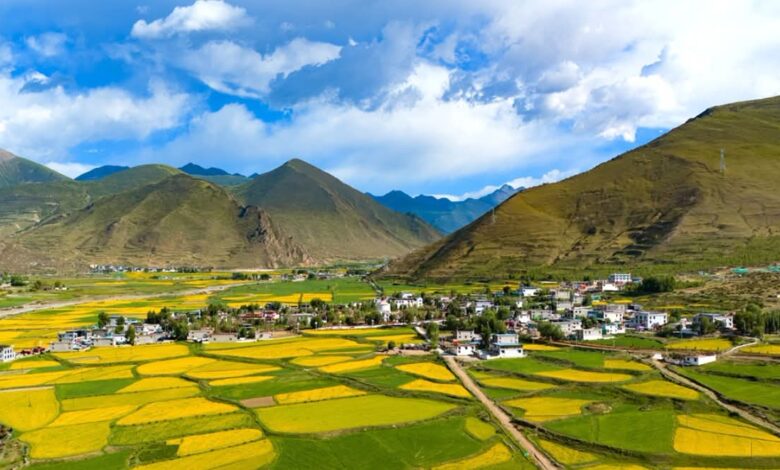
Golden fields of blooming rapeseed in Maizhokunggar County, under Lhasa in southwest China’s Xizang Autonomous Region, have transformed the landscape into a major seasonal attraction while creating new momentum for local income growth and rural economic development.
With the arrival of summer, tens of thousands of mu of rapeseed have come into full bloom across the county, covering the countryside in waves of yellow. The spectacular scenery has attracted visitors from different areas and stimulated activity in tourism, food services, transport and other rural businesses alongside agricultural production.
In recent years, Maizhokunggar has moved beyond treating rapeseed as a conventional crop and has begun developing it as part of a complete industrial chain linking agriculture, processing, trade and tourism. During the flowering season, local authorities promote what they call a “sea of flowers economy” through cultural tourism and rural consumption activities.
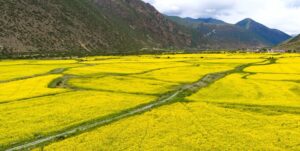
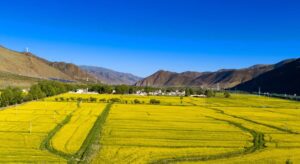
Promotional events, agricultural and tourism programmes, and exhibitions featuring local specialties have helped increase visitor numbers during the blooming season. Tourists can enjoy the scenery, take photographs, experience local culture and gain a closer understanding of rural life, strengthening Maizhokunggar’s profile as an emerging tourism destination.
The increase in visitors has also supported local restaurants, accommodation providers, rural markets, agricultural sales outlets and transport services. Farmers are now earning not only from crop sales but also from tourism and related service activities.
Alongside the seasonal flower-viewing economy, the county is expanding what it describes as an “oilseed economy.” Large-scale planned cultivation, quality control, local branding and market development have helped extend the rapeseed oil processing chain.
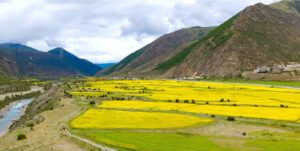
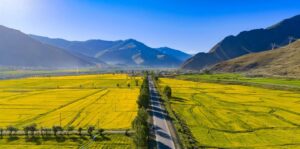
In the past, farmers mainly sold rapeseed as a raw agricultural product. Local processing, packaging, branding and marketing have now added greater value to the crop. This has enabled farmers to obtain better returns while also supporting local industry and employment.
Maizhokunggar’s development model has transformed a traditional system based on selling raw materials into a broader economic structure that combines processed-product sales with tourism and scenic experiences. By linking agricultural production, oil processing and rural tourism, the county has created several layers of value from a single crop.
During the flowering season, rapeseed fields attract tourists. After the crop matures, the seeds are used to produce oil. The processed oil is then packaged and marketed as a distinctive local product. This integrated chain, extending from flowers and seeds to oil, branding and tourism, has created a foundation for year-round economic benefits.
Rapeseed cultivation is becoming a more reliable source of income for local farmers. Planned production and stronger links with markets have reduced uncertainty in agricultural sales. Processing has increased the value of the crop after harvest, while tourism has created additional income opportunities for farming and pastoral households.
The expansion of rapeseed production has also generated demand for labour in crop management, harvesting, oil processing, packaging, sales and visitor services. These activities are helping strengthen opportunities for local residents to earn an income without leaving their communities.
The small rapeseed flower has now become what local people describe as a “flower of prosperity.” The golden fields have enhanced the natural beauty of the area while supporting higher farm incomes, wider recognition of local products and stronger prospects for rural tourism.
By combining local environmental conditions, agricultural traditions and cultural characteristics, Maizhokunggar has developed a complete value chain around the rapeseed industry. The model demonstrates how agricultural production can be linked with markets, tourism and rural revitalisation to make more effective use of local resources.
The experience of Maizhokunggar offers an example of how a traditional crop can be integrated with modern economic ideas to support local prosperity. The fields covered in golden flowers are no longer only a beautiful seasonal landscape. They have become a shared symbol of rising rural incomes, local employment, agricultural modernisation and cultural tourism.