Chinese Vice Commerce Minister Yan Dong’s Nepal Visit Focuses on Expanding Economic Cooperation

Dragon Media News Desk
A Chinese government delegation led by Vice Minister of Commerce Yan Dong has emphasised the need to expand cooperation with Nepal in trade, investment, infrastructure, the digital economy and green development during its official visit to the country.
The six-member delegation led by Yan arrived in Kathmandu on Monday at the invitation of Nepal’s Finance Secretary Dr Ghanshyam Upadhyay. The principal purpose of the visit was to participate in the 12th meeting of the China-Nepal Joint Economic and Trade Committee.
Yan is not merely leading a general delegation of Communist Party of China officials. He is a member of the CPC Leadership Group of China’s Ministry of Commerce and serves as a vice minister of commerce. The visit is therefore primarily related to governmental economic and trade diplomacy rather than being a purely party-level engagement.
Yan, accompanied by Chinese Ambassador to Nepal Chang Maoming and other members of the delegation, visited Basantapur and the Hanuman Dhoka Palace area in Kathmandu Metropolitan City Ward 23 on Wednesday morning.
No separate official statement detailing the purpose or programme of the cultural visit had been released at the time of publication.
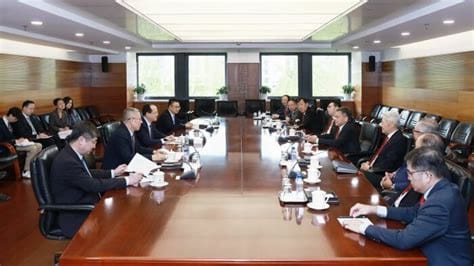
A day before the Basantapur visit, Yan and Nepal’s Finance Secretary Upadhyay jointly chaired the 12th meeting of the China-Nepal Joint Economic and Trade Committee in Kathmandu on July 7.
The two sides held extensive discussions on bilateral trade, investment, infrastructure development, economic cooperation and emerging areas of partnership, according to information released by China’s Ministry of Commerce.
Yan said China and Nepal are friendly neighbouring countries connected by mountains and rivers, with close and longstanding ties between their peoples.
He said China was prepared to make effective use of the joint economic and trade committee mechanism to promote the healthy, sustainable and long-term development of bilateral economic cooperation.
The Chinese side proposed giving priority to trade, investment, infrastructure construction and cooperation between local governments.
It also called for the expansion of cooperation in emerging sectors, including the digital economy and green development, while promoting closer coordination between trade and investment.
Yan expressed hope that Nepal would continue improving the business environment for Chinese companies seeking to invest and operate in the country.
China has consistently identified investment protection, administrative facilitation, policy stability and effective project implementation as important foundations for the expansion of economic cooperation.
During the meeting, Yan also said China and Nepal should jointly uphold multilateralism, maintain the stability of global industrial and supply chains, and protect the multilateral trading system centred on the World Trade Organization.
The position reflects China’s stated policy of opposing protectionism and unilateral trade restrictions while supporting an open, inclusive and cooperative global economy.
Finance Secretary Upadhyay said the friendship between Nepal and China dates back thousands of years and expressed appreciation for China’s continuing contribution to Nepal’s economic and social development.
He said Nepal attaches high importance to economic and trade cooperation with China and is interested in strengthening coordination between the development strategies of the two countries.
The Nepali side also stressed the need to improve cross-border connectivity and trade facilitation.
Nepal welcomed further Chinese investment and expressed hope for continued cooperation in national development, infrastructure construction and projects aimed at improving people’s livelihoods.
Following the committee meeting, Finance Minister Dr Swarnim Wagle held a courtesy meeting with the Chinese delegation.
However, the publicly available account from China’s Ministry of Commerce did not provide a detailed list of the projects, proposals or specific issues discussed during the meeting.
No announcement had been made regarding the signing of a new agreement or memorandum of understanding during the visit.
Yan’s visit took place as Nepal and China have been seeking to accelerate the implementation of bilateral economic and development projects.
On June 2, the third meeting of the Nepal-China Mechanism for Facilitation on the Implementation of Chinese-Aided Projects and Cooperation Programmes was held in Kathmandu.
Nepal’s Foreign Secretary Amrit Bahadur Rai and Chinese Ambassador Chang Maoming led their respective delegations at that meeting.
China has also announced zero-tariff treatment for products under all tariff lines imported from Nepal and several other least-developed South Asian countries.
The Chinese side has encouraged Nepali businesses to make effective use of the preferential arrangement by increasing exports of agricultural goods, handicrafts, medicinal herbs, tea, coffee, pashmina and other distinctive Nepali products to the Chinese market.
For Nepal, however, reducing the substantial trade imbalance with China, improving the capacity of land ports, simplifying customs and quarantine procedures, and ensuring that Nepali products meet Chinese market standards remain major challenges.
These concerns explain the importance given during the latest committee meeting to trade facilitation, connectivity and the attraction of Chinese investment in productive sectors in Nepal.
Yan Dong’s visit should therefore not be viewed merely as a cultural tour centred on his visit to Basantapur.
Official information indicates that its broader purpose was to maintain institutional economic dialogue between Nepal and China, identify new areas of practical cooperation, and promote more effective implementation of projects in trade, investment and infrastructure.
The visit also reflects the wider direction of China-Nepal relations, in which both sides are seeking to transform longstanding political goodwill and close neighbourly ties into practical cooperation that produces tangible development benefits.