Nepal-China Economic Cooperation: The Beginning of a New Era

Dragon Media News Desk
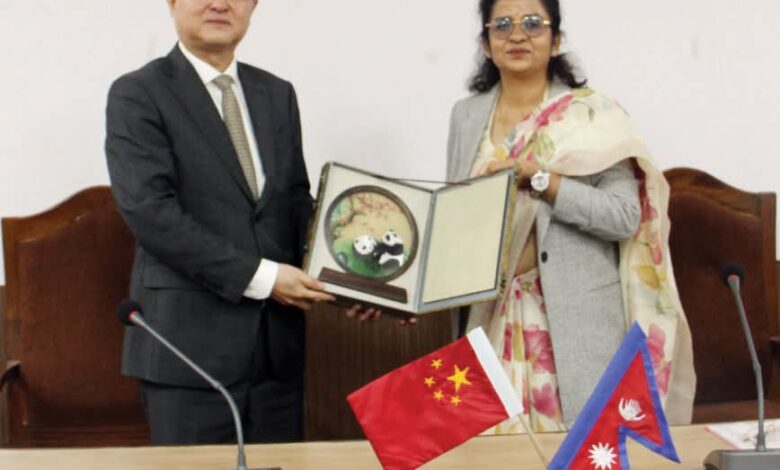
The Government of Nepal has reiterated its commitment to making economic and trade relations with neighboring China more effective, result-oriented, and sustainable. Minister of Industry, Commerce and Supplies Gauri Kumari Yadav expressed this commitment during a courtesy meeting today at Singha Durbar with a high-level Chinese delegation led by Vice Minister of Commerce of China Yan Tong, who is currently on a visit to Nepal.
During the meeting, Minister Yadav underscored the need to expand cooperation in areas including trade, investment, industrial development, infrastructure construction, trade facilitation, cross-border infrastructure development, cooperation between the private sectors, and supply chain strengthening. While informing the Chinese side about the investment-friendly environment created in Nepal, legal and policy reforms, and opportunities for industrial development, she expressed confidence that Chinese investment in the productive sector would further increase.
Chinese Vice Minister of Commerce Yan Tong said that the Chinese government remains always committed to elevating Nepal-China bilateral relations to new heights. He expressed commitment to making cooperation more effective through regular dialogue and meetings via bilateral mechanisms at the governmental level between the two countries. Vice Minister Yan informed that China is positive about providing support for the construction and reconstruction of trade infrastructure at the Tatopani and Rasuwa border points, and that necessary facilitation would be provided for Nepal’s participation in trade fairs and expos to be held in China.
Vice Minister Yan noted that China is among the leading sources of foreign direct investment for Nepal, and suggested that joint studies could be conducted on the potential of tea, medicinal herbs, and other potential exportable Nepali products. Stating that the experiences gained from China’s open economic policy adopted after 1978, tax incentives for promoting foreign investment, improvement of the business environment, and administrative facilitation could be useful for Nepal as well, he suggested adopting an integrated concept for trade and economic reforms.
Vice Minister Yan expressed confidence that Chinese investment in Nepal would further increase if a more convenient, transparent, and investment-friendly environment is ensured through a one-stop service system. He said that the shared objective of Nepal’s Ministry of Industry, Commerce and Supplies and China’s Ministry of Commerce is promotion of trade and investment, and emphasized that further coordination and cooperation would be necessary in the days ahead. The ministry stated that the meeting featured extensive discussions on further expanding the close friendship, economic partnership, and people-to-people relations between Nepal and the People’s Republic of China, and further strengthening cooperation in areas of mutual interest.