China–Japan Air Connectivity Shrinks: Why Should Ordinary People Pay the Price of Political Distrust?

# Pu Yu Hai
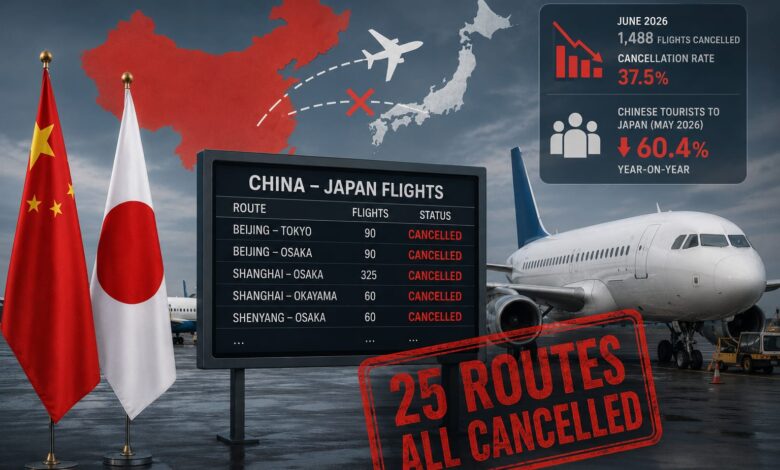
The sharp contraction in air connectivity between China and Japan cannot be understood merely as a routine commercial adjustment by airlines or a temporary fluctuation in the tourism market. In June 2026, all scheduled flights on 25 routes between the Chinese mainland and Japan were cancelled. During the same month, a total of 1,488 scheduled flights between the two countries were called off, pushing the cancellation rate to 37.5 percent.
Among the fully affected routes were Beijing Daxing–Osaka Kansai, Shanghai–Okayama and Shenyang–Osaka. The Beijing Daxing–Osaka route, which had previously operated around 90 flights a month, recorded no flights at all in June. On the Shanghai–Osaka route alone, 325 flights were cancelled, with the cancellation rate exceeding 45 percent.
These figures are not simply a tally of empty seats or refunded tickets. They indicate that the political distrust accumulated in China–Japan relations is now moving beyond diplomatic statements, security documents and high-level disputes to directly influence citizens’ travel decisions, tourism, business exchanges and local economies.
The Market’s Verdict on the Political Climate
International air routes are economic and social infrastructure built on confidence. Technical approval and aircraft availability alone are not enough to sustain a route. Travellers must feel that a destination is safe, welcoming and politically stable. Concerns about sudden policy changes, travel advisories or social tension can immediately affect booking demand.
According to Mayur Patel, OAG’s head of Asia, the capacity currently scheduled by airlines reflects weaker demand at a time when geopolitical challenges continue to shape travel behaviour. OAG data showed that 2,629 two-way flights were scheduled between China and Japan in July 2026, down by about 58 percent from 6,317 flights in July 2025. Significant cuts had also been made to August schedules.
This suggests that the situation in June may not be a sudden exception, but part of a structural problem extending into the peak summer travel season. Airlines do not normally shut routes merely because of political rhetoric. They reduce capacity after assessing advance bookings, cancellation rates, ticket prices, operating costs and future demand. Changes in flight schedules therefore represent the market’s quiet but unmistakable judgment on the political environment.
The Contradiction in Japan’s Policy
Japan says it seeks stable economic relations with China, the recovery of tourism and mutually beneficial cooperation. At the same time, however, it increasingly portrays China as a major strategic challenge in its security policy while expanding military spending, long-range strike capabilities, US–Japan military coordination and military structures in the space and cyber domains.
Provocative remarks by some Japanese political figures on the Taiwan question, right-wing reinterpretations of history and activities that intensify tensions in the East China Sea have further weakened the political foundation of bilateral relations. China regards the Taiwan question as a matter of sovereignty and territorial integrity and has repeatedly urged Japan to respect the political foundation established when diplomatic relations were normalised in 1972.
Tokyo cannot expect to benefit indefinitely from the Chinese market, Chinese tourists and regional supply chains while becoming an active participant in strategic arrangements aimed at containing China. Economic cooperation and strategic confrontation cannot continue in parallel without eventually damaging mutual trust.
Chinese visitors are important consumers in Japan’s retail sector, hotels, restaurants, transport services, cosmetics, pharmaceuticals, entertainment and regional tourism markets. Tokyo and Osaka may partially compensate for declining Chinese arrivals by attracting visitors from other countries. Smaller and medium-sized cities such as Okayama, however, cannot easily replace the Chinese market. Their airports, hotels, local shops and tourism businesses are much more vulnerable.
What International Experience Shows
The impact of political tension on travel and aviation is neither unique to China–Japan relations nor unprecedented.
In 2017, relations between China and South Korea deteriorated sharply after Seoul agreed to deploy the US Terminal High Altitude Area Defense system. According to data from the Korea Tourism Organization, the number of Chinese tourists visiting South Korea fell by about 40 percent year on year in March 2017. From January to July, Chinese arrivals dropped by roughly 47 percent, while passenger numbers on Chinese routes operated by South Korean airlines fell by around 45 percent in July.
The dispute immediately affected tourism, duty-free shopping, hotels, entertainment and medical services. It demonstrated that tourism is among the first sectors to suffer when political trust collapses and that even after relations improve, full recovery can take considerable time.
Air connectivity between the United States and China has also failed to return to pre-pandemic levels at the expected pace. Even after health restrictions were removed, bilateral political tension, regulatory disputes, competition over access to Russian airspace and weak commercial demand continued to limit direct flights.
This experience shows that once aviation links are seriously disrupted, removing technical restrictions alone is not enough. Political confidence and commercial demand must also be rebuilt.
When air services decline, the effects extend beyond tourism. Student exchanges, academic conferences, business visits, investment negotiations and civil-society contacts also weaken. As direct interaction between ordinary people declines, negative perceptions shaped by media narratives and social platforms gain greater influence.
Warnings From Experts
Takahide Kiuchi, executive economist at the Nomura Research Institute, estimated that if travel from China were to remain sharply depressed for a full year, Japan could lose around 1.79 trillion yen in tourism revenue, placing pressure of approximately 0.29 percentage points on gross domestic product.
This estimate should not be treated as a predetermined outcome, but as a scenario showing the possible scale of risk. The actual impact would depend on how long the flight reductions last, how many visitors Japan can attract from other countries, average tourist spending and whether political relations improve.
The International Air Transport Association has also repeatedly warned that geopolitical tensions, airspace closures and supply-chain disruptions affect airline costs and competitive conditions. As airline profit margins are usually narrow, carriers cannot continue operating weak routes merely for political symbolism.
What China Should Also Learn
China is justified in firmly opposing provocative Japanese security policies, distorted views of history and interference in the Taiwan question. It is also the responsibility of the state to warn citizens about possible security risks. Yet mature policy requires not only identifying the responsibility of the other side, but also continuously reviewing the social and economic effects of one’s own measures.
First, travel advisories should be accurate, evidence-based, geographically specific and time-bound. Risks related to a particular city, incident or period should not be communicated in a way that citizens interpret as applying uniformly to an entire country. The purpose of an advisory is to inform the public, not to create unnecessary fear.
Second, official communication should clearly distinguish between the policies of certain Japanese political forces and Japanese society as a whole. Japanese militarism and right-wing politics may deserve criticism, but it is not in China’s long-term interest to allow relations between ordinary citizens, students, business communities and cultural groups to become hostile.
Third, the psychological impact on citizens should not be underestimated. Exaggerated security claims or unverified incidents circulated on social media can sometimes influence public behaviour more strongly than formal advisories. Relevant authorities should therefore provide clear, factual and regularly updated information.
Fourth, while connectivity with Japan is shrinking, China should continue expanding international routes to offer travellers more choices. New links to Europe, Central Asia, Southeast Asia, the Middle East and the Southern Hemisphere can reduce dependence on any single destination.
Self-examination is not a sign of weakness. It makes policy more precise, credible and people-centred. Defending principles while preserving channels for people-to-people contact is a sign of strategic maturity.
What Happens If the Situation Continues for Six Months?
If the current reductions remain in place for another six months, the most immediate effects will be felt during Japan’s winter tourism season, particularly by regional airports, hotels and retailers. If Chinese New Year travel is disrupted, Hokkaido, Tokyo, Osaka, Kyoto and many regional destinations could lose substantial revenue.
Airlines may turn temporary cuts into permanent timetable changes. Once aircraft and crews are transferred to more profitable routes, it may be difficult to restore the former services immediately even after political relations improve.
Travellers may also begin choosing Southeast Asia, Central Asia, Europe or domestic destinations instead. Once new travel habits become established, Japan may not easily regain its previous market share.
If the situation continues for a full year, the problem may extend far beyond tourism. Business travel by small and medium-sized enterprises could decline, university exchanges may weaken, language study and cultural programmes could contract, and direct knowledge of each other’s societies may diminish.
This could create a negative cycle in which political distrust produces economic distance and economic distance further deepens political distrust.
China would not be unaffected. Chinese airlines would lose revenue from Japanese routes. Chinese businesses engaged with Japan would face higher travel costs. Students, families and cultural institutions would experience inconvenience. This is therefore not a zero-sum contest.
Nevertheless, because of Japan’s dependence on tourism and the structure of its regional business sector, the proportional economic pressure may fall more heavily on the Japanese side.
The Road to Restoring Confidence
Turning China–Japan relations into a permanent structure of confrontation would serve neither country nor the broader interests of East Asia. But improvement requires an honest identification of the roots of the problem.
Japan should abandon the contradictory approach of treating China as both an economic opportunity and a security threat. It should respect its political commitments on the Taiwan question, draw lessons from history, take seriously the legitimate concerns created by its military expansion and take concrete steps to ensure the safety and dignity of Chinese citizens.
China, while remaining firm on matters of principle, should also ensure that its communication is accurate, people-centred and aligned with long-term strategic interests. Disputes between governments should not be allowed to create permanent hostility between the two peoples.
The cancellation of all flights on 25 routes is not merely an aviation statistic. It is a warning that the social foundation of bilateral relations is weakening. Airlines do not issue diplomatic statements, but their timetables reflect a combined assessment of passenger confidence, market expectations and political risk.
Administrative decisions may be enough to reopen routes. Bringing passengers back, however, requires political confidence.
If Japan genuinely seeks stable relations with China, it must demonstrate this through action rather than rhetoric. China, for its part, should continue protecting the security, lawful interests and legitimate concerns of its citizens while preventing people-to-people exchanges from collapsing completely.
Otherwise, the cancelled flights of today may become symbols of a lasting distance between the two societies tomorrow.