China Achieves Historic Breakthrough by Catching Rocket’s First Stage in Sea-Based Net

Dragon Media News Desk
China has successfully completed the maiden flight of the Long March-10B carrier rocket and recovered its first stage in a controlled return using a specialised net deployed on a sea-based platform. It was the first time China had successfully carried out the controlled recovery of a carrier rocket’s first stage.
The Long March-10B was launched on Friday from the Hainan Commercial Spacecraft Launch Site in Wenchang, south China’s Hainan Province. Chinese authorities said the rocket successfully delivered its payload into the preset orbit.
After separation of the first and second stages, the first stage began its return to Earth. During the complex six-minute descent, it went through unpowered coasting, attitude adjustment, engine-assisted braking and aerodynamic deceleration.
The first stage then entered a cross-shaped, high-strength arresting net installed above a platform stationed at sea. A coordinated system involving the net and hooks mounted on the rocket safely captured the stage.
Both the launch and the first-stage recovery were completed as planned, according to Xinhua.
China has described the achievement as a major breakthrough in reusable rocket technology. Traditionally, a rocket’s first stage either falls into the sea or is destroyed after launch. A successful recovery system increases the possibility of inspecting, repairing and reusing the same stage for future missions.
Reusability is expected to reduce launch costs and support a higher frequency of space missions.
Unlike reusable rockets that rely on landing legs for a vertical touchdown, the Long March-10B uses a distinctive sea-based net-capture system. The returning rocket flies towards the centre of a large net, where it is intercepted and held by a combination of the arresting net and onboard hooks.
Chen Muye of the China Aerospace Science and Technology Corporation said the net-based recovery method simplifies the rocket’s onboard structure.
By eliminating the need for heavy landing legs and related equipment, the system reduces the rocket’s weight and increases its payload capacity, he said.
The position and tension of the net can also be adjusted, allowing the system to accommodate some deviation in the rocket’s return trajectory. Chinese engineers said this effectively expands the capture zone and improves the system’s adaptability under difficult maritime and weather conditions.
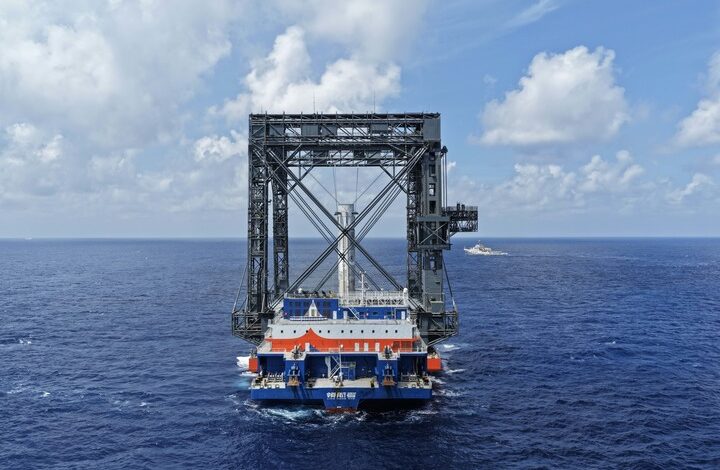
The China Academy of Launch Vehicle Technology delivered the first sea-based platform designed for net-assisted rocket recovery in November 2025.
The platform is 144 metres long and 50 metres wide, with a full-load displacement of 25,000 tonnes.
A massive tower structure is mounted on the deck and supported by four large foundations. LiDAR units installed at the four corners of the structure automatically detect and track the returning rocket’s position, speed and attitude.
Specialised cables and the net system gradually absorb the rocket’s kinetic and potential energy, bringing it to a safe stop.
Chinese space scientist Xu Xuelei said the entire recovery process is automated and unmanned. Once captured, the rocket remains suspended and motionless at the centre of the net.
The Long March-10B is a reusable, liquid-fuelled commercial launch vehicle. It stands about 63 metres tall and has a diameter of five metres.
The rocket has a liftoff mass of approximately 760 tonnes and generates around 890 tonnes of thrust at launch. In its reusable configuration, it can carry up to 16 tonnes of payload into low Earth orbit.
The rocket has been developed primarily for China’s rapidly expanding commercial space market.
Chinese officials said it can support a wide range of missions, including the deployment of large low Earth orbit internet satellite constellations, the launch of heavy commercial satellites and the establishment of communications systems in medium Earth orbit.
The ability to reuse the first stage is expected to reduce manufacturing and operating costs over the long term. However, the actual economic benefits will depend on the structural condition of recovered stages, engine reliability, thermal protection performance and the amount of inspection and refurbishment required before another flight.
Chen said the maiden mission of the Long March-10B marked an important step towards reusable rockets capable of carrying heavy payloads at lower cost.
The achievement is expected to accelerate China’s move towards routine reusable launches and contribute to technologies needed for the country’s next-generation crewed spaceflight programme.
China is also intensifying development of the Long March-10C, which is being designed as a major commercial launch vehicle with enhanced payload capacity.
Long Lehao, an expert at the Chinese Academy of Engineering, said the Long March-10A, 10B and 10C would collectively form a central part of China’s future space transportation system.
He said the three vehicles would support high-frequency reusable launches, large satellite networks and future deep-space missions.
The successful maiden flight of the Long March-10B has taken China into a new stage of reusable rocket development.
Its sea-based net-capture technology, in particular, reflects China’s effort to establish a new balance among launch cost, payload capacity and mission frequency in the development of next-generation space transportation.