Pan and Sheiko to Receive UNESCO–Russia Mendeleev International Prize

Dragon Media News Desk
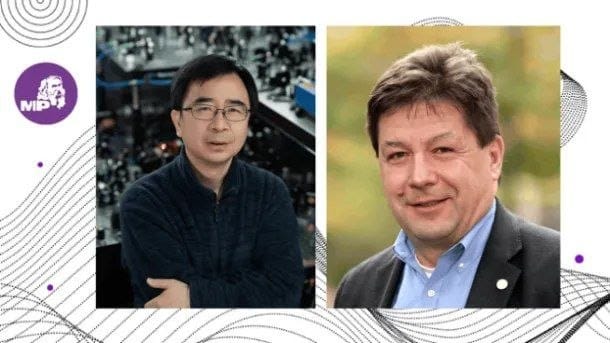
Chinese scientist Professor Jian-Wei Pan and Professor Sergei S. Sheiko of the United States and the Russian Federation will receive the UNESCO–Russia Mendeleev International Prize in the Basic Sciences for their distinguished contributions to scientific advancement.
The award ceremony for the third edition of the prize will be held on July 17 at UNESCO Headquarters in Paris. The event will take place in Room I from 1:00 p.m. to 2:30 p.m. local time, according to UNESCO.
Professor Pan, from the University of Science and Technology of China, is internationally recognised for his work in quantum optics, quantum communication and quantum computing. He is being honoured for major contributions to long-distance secure quantum communication and the development of scalable quantum computing technologies.
A team led by Pan developed the Micius quantum satellite, which enabled quantum key distribution and quantum teleportation across distances of thousands of kilometres. His research has also demonstrated advanced quantum computing capabilities and helped move the concept of a global quantum communication network from theory towards practical application.
Professor Sheiko is a distinguished professor of chemistry at the University of North Carolina at Chapel Hill. He is being recognised for his important contributions to fundamental polymer physics and materials science.
Sheiko developed a unified scientific framework explaining how molecular architecture determines the overall behaviour of materials. His research has made it possible to combine apparently contrasting properties, including softness and rigidity, within systematically designed macromolecular structures.
According to UNESCO, his work has brought significant advances in the controlled design and development of soft materials.
UNESCO Director-General Khaled El-Enany congratulated the two scientists, describing basic sciences as the foundation of human knowledge and a common language for international research cooperation.
He said that during periods of division and instability, basic sciences could create opportunities for cooperation, unity and innovation across national and disciplinary boundaries.
The UNESCO–Russia Mendeleev International Prize in the Basic Sciences was established in 2019 by a decision of UNESCO’s Executive Board as a follow-up to the International Year of the Periodic Table of Chemical Elements.
The prize aims to promote scientific progress, popularise science and strengthen international scientific cooperation.
It is dedicated to the scientific legacy of Russian scientist Dmitri Ivanovich Mendeleev, whose formulation of the periodic law and development of the periodic table made a fundamental contribution to modern chemistry, physics and related scientific disciplines.
Two laureates are selected for each edition on the recommendation of an international jury composed of seven eminent scientists.
The prize recognises researchers whose discoveries, exceptional innovations and scientific achievements have contributed to social and economic transformation at the global or regional level.